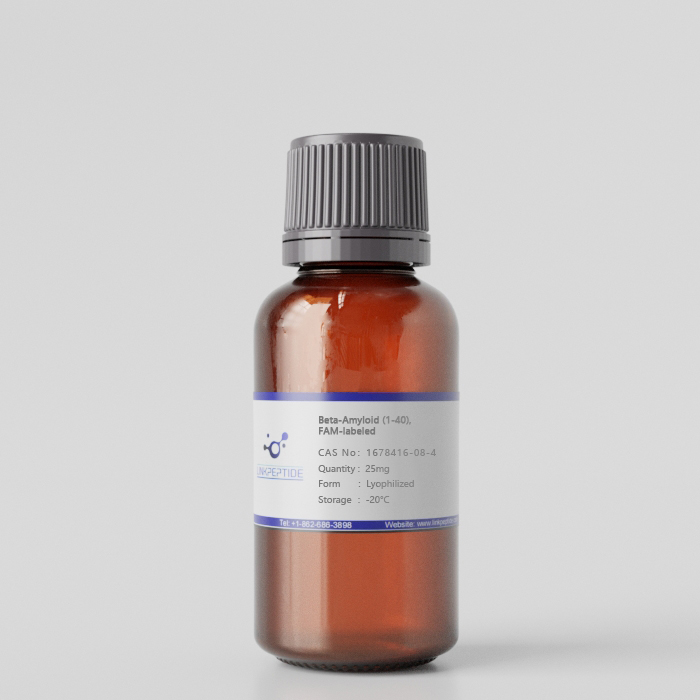
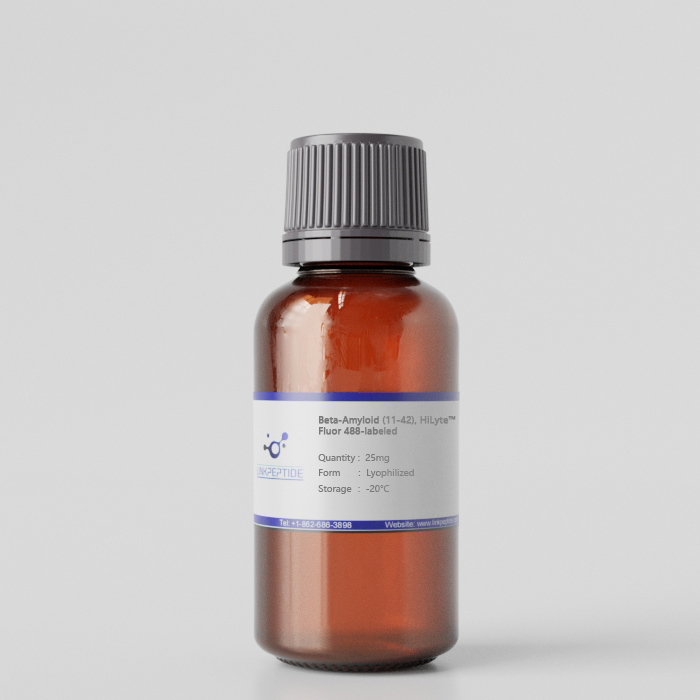
Product Name: Beta-Amyloid (1-40), FAM-labeled
Sequence One Letter Code: FAM-DAEFRHDSGYEVHHQKLVFFAEDVGSNKGAIIGLMVGGVV
Sequence Three Letter Code: FAM-Asp-Ala-Glu-Phe-Arg-His-Asp-Ser-Gly-Tyr-Glu-Val-His-His-Gln-Lys-Leu-Val-Phe-Phe-Ala-Glu-Asp-Val-Gly-Ser-Asn-Lys-Gly-Ala-Ile-Ile-Gly-Leu-Met-Val-Gly-Gly-Val-Val-OH
Cas No: 1678416-08-4
Chemical Formula:C215H305N53O64S
Molecular Weight: 4688.5
Purity: 95%
Form: Lyophilized
Storage Conditions: - 20 °C Protected from light
Research Area: Neurological Disease
Source / Species: human
Conjugation: Conjugated
Conjugation Type: Fluorescent dyes
Code Nacres: NA.26
Application: FAM-labeled Beta-Amyloid (1–40) is a fluorescently tagged form of a major amyloid-β peptide involved in Alzheimer’s disease pathology. Similar to Aβ (1–42), Aβ (1–40) aggregates and deposits in the brain, particularly in vascular amyloid. The attached FAM fluorophore (Ex/Em ~494/521 nm) enables visualization and quantitative analysis of peptide aggregation, cellular uptake, and localization. FAM offers improved photostability and chemical robustness compared to traditional fluorophores, making this peptide suitable for fluorescence-based assays. It is widely used in studies of amyloid aggregation, trafficking, and neurotoxicity, supporting real-time analysis of peptide behavior in neurodegeneration research.
Current Research: FAM-labeled β-Amyloid (1–40) is a fluorescently tagged variant of the amyloid-β (Aβ) 1–40 peptide, a major component of amyloid deposits associated with Alzheimer’s disease (AD). By conjugating the peptide with 5-carboxyfluorescein (FAM), this construct enables direct visualization and quantitative analysis of amyloid behavior in biochemical and cellular systems. Combining the biological relevance of Aβ (1–40) with the optical properties of FAM makes this peptide a powerful tool for studying aggregation, trafficking, and neurotoxicity mechanisms. Aβ (1–40) and Its Role in Alzheimer’s Disease Aβ (1–40) is one of the primary cleavage products of amyloid precursor protein (APP) and is widely distributed in the brain. Although less aggregation-prone than Aβ (1–42), it is the dominant isoform in cerebrovascular amyloid deposits, particularly in conditions such as cerebral amyloid angiopathy (CAA). Key characteristics of Aβ (1–40) include: Ability to form soluble oligomers and fibrils Involvement in vascular amyloid accumulation Contribution to neurovascular dysfunction and toxicity Studying this isoform is essential for understanding both neuronal and vascular aspects of Alzheimer’s pathology. Properties of the FAM Fluorophore The FAM (5-carboxyfluorescein) label provides strong fluorescence with excitation and emission maxima of approximately 494 nm and 521 nm, respectively. This fluorophore is widely used due to its: High quantum yield and brightness Improved photostability compared to traditional dyes Chemical robustness under experimental conditions These properties allow reliable detection and real-time monitoring of peptide behavior in various assay formats. Monitoring Amyloid Aggregation in Real Time FAM-labeled Aβ (1–40) enables direct observation of aggregation processes, which are central to Alzheimer’s disease progression. Unlike unlabeled peptides that require indirect detection methods, the fluorescent tag allows continuous tracking of peptide assembly. Applications include: Real-time aggregation assays using fluorescence intensity or anisotropy Kinetic studies of oligomer and fibril formation Analysis of aggregation modulators or inhibitors Visualization of aggregation intermediates These studies provide insight into how Aβ transitions from soluble monomers to structured aggregates. Studying Cellular Uptake and Trafficking The fluorescent label also enables investigation of cellular interactions with Aβ peptides. Researchers can track how the peptide is internalized, distributed, and processed within cells. Typical applications include: Cellular uptake assays in neuronal or glial models Subcellular localization studies using fluorescence microscopy Tracking intracellular trafficking pathways Analysis of peptide accumulation and clearance mechanisms These experiments are critical for understanding how Aβ interacts with cellular systems and contributes to toxicity. Applications in Neurotoxicity and Mechanistic Studies Aβ peptides are known to induce synaptic dysfunction, oxidative stress, and neuronal damage. FAM-labeled Aβ (1–40) allows researchers to correlate peptide localization and aggregation with biological effects in real time. It is commonly used to study: Peptide-induced cytotoxicity in neuronal cultures Interactions with cell membranes and receptors Mechanisms of amyloid-induced cellular stress Differences between extracellular and intracellular Aβ effects The ability to visualize peptide distribution enhances interpretation of these functional studies. Advantages in Fluorescence-Based Assays Compared to unlabeled peptides, FAM-labeled Aβ (1–40) offers several experimental advantages: Direct detection without secondary labeling steps Compatibility with fluorescence microscopy, flow cytometry, and plate-based assays Suitability for high-throughput screening applications Quantitative measurement of peptide concentration and dynamics These features make it particularly useful for drug discovery and assay development targeting amyloid pathways. A Versatile Tool for Alzheimer’s Disease Research FAM-labeled β-Amyloid (1–40) combines the pathological relevance of a key amyloid peptide with the analytical power of fluorescence detection. It supports a wide range of applications, from aggregation kinetics and protein interaction studies to cellular trafficking and neurotoxicity analysis. By enabling real-time visualization and quantitative measurement of amyloid behavior, this peptide continues to play an important role in advancing research on amyloid biology, vascular pathology, and therapeutic strategies for Alzheimer’s disease.
Get a Quote
 LinkPeptide