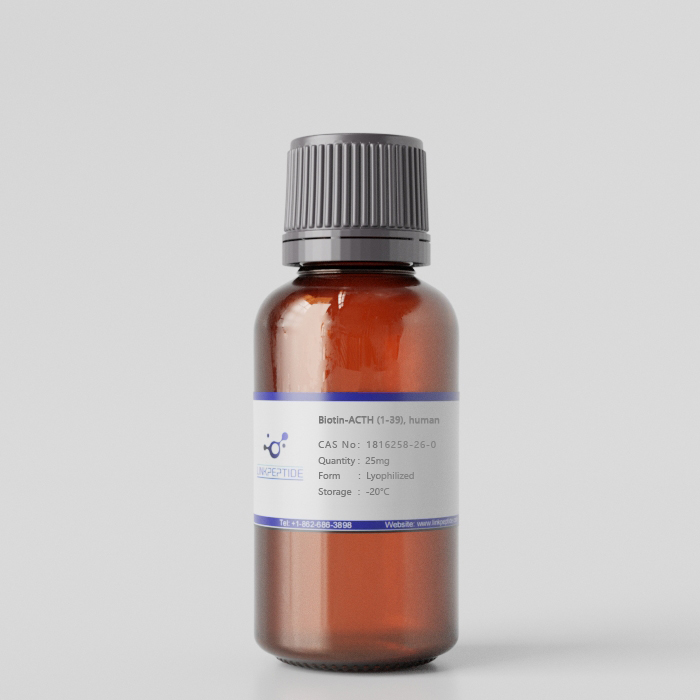
Product Name: Biotin-ACTH (1-39), human
Sequence One Letter Code: Biotin-SYSMEHFRWGKPVGKKRRPVKVYPNGAEDESAEAFPLEF
Sequence Three Letter Code: Biotin-Ser-Tyr-Ser-Met-Glu-His-Phe-Arg-Trp-Gly-Lys-Pro-Val-Gly-Lys-Lys-Arg-Arg-Pro-Val-Lys-Val-Tyr-Pro-Asn-Gly-Ala-Glu-Asp-Glu-Ser-Ala-Glu-Ala-Phe-Pro-Leu-Glu-Phe-OH
Cas No: 1816258-26-0
Chemical Formula:C217H322N58O60S2
Molecular Weight: 4767.6
Purity: 95%
Form: Lyophilized
Storage Conditions: - 20 °C
Research Area: Endocrinology Disease Research
Source / Species: human
Conjugation: Conjugated
Conjugation Type: Biotins
Code Nacres: NA.26
Application: Biotin–ACTH (1–39), human, is a C-terminally biotinylated form of full-length adrenocorticotropic hormone derived from the proopiomelanocortin precursor. ACTH stimulates glucocorticoid synthesis in adrenal cortical cells through activation of its cognate receptor, playing a central role in hypothalamic–pituitary–adrenal axis regulation. Biotin labeling enables sensitive detection and affinity-based applications, including ELISA and receptor-binding assays. This peptide supports research in stress physiology, adrenal endocrinology, and hormone-mediated signaling pathways.
Current Research: Biotin–ACTH (1–39), human is a C-terminally biotinylated form of the full-length adrenocorticotropic hormone (ACTH), a 39–amino acid peptide generated from the proopiomelanocortin (POMC) precursor. ACTH is a central effector hormone of the hypothalamic–pituitary–adrenal (HPA) axis, where it stimulates glucocorticoid production in adrenal cortical cells. C-terminal biotin conjugation enables high-affinity interaction with streptavidin-based systems while preserving the N-terminal region required for receptor activation. This modification supports sensitive detection, immobilization, and receptor-binding analyses in biochemical and cell-based assays. Biological Function ACTH exerts its effects through the melanocortin 2 receptor (MC2R), a Gs-coupled GPCR selectively expressed in the adrenal cortex. Upon receptor engagement, ACTH triggers: Activation of adenylyl cyclase Increased intracellular cAMP levels Protein kinase A (PKA) activation Upregulation of steroidogenic enzymes This signaling cascade stimulates synthesis and secretion of glucocorticoids (e.g., cortisol in humans), which regulate metabolism, immune responses, and systemic adaptation to stress. Functional Advantages of Biotin Labeling Biotinylation provides several analytical and experimental benefits: High-affinity capture via streptavidin-coated plates or beads Enhanced sensitivity in ELISA and immunoassay platforms Stable immobilization for receptor-binding assays Compatibility with fluorescent or enzyme-linked streptavidin detection systems Because the biotin–streptavidin interaction is exceptionally strong, the labeled peptide is suitable for robust affinity-based workflows. Research Applications 1. Receptor Binding Studies Biotin–ACTH (1–39) can be used to evaluate MC2R binding characteristics in competitive displacement assays or surface-based binding systems. 2. ELISA and Detection Assays The peptide supports quantitative hormone detection or calibration workflows when incorporated into streptavidin-based assay formats. 3. Signal Transduction Analysis In adrenal cell models, Biotin–ACTH enables correlation of ligand binding with downstream signaling readouts such as cAMP production, steroidogenesis, and gene expression. 4. Stress Physiology and Endocrinology Research The peptide is applicable in studies examining HPA axis regulation, adrenal responsiveness, and hormonal control mechanisms in physiological and pathological conditions. Experimental Considerations Because ACTH receptor activation depends on its N-terminal sequence, C-terminal biotinylation helps minimize interference with receptor interaction; however, validation against native ACTH is recommended when quantitative pharmacological parameters are required. Proper storage and handling are important to preserve peptide integrity and biological activity.
Get a Quote
 LinkPeptide