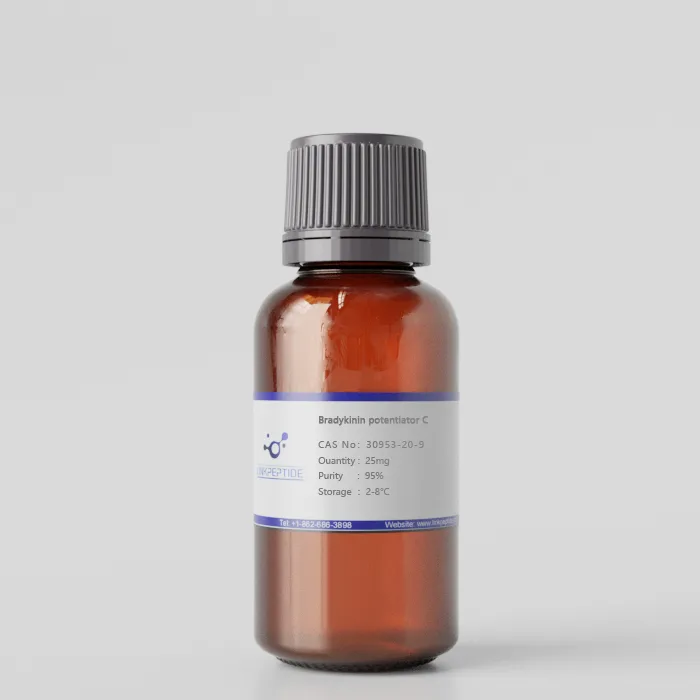
Product Name:Bradykinin potentiator C
Form:TFA salt
Purity:95%
Storage:2-8 degree Celsius
Cas No:30953-20-9
Molar Mass:1052.2
Chemical Formula:C51H77N11O13
IUPAC Name:1-[1-[3-methyl-2-[[1-[1-[2-[[1-[1-[4-methyl-2-[[2-[(5-oxopyrrolidine-2-carbonyl)amino]acetyl]amino]pentanoyl]pyrrolidine-2-carbonyl]pyrrolidine-2-carbonyl]amino]acetyl]pyrrolidine-2-carbonyl]pyrrolidine-2-carbonyl]amino]pentanoyl]pyrrolidine-2-carbonyl]pyrrolidine-2-carboxylic acid
SMILES:CCC(C)C(C(=O)N1CCCC1C(=O)N2CCCC2C(=O)O)NC(=O)C3CCCN3C(=O)C4CCCN4C(=O)CNC(=O)C5CCCN5C(=O)C6CCCN6C(=O)C(CC(C)C)NC(=O)CNC(=O)C7CCC(=O)N7
InChIKey:QWJCUHXRTRCBDI-UHFFFAOYSA-N
InChI:InChI=1S/C51H77N11O13/c1-5-30(4)42(50(73)61-24-10-16-37(61)49(72)62-25-11-17-38(62)51(74)75)56-45(68)34-13-7-22-59(34)47(70)35-14-8-20-57(35)41(65)28-53-44(67)33-12-6-21-58(33)48(71)36-15-9-23-60(36)46(69)32(26-29(2)3)55-40(64)27-52-43(66)31-18-19-39(63)54-31/h29-38,42H,5-28H2,1-4H3,(H,52,66)(H,53,67)(H,54,63)(H,55,64)(H,56,68)(H,74,75)
Sequence:Glp-Gly-Leu-Pro-Pro-Gly-Pro-Pro-Ile-Pro-Pro
Application:
Bradykinin Potentiator C is a natural peptide that enhances the biological activity of bradykinin, a key regulator of vasodilation, inflammation, and pain modulation. Isolated from Bothrops jararaca (Brazilian pit viper) venom, this peptide functions as an angiotensin-converting enzyme (ACE) inhibitor, preventing the degradation of bradykinin and promoting its vasodilatory effects. Bradykinin Potentiator C is widely studied for its role in cardiovascular regulation, blood pressure modulation, and inflammatory response. It has also served as the foundation for developing clinical ACE inhibitors, including captopril. Researchers continue to explore its potential in hypertension, endothelial function, and pain management.
Current Research:
Bradykinin Potentiator C (BPC) is a bioactive peptide that enhances bradykinin-mediated vasodilation and inflammatory responses by inhibiting angiotensin-converting enzyme (ACE). As a naturally occurring ACE inhibitor, BPC has attracted significant research interest for its roles in cardiovascular health, pain management, and inflammatory diseases. 1. Cardiovascular Research and Hypertension Treatment Bradykinin is a powerful vasodilator, increasing nitric oxide (NO) and prostaglandin production, leading to lower blood pressure and improved endothelial function. Bradykinin Potentiator C prevents bradykinin degradation by blocking ACE, prolonging its vasodilatory effects. Studies on BPC have demonstrated its effectiveness in reducing hypertension, similar to synthetic ACE inhibitors such as captopril. Research has explored its role in: Hypertension management by lowering systemic vascular resistance. Endothelial protection, reducing oxidative stress and inflammation in blood vessels. Prevention of cardiovascular diseases, including stroke and heart failure, by improving vascular function. Ongoing studies are evaluating the long-term effects of BPC and its potential in novel antihypertensive drug development. 2. Role in Inflammation and Pain Modulation Bradykinin is a major mediator of pain and inflammation, acting through B1 and B2 bradykinin receptors. By potentiating bradykinin activity, BPC has been studied for its role in: Neuropathic pain relief, as bradykinin contributes to pain sensitization. Anti-inflammatory effects, particularly in rheumatoid arthritis and inflammatory bowel disease (IBD). Pain modulation in cancer and post-surgical recovery. Research indicates that BPC-based therapies could provide an alternative to opioid analgesics for chronic pain management. 3. Implications in Metabolic and Kidney Diseases Given its ACE-inhibitory properties, BPC has been investigated for its renal protective effects, particularly in diabetic nephropathy and chronic kidney disease (CKD). Studies suggest that bradykinin potentiation may: Improve renal blood flow, reducing glomerular damage. Lower proteinuria and kidney inflammation. Regulate insulin sensitivity, offering potential benefits in type 2 diabetes. Researchers are exploring whether BPC-based therapies could protect kidney function while minimizing the side effects of synthetic ACE inhibitors. 4. Drug Development and Biotechnological Applications Bradykinin Potentiator C was the foundation for captopril, the first clinically approved ACE inhibitor. The success of captopril has sparked continued interest in peptide-derived cardiovascular drugs. Modern research aims to: Develop new bradykinin potentiators with enhanced selectivity. Investigate synthetic analogs with improved stability and bioavailability. Explore BPC-based therapeutics beyond hypertension, such as neuroprotection and immune modulation. Conclusion Bradykinin Potentiator C remains an essential molecule in hypertension, inflammation, and pain management research. Its natural ACE-inhibitory function continues to inspire drug development efforts, particularly in cardiovascular, renal, and metabolic diseases. With ongoing research, BPC and its derivatives may lead to new therapeutic strategies for treating vascular dysfunction, chronic pain, and inflammatory conditions.
Get a Quote
 LinkPeptide