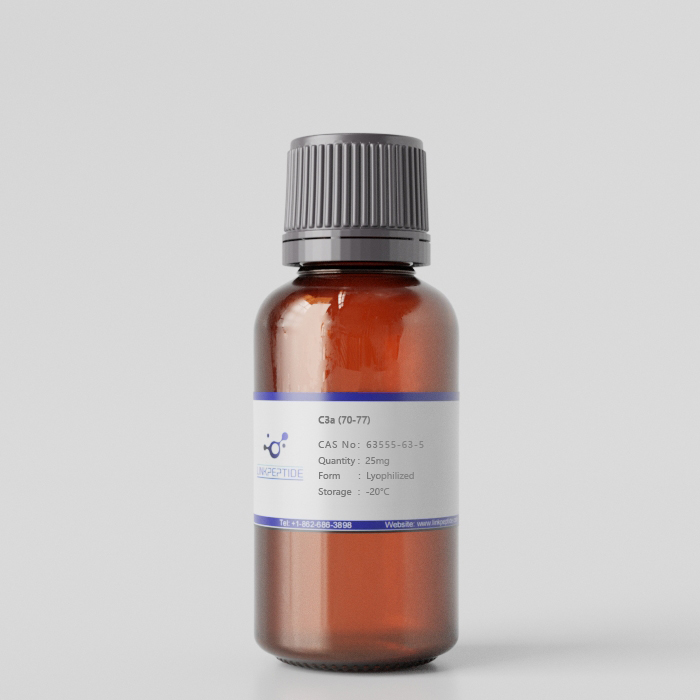
Product Name: C3a (70-77)
Sequence One Letter Code: ASHLGLAR
Sequence Three Letter Code: H-Ala-Ser-His-Leu-Gly-Leu-Ala-Arg-OH
Cas No: 63555-63-5
Chemical Formula:C35H61N13O10
Molecular Weight: 824
Purity: 95%
Form: Lyophilized
Storage Conditions: - 20 °C
Research Area: Inflammation and Immunology Research
SMILES: C[C@@H](C(=O)N[C@@H](CO)C(=O)N[C@@H](CC1C=NC=N1)C(=O)N[C@@H](CC(C)C)C(=O)NCC(=O)N[C@@H](CC(C)C)C(=O)N[C@@H](C)C(=O)N[C@@H](CCCN=C(N)N)C(=O)O)N
IUPAC: (2S)-2-[[(2S)-2-[[(2S)-2-[[2-[[(2S)-2-[[(2S)-2-[[(2S)-2-[[(2S)-2-aminopropanoyl]amino]-3-hydroxypropanoyl]amino]-3-(4H-imidazol-4-yl)propanoyl]amino]-4-methylpentanoyl]amino]acetyl]amino]-4-methylpentanoyl]amino]propanoyl]amino]-5-(diaminomethylideneamino)pentanoic acid
INCHIKEY: PZGDJPJCVBFTSD-FZNMGIFLSA-N
INCHI:
InChI=1S/C35H61N13O10/c1-17(2)10-23(46-32(55)25(12-21-13-39-16-42-21)47-33(56)26(15-49)48-28(51)19(5)36)30(53)41-14-27(50)44-24(11-18(3)4)31(54)43-20(6)29(52)45-22(34(57)58)8-7-9-40-35(37)38/h13,16-26,49H,7-12,14-15,36H2,1-6H3,(H,41,53)(H,43,54)(H,44,50)(H,45,52)(H,46,55)(H,47,56)(H,48,51)(H,57,58)(H4,37,38,40)/t19-,20-,21?,22-,23-,24-,25-,26-/m0/s1
Source / Species: human, macaque
Conjugation: Unconjugated
Code Nacres: NA.26
Application: C3a(70–77) Complement Peptide Fragment is an octapeptide corresponding to the C-terminal region of the complement anaphylatoxin C3a and retains partial biological activity. Although significantly less potent than full-length C3a, the peptide exhibits approximately 1–2% of the native molecule’s activity, including smooth muscle contraction, mast cell activation, and increased vascular permeability. It has also been shown to interact directly with human lymphocytes, making it a useful minimal functional fragment for studying complement-mediated immune responses. This peptide is widely used in complement system research, inflammation studies, and structure–function analyses of anaphylatoxin signaling.
Current Research: The complement system is a crucial component of innate immunity, providing rapid defense against pathogens and contributing to inflammatory signaling. Activation of the complement cascade generates several bioactive fragments, including the anaphylatoxins C3a, C4a, and C5a, which act as potent mediators of inflammation. Among these, C3a plays a key role in immune modulation by influencing vascular responses, immune cell activation, and inflammatory signaling pathways. The C3a(70–77) complement peptide fragment is a short octapeptide derived from the C-terminal region of the C3a molecule, an area known to contain important determinants of biological activity. Although this truncated fragment exhibits significantly lower potency than the full-length protein, it retains measurable biological effects and provides a useful model for studying the functional domains of C3a. The Complement System and C3a Function The complement system consists of a network of plasma proteins that become activated through classical, lectin, or alternative pathways in response to infection or immune complexes. Activation of the complement component C3 leads to its cleavage into two fragments: C3a, a soluble peptide that functions as an inflammatory mediator C3b, which participates in pathogen opsonization and complement amplification C3a belongs to the family of anaphylatoxins, peptides that trigger inflammatory responses by interacting with immune and vascular cells. These molecules contribute to host defense by promoting local inflammation and recruiting immune cells to sites of infection or injury. Structure of the C3a(70–77) Fragment The C3a(70–77) peptide corresponds to the eight amino acids located at the C-terminus of the full-length C3a molecule. Structural studies have shown that the C-terminal region of C3a plays an essential role in receptor interaction and biological activity. Although the fragment lacks much of the structural complexity of the intact protein, it still preserves key residues responsible for receptor engagement and functional signaling. Because of this, the peptide retains a small but measurable fraction of C3a’s biological activity, typically estimated at approximately 1–2% of the activity of the full-length molecule. Biological Activities of the Peptide Despite its reduced potency, the C3a(70–77) fragment can reproduce several biological effects associated with C3a signaling. These include: Smooth muscle contraction, a characteristic response induced by anaphylatoxins Mast cell activation, leading to release of inflammatory mediators Increased vascular permeability, which contributes to inflammatory responses These activities reflect the ability of the peptide to interact with cellular receptors or signaling pathways associated with complement activation. Interaction with Immune Cells In addition to its effects on vascular and inflammatory responses, the C3a(70–77) fragment has been shown to interact directly with human lymphocytes. This interaction highlights the role of complement components in shaping immune cell behavior and coordinating innate and adaptive immune responses. Studies using this minimal fragment help researchers explore how complement peptides influence immune cell signaling and communication during inflammation or immune activation. Applications in Complement System Research Because the C3a(70–77) peptide represents the minimal functional region of the C3a molecule, it is widely used in structure–function studies aimed at identifying the specific amino acid residues responsible for biological activity. Researchers often use this fragment to investigate: Receptor recognition mechanisms of C3a-derived peptides Structural features required for anaphylatoxin activity Minimal sequences capable of triggering inflammatory responses By comparing the activity of this fragment with longer peptides or the full-length protein, scientists can determine which regions of C3a are essential for receptor activation. Role in Inflammation and Immune Signaling Studies The complement system plays a significant role in inflammatory diseases, immune regulation, and host–pathogen interactions. Experimental tools such as the C3a(70–77) fragment help researchers study how complement-derived peptides contribute to these processes. Typical research applications include: Analysis of anaphylatoxin signaling pathways Studies of mast cell and immune cell activation Investigation of vascular responses during inflammation Because the peptide retains partial biological activity while remaining structurally simple, it serves as a convenient model for experimental analysis. Supporting Structure–Function Analysis of Anaphylatoxins Understanding how complement fragments interact with immune cells and vascular tissues is essential for clarifying the mechanisms that regulate inflammatory responses. The C3a(70–77) complement peptide fragment provides a minimal yet functional representation of the C3a molecule’s active region. Through its use in complement biology, inflammation research, and receptor signaling studies, this peptide helps researchers dissect the structural features responsible for anaphylatoxin activity and better understand how complement components contribute to immune system regulation.
Get a Quote
 LinkPeptide