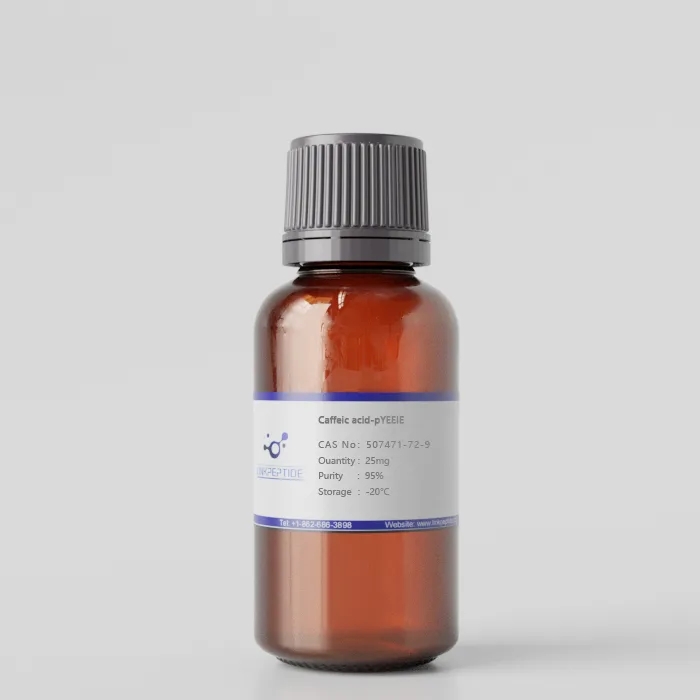
Product Name:Caffeic acid-pYEEIE
Synonyms:(2S)-2-[[(2S,3S)-2-[[(2S)-4-Carboxy-2-[[(2S)-4-carboxy-2-[[(2S)-2-[[(E)-3-(3,4-dihydroxyphenyl)prop-2-enoyl]amino]-3-(4-phosphonooxyphenyl)propanoyl]amino]butanoyl]amino]butanoyl]amino]-3-methylpentanoyl]amino]pentanedioic acid
CAS No:507471-72-9
Purity:95%
Molar Mass:923.8
Chemical Formula:C39H50N5O19P
Storage:Store at -20 degrees Celsius
Sequence:XEEIE
Application:Caffeic acid-pYEEIE is a synthetic peptide conjugate that combines caffeic acid, a naturally occurring polyphenol, with a phosphorylated peptide sequence (pYEEIE). The caffeic acid component is known for its antioxidant, anti-inflammatory, and anticancer properties. When linked to the pYEEIE peptide, this conjugate is often used in research to study its effects on signaling pathways, particularly those involving protein tyrosine phosphorylation. The pYEEIE sequence mimics a phosphorylation site on proteins, making this conjugate valuable for investigating interactions with specific phosphotyrosine-binding domains, such as SH2 domains, and for exploring mechanisms underlying cellular signaling, oxidative stress response, and potential therapeutic applications in diseases like cancer and inflammation.
Current Research:
Caffeic acid-pYEEIE is a synthetic phosphopeptide ligand designed to target the Src homology 2 (SH2) domain of Src family kinases, particularly the Lck-SH2 domain. It exhibits a potent binding affinity, with an IC₅₀ value of 42 nM, demonstrating approximately 30-fold higher affinity compared to the analogous peptide Ac-pYEEIE.
Structural Composition
The peptide sequence of Caffeic acid-pYEEIE is N-[3-(3,4-Dihydroxyphenyl)-1-oxo-2-propenyl]-O-phosphono-L-tyrosyl-L-α-glutamyl-L-α-glutamyl-L-isoleucyl-L-glutamic acid. This structure incorporates a caffeic acid moiety conjugated to a phosphorylated tyrosine residue, enhancing its specificity and binding affinity for SH2 domains.
Mechanism of Action
By binding to the SH2 domain of Src family kinases, Caffeic acid-pYEEIE effectively inhibits protein-protein interactions essential for downstream signaling pathways. This inhibition can modulate various cellular processes, including proliferation, differentiation, and survival, making it a valuable tool for dissecting Src-mediated signaling mechanisms.
Applications in Research
Caffeic acid-pYEEIE serves as a critical reagent in studies aiming to elucidate the role of Src family kinases in cellular signaling. Its high affinity and specificity for SH2 domains make it suitable for:
Investigating the molecular mechanisms of Src-related oncogenic transformation.
Developing therapeutic strategies targeting aberrant Src kinase activity in diseases such as cancer.
Exploring the regulation of immune cell functions mediated by Lck, a Src family kinase predominantly expressed in T cells.
Handling and Storage
For optimal stability, Caffeic acid-pYEEIE should be stored at -20°C, protected from moisture. When preparing solutions, it is recommended to dissolve the peptide in water or appropriate buffers, considering its solubility profile.
Conclusion
Caffeic acid-pYEEIE is a potent and selective ligand for the SH2 domains of Src family kinases, offering researchers a valuable tool to probe the intricacies of Src-mediated signaling pathways and their implications in health and disease.
Reference:
Get a Quote
 LinkPeptide