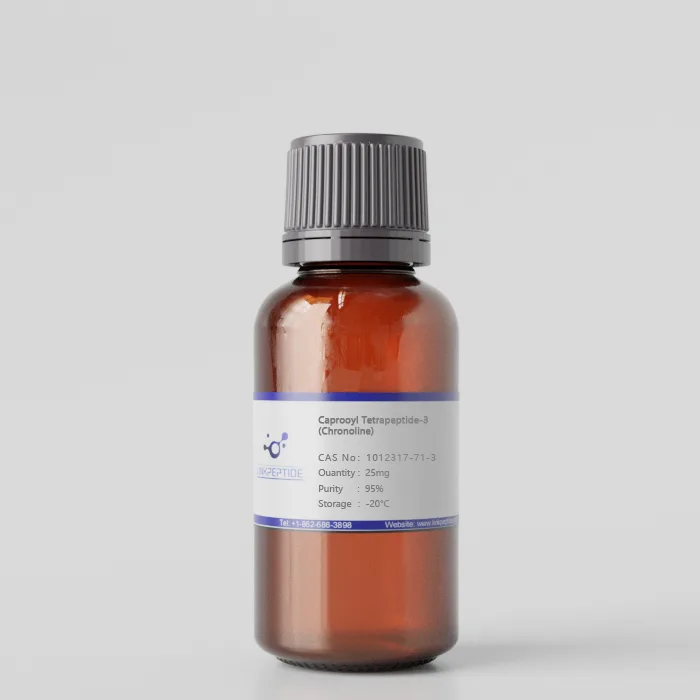
Product Name: Caprooyl Tetrapeptide-3 (Chronoline)
Cas No: 1012317-71-3
Purity: 95%
Storage: Keep in dark and cool dry place -5~8 degree Celsius
Sequence: Caprooyl-Lys-Gly-His-Lys-NH2
Molar Mass: 625.8
Chemical Formula: C28H51N9O7
IUPAC Name: acetic acid;(2S)-6-amino-2-[[(2S)-2-[[2-[[(2S)-6-amino-2-(hexanoylamino)hexanoyl]amino]acetyl]amino]-3-(1H-imidazol-5-yl)propanoyl]amino]hexanamide
SMILES: CCCCCC(=O)N[C@@H](CCCCN)C(=O)NCC(=O)N[C@@H](CC1=CN=CN1)C(=O)N[C@@H](CCCCN)C(=O)N.CC(=O)O
InChIKey: UAAVFMYNDSZDNL-OCIDDWSYSA-N
InChI: InChI=1S/C26H47N9O5.C2H4O2/c1-2-3-4-11-22(36)33-20(10-6-8-13-28)25(39)31-16-23(37)34-21(14-18-15-30-17-32-18)26(40)35-19(24(29)38)9-5-7-12-27;1-2(3)4/h15,17,19-21H,2-14,16,27-28H2,1H3,(H2,29,38)(H,30,32)(H,31,39)(H,33,36)(H,34,37)(H,35,40);1H3,(H,3,4)/t19-,20-,21-;/m0./s1
Application:
Caprooyl Tetrapeptide-3 (Chronoline) is a biomimetic peptide designed to support skin firmness, elasticity, and visible rejuvenation. By coupling a tetrapeptide sequence with a caprooyl group, it enhances penetration and stability, making it effective for research on strengthening the extracellular matrix. Chronoline is widely used in cosmetic studies targeting smoother texture, reduced fine lines, and improved skin bounce. It helps support optimal collagen organization and promotes a more refined, youthful appearance. Its excellent compatibility with serums, creams, and advanced anti-aging treatments makes it a valuable ingredient for formulations focused on restoring firmness and promoting long-term skin resilience.
Current Research:
Caprooyl Tetrapeptide-3 (Chronoline): Research Overview
Caprooyl Tetrapeptide-3 is a synthetic lipo-tetrapeptide composed of a short amino acid sequence conjugated to a caproic acid (hexanoic acid) chain. It is classified as a signal peptide with primary activity on dermal extracellular matrix (ECM) components and the dermal–epidermal junction (DEJ). The lipid tail increases affinity for cell membranes and enhances penetration into the upper dermis, while the tetrapeptide portion acts as a bioactive fragment that can modulate cell signaling in fibroblasts and keratinocytes.
Caprooyl Tetrapeptide-3 is designed as a biomimetic fragment of regions associated with growth factor or matrix-derived signaling, particularly within pathways related to transforming growth factor-β (TGF-β) and ECM assembly. In vitro work indicates that the peptide can stimulate fibroblast activity, leading to increased synthesis and organization of structural proteins involved in dermal architecture.
The caprooyl group confers amphiphilic character, supporting insertion into lipid domains of the stratum corneum and cell membranes, which may facilitate interaction with receptors and downstream signaling components. This design follows the broader strategy used for many palmitoyl and caprooyl peptides: using a short peptide sequence as a signal ligand and a fatty acid as a delivery and anchoring element.
Research on dermal fibroblast cultures exposed to Caprooyl Tetrapeptide-3 shows upregulation of key ECM proteins, with particular emphasis on those that structure the DEJ and upper dermis. Frequently reported targets include:
Fibronectin, a multi-adhesive glycoprotein essential for matrix assembly and cell adhesion.
Laminin-5 (laminin-332), a major component of the basement membrane involved in keratinocyte attachment.
Collagen types IV and VII, which form crucial networks and anchoring fibrils at the DEJ.
By enhancing synthesis of these molecules, Caprooyl Tetrapeptide-3 is proposed to improve the density and organization of the DEJ and papillary dermis. This structural reinforcement is relevant to the mechanical support of the overlying epidermis and to resistance against shear forces that contribute to wrinkle formation and skin laxity.
The DEJ undergoes flattening with age, characterized by reduced rete ridges and a more planar interface between epidermis and dermis. Experimental models using skin explants or reconstructed skin show that treatment with this tetrapeptide can increase expression of basement-membrane markers and support a more complex, undulating DEJ morphology.
Electron microscopy and immunostaining data in these models indicate improved continuity of the lamina densa and more robust anchoring fibrils when the peptide is present. Functionally, this structural reinforcement correlates with better cohesion between epidermis and dermis and contributes to improvements in skin microrelief parameters, such as more regular surface topography and reduced depth of microfolds.
Instrumental cosmetic studies using formulations containing Caprooyl Tetrapeptide-3 typically assess changes in:
Wrinkle depth and volume via profilometry or 3D optical imaging.
Surface roughness indices.
Firmness and elasticity via cutometry or similar biomechanical measurements.
Reports describe statistically significant reductions in average and maximum wrinkle depth on areas such as crow’s feet and nasolabial folds after several weeks of twice-daily application, along with improvements in firmness and resilience. These effects are interpreted as downstream consequences of enhanced ECM synthesis and DEJ integrity rather than direct muscle-related mechanisms.
Beyond structural proteins, some in vitro studies document modulation of additional markers:
Increased expression of integrins involved in dermal–epidermal adhesion.
Upregulation of proteoglycans and glycosaminoglycans contributing to tissue hydration and viscoelastic behavior.
Potential normalization of matrix metalloproteinase (MMP) activity, shifting the balance toward matrix preservation and rebuilding.
These findings reinforce the classification of Caprooyl Tetrapeptide-3 as a matrix-signaling peptide acting primarily on fibroblast–matrix interactions and DEJ remodeling.
Caprooyl Tetrapeptide-3 is a lipopeptide with a relatively small peptide backbone and a caproic acid moiety. Typical characteristics include:
Amphiphilic behavior, allowing dispersion in water-based systems with aid of solubilizers or incorporation into emulsions.
Compatibility with lipid carriers, liposomes, nanoemulsions, or other delivery systems designed to enhance dermal delivery.
Stability under standard cosmetic conditions when formulated at appropriate pH and added at cool-down temperatures.
Its low usage levels and defined structure permit inclusion in serums, creams, and eye-area formulations focused on dermal support and wrinkle-targeted research.
Current work around Caprooyl Tetrapeptide-3 centers on:
Detailed mapping of its effects on DEJ components and anchoring structures.
Longitudinal evaluation of its impact on dermal density and mechanical properties in ex vivo skin.
Combination studies with other peptides (for example, collagen-stimulating matrikines or barrier-support actives) within multi-pathway anti-aging systems.
Overall, Caprooyl Tetrapeptide-3 is characterized in cosmetic science as a dermal–epidermal junction–focused signal peptide that promotes ECM protein synthesis, supports DEJ structure, and contributes to improved biomechanical and surface-aging parameters in experimental models.
Get a Quote
 LinkPeptide