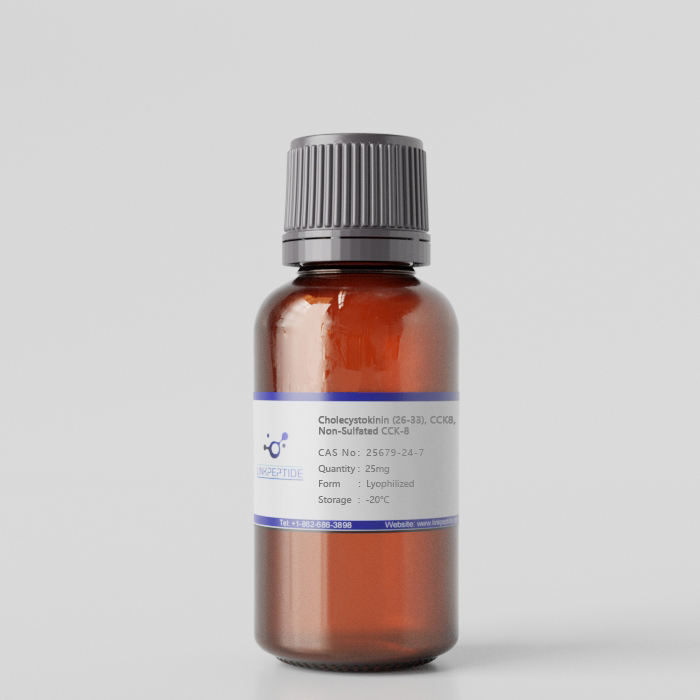
Product Name: Cholecystokinin (26-33), CCK8, Non-Sulfated CCK-8
Sequence One Letter Code: DYMGWMDF-NH2
Sequence Three Letter Code: H-Asp-Tyr-Met-Gly-Trp-Met-Asp-Phe-NH2
Cas No: 25679-24-7
Chemical Formula:C49H62N10O13S2
Molecular Weight: 1063.3
Purity: ≥ 95%
Form: Lyophilized
Storage Conditions: - 20 °C
SMILES: CSCC[C@@H](C(=O)N[C@@H](CC1=CC=C(C=C1)O)C(=O)C(=O)[C@H](CC(=O)O)N)NC(=O)CNC(=O)[C@H](CC2=CNC3=CC=CC=C32)NC(=O)[C@H](CCSC)NC(=O)[C@H](CC(=O)O)NC(=O)[C@H](CC4=CC=CC=C4)NN
IUPAC: (3S,6S)-3-amino-6-[[(2S)-2-[[2-[[(2S)-2-[[(2S)-2-[[(2S)-3-carboxy-2-[[(2S)-2-hydrazinyl-3-phenylpropanoyl]amino]propanoyl]amino]-4-methylsulfanylbutanoyl]amino]-3-(1H-indol-3-yl)propanoyl]amino]acetyl]amino]-4-methylsulfanylbutanoyl]amino]-7-(4-hydroxyphenyl)-4,5-dioxoheptanoic acid
INCHIKEY: ZBTPHEHKAHBSMT-YRVFCXMDSA-N
INCHI:
InChI=1S/C49H62N10O13S2/c1-73-18-16-34(46(69)56-36(20-28-12-14-30(60)15-13-28)44(67)43(66)32(50)23-41(62)63)54-40(61)26-53-45(68)37(22-29-25-52-33-11-7-6-10-31(29)33)57-47(70)35(17-19-74-2)55-48(71)38(24-42(64)65)58-49(72)39(59-51)21-27-8-4-3-5-9-27/h3-15,25,32,34-39,52,59-60H,16-24,26,50-51H2,1-2H3,(H,53,68)(H,54,61)(H,55,71)(H,56,69)(H,57,70)(H,58,72)(H,62,63)(H,64,65)/t32-,34-,35-,36-,37-,38-,39-/m0/s1
Source / Species: Human, mouse, rat, pig
Conjugation: Unconjugated
Code Nacres: NA.26
Application: Non-sulfated CCK-8 is an octapeptide fragment of cholecystokinin, an important gastrointestinal hormone and neuropeptide involved in digestion, satiety, and gut–brain signaling. CCK regulates pancreatic enzyme secretion, gallbladder contraction, and central appetite control. Although sulfation enhances receptor affinity, the non-sulfated CCK-8 form remains valuable for studying receptor subtype selectivity, peptide–receptor interactions, and signaling dynamics. This peptide is commonly used in neuroscience research, metabolism studies, appetite regulation models, gastrointestinal physiology, and investigations of endocrine communication between the digestive system and central nervous system.
Get a Quote
 LinkPeptide