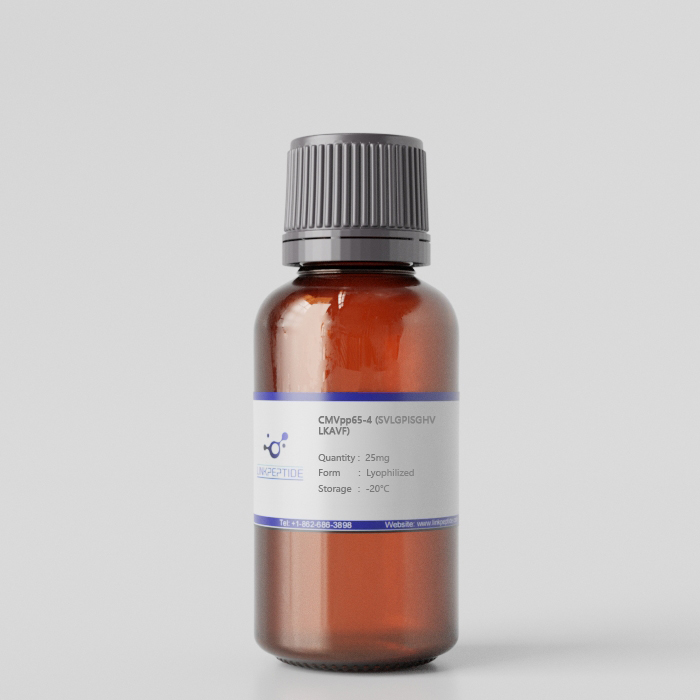
Product Name: CMVpp65-4 (SVLGPISGHVLKAVF)
Sequence One Letter Code: SVLGPISGHVLKAVF
Sequence Three Letter Code: H-Ser-Val-Leu-Gly-Pro-Ile-Ser-Gly-His-Val-Leu-Lys-Ala-Val-Phe-OH
Chemical Formula:C72H118N18O18
Molecular Weight: 1523.9
Purity: 95%
Form: Lyophilized
Storage Conditions: - 20 °C
Research Area: Inflammation and Immunology Research
Source / Species: CMV
Conjugation: Unconjugated
Code Nacres: NA.26
Application: CMVpp65-4 is a synthetic peptide derived from residues 13–27 of the human cytomegalovirus (CMV) pp65 matrix phosphoprotein. This sequence contains an immunodominant epitope presented by H2-Dd MHC class I molecules and is specifically recognized by CMV-reactive CD8⁺ T cells. The peptide is widely used to investigate antigen processing and presentation, cytotoxic T lymphocyte activation, and memory T cell responses in murine models. It supports immune monitoring assays, ELISPOT analyses, and functional characterization of antiviral T cell immunity. CMVpp65-4 serves as a well-defined reagent for studying virus-specific cellular immunity and mechanisms underlying T cell–mediated antiviral defense.
Current Research: Human cytomegalovirus (CMV) is a ubiquitous β-herpesvirus that establishes lifelong latency and elicits robust cellular immune responses. Control of CMV infection relies heavily on CD8⁺ cytotoxic T lymphocytes (CTLs), which recognize viral peptides presented by major histocompatibility complex (MHC) class I molecules on infected cells. CMVpp65-4 is a synthetic peptide derived from residues 13–27 of the CMV pp65 matrix phosphoprotein. This sequence contains an immunodominant epitope presented by H2-D^d MHC class I molecules and is specifically recognized by CMV-reactive CD8⁺ T cells in murine systems. As a defined antigenic reagent, CMVpp65-4 is widely used to investigate virus-specific cellular immunity. The pp65 protein (UL83) is one of the most abundant structural proteins of CMV virions and a major target of T cell responses during infection. Immunodominant epitopes within pp65 elicit strong CD8⁺ T cell activation, contributing to effective viral control. The CMVpp65-4 peptide reproduces a naturally processed and presented epitope, enabling precise stimulation of antigen-specific CTLs without reliance on viral infection. This defined system facilitates mechanistic dissection of T cell activation, effector function, and memory formation. In antigen presentation studies, CMVpp65-4 is used to pulse antigen-presenting cells (APCs), such as dendritic cells or macrophages, to evaluate peptide loading onto H2-D^d molecules. This approach allows controlled examination of MHC class I stabilization, peptide–MHC affinity, and TCR recognition. By bypassing upstream antigen processing steps, investigators can focus specifically on TCR signaling and effector responses. Alternatively, comparison between peptide pulsing and infection-based presentation provides insight into antigen processing efficiency and cross-presentation pathways. The peptide is extensively applied in functional assays measuring CD8⁺ T cell activation. Upon recognition of CMVpp65-4 presented by MHC class I, CMV-specific CTLs proliferate and secrete effector cytokines such as interferon-γ (IFN-γ) and tumor necrosis factor-α (TNF-α). ELISPOT assays using CMVpp65-4 stimulation enable sensitive quantification of cytokine-producing T cells. Intracellular cytokine staining and flow cytometry further allow characterization of polyfunctional T cell responses, cytotoxic granule mobilization, and expression of activation markers. CMVpp65-4 also supports analysis of cytolytic function. In vitro killing assays using peptide-pulsed target cells provide a direct readout of antigen-specific cytotoxicity. These assays are essential for evaluating CTL potency, TCR avidity, and the effects of immunomodulatory interventions. Because the peptide defines a single epitope–MHC complex, it ensures reproducibility and specificity in cytotoxicity measurements. Memory T cell responses are another key area of investigation. CMV infection is known to drive inflationary memory CD8⁺ T cell populations in certain models. Using CMVpp65-4, researchers can longitudinally monitor epitope-specific memory T cell expansion, contraction, and maintenance. Tetramer staining with peptide–MHC complexes incorporating CMVpp65-4 enables precise enumeration and phenotypic analysis of antigen-specific T cells in vivo. In translational research contexts, CMVpp65-4 is employed to evaluate immune competence and vaccine efficacy. Peptide-based stimulation assays assess the magnitude and quality of CMV-specific T cell responses under conditions such as immunosuppression or therapeutic intervention. This is particularly relevant in transplantation and immunodeficiency studies, where CMV reactivation poses clinical risk. Overall, CMVpp65-4 is a well-defined immunodominant peptide derived from the CMV pp65 protein that selectively engages H2-D^d–restricted CD8⁺ T cells. Its application in antigen presentation assays, ELISPOT analysis, cytotoxicity testing, and memory T cell monitoring makes it an essential reagent for studying antiviral cellular immunity. By providing a controlled system for dissecting T cell–mediated defense mechanisms, CMVpp65-4 advances understanding of host–virus interactions and adaptive immune regulation.
Get a Quote
 LinkPeptide