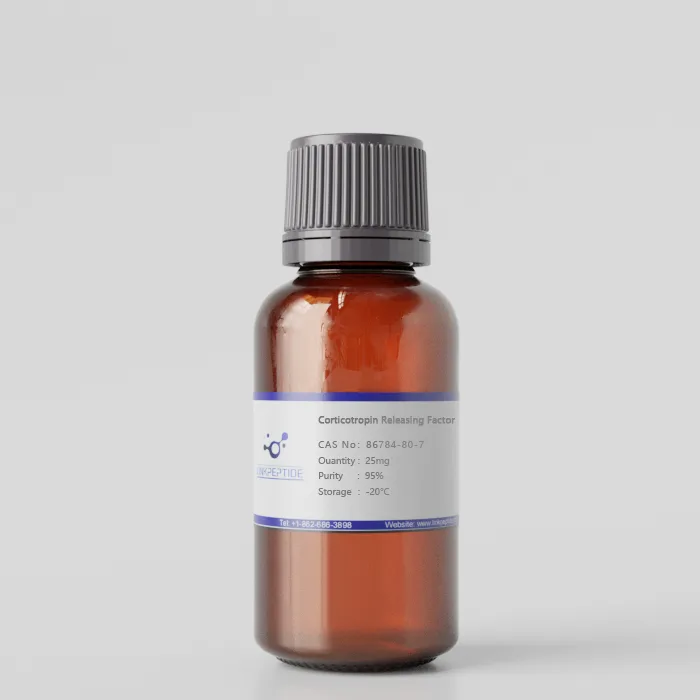
Product Name:Corticotropin Releasing Factor
Form:TFA salt
Purity:95%
Storage:-20oC
Cas No:86784-80-7
Molar Mass:4757.45
Chemical Formula:C208H344N60O63S2
SMILES:[H]N[C@@H](CO)C(=O)N[C@@H](CCC(O)=O)C(=O)N[C@@H](CCC(O)=O)C(=O)N1CCC[C@H]1C(=O)N1CCC[C@H]1C(=O)N[C@@H]([C@@H](C)CC)C(=O)N[C@@H](CO)C(=O)N[C@@H](CC(C)C)C(=O)N[C@@H](CC(O)=O)C(=O)N[C@@H](CC(C)C)C(=O)N[C@@H]([C@@H](C)O)C(=O)N[C@@H](CC1=CC=CC=C1)C(=O)N[C@@H](CC1=CNC=N1)C(=O)N[C@@H](CC(C)C)C(=O)N[C@@H](CC(C)C)C(=O)N[C@@H](CCCNC(N)=N)C(=O)N[C@@H](CCC(O)=O)C(=O)N[C@@H](C(C)C)C(=O)N[C@@H](CC(C)C)C(=O)N[C@@H](CCC(O)=O)C(=O)N[C@@H](CCSC)C(=O)N[C@@H](C)C(=O)N[C@@H](CCCNC(N)=N)C(=O)N[C@@H](C)C(=O)N[C@@H](CCC(O)=O)C(=O)N[C@@H](CCC(N)=O)C(=O)N[C@@H](CC(C)C)C(=O)N[C@@H](C)C(=O)N[C@@H](CCC(N)=O)C(=O)N[C@@H](CCC(N)=O)C(=O)N[C@@H](C)C(=O)N[C@@H](CC1=CNC=N1)C(=O)N[C@@H](CO)C(=O)N[C@@H](CC(N)=O)C(=O)N[C@@H](CCCNC(N)=N)C(=O)N[C@@H](CCCCN)C(=O)N[C@@H](CC(C)C)C(=O)N[C@@H](CCSC)C(=O)N[C@@H](CCC(O)=O)C(=O)N[C@@H]([C@@H](C)CC)C(=O)N[C@@H]([C@@H](C)CC)C(N)=O
InChIKey:VXFVFWFSJFSXHN-FAUHKOHMSA-N
Sequence:SEEPPISLDLTFHLLREVLEMARAEQLAQQAHSNRKLMEII
Application:Corticotropin-Releasing Factor (CRF), also known as corticotropin-releasing hormone (CRH), is a key neuropeptide that regulates the hypothalamic-pituitary-adrenal (HPA) axis, controlling the body??s response to stress. It stimulates adrenocorticotropic hormone (ACTH) release, leading to cortisol secretion from the adrenal glands. CRF plays a crucial role in stress, immune modulation, inflammation, and neuropsychiatric disorders. While primarily used in diagnostic testing for adrenal insufficiency, ongoing research explores its role in depression, anxiety, neurodegeneration, metabolic disorders, and inflammatory diseases, making it a promising therapeutic target for endocrinology, neurology, and psychiatric medicine.
Current Research:Corticotropin-Releasing Factor (CRF) is a critical regulator of the stress response, primarily acting through the hypothalamic-pituitary-adrenal (HPA) axis to mediate ACTH and cortisol release. Beyond its role in endocrinology, research has expanded into psychiatry, neurology, immunology, and metabolic diseases, revealing CRF??s influence on mood, cognition, inflammation, and autonomic regulation. Endocrine and Stress Response Research CRF is essential in regulating the body's response to stress via HPA axis activation. Adrenal insufficiency diagnosis: CRF stimulation tests help assess ACTH and cortisol response, aiding in the diagnosis of Cushing??s syndrome and Addison??s disease. HPA axis dysregulation in chronic stress: Studies show that chronic CRF activation leads to excessive cortisol secretion, contributing to stress-related metabolic and psychiatric disorders. Glucocorticoid resistance in inflammatory diseases: Research explores how CRF modulation may impact conditions like autoimmune diseases and chronic fatigue syndrome. Neuropsychiatric Research: Depression, Anxiety, and PTSD CRF is a key player in mental health disorders, particularly depression, anxiety, and post-traumatic stress disorder (PTSD). Hyperactive CRF system in major depression: Elevated CRF levels have been observed in patients with depression, leading to increased stress sensitivity and HPA axis overactivation. CRF receptor antagonists: Emerging therapies targeting CRF receptors (CRF1 and CRF2) are being studied as potential treatments for anxiety, PTSD, and mood disorders. Neurotransmitter interactions: Research explores how CRF affects dopamine, serotonin, and norepinephrine signaling, impacting mood regulation and cognitive function. Neurodegeneration and Cognitive Research CRF is being investigated for its role in cognitive decline and neuroinflammation. Alzheimer??s disease: Studies suggest that chronic stress and CRF dysregulation may contribute to amyloid-beta accumulation and neurodegeneration. Parkinson??s disease: CRF??s involvement in dopaminergic neuron survival is being explored for its potential in neuroprotection. Inflammation and Immune System Modulation CRF plays a significant role in immune function and inflammatory pathways. Autoimmune diseases: Research indicates that CRF overactivation may worsen conditions like rheumatoid arthritis, inflammatory bowel disease (IBD), and psoriasis. Mast cell activation and allergic responses: Studies suggest that CRF may regulate histamine release and inflammatory cytokine production, influencing allergic reactions and asthma. Metabolic and Cardiovascular Research CRF??s influence extends to metabolic disorders and cardiovascular regulation. Obesity and metabolic syndrome: Chronic CRF activation is linked to insulin resistance, visceral fat accumulation, and dysregulated energy balance. Blood pressure regulation: Research suggests a connection between CRF receptor signaling and autonomic dysfunction, influencing hypertension and cardiovascular diseases. Emerging Research Areas Pain and opioid regulation: CRF involvement in pain perception and opioid sensitivity is being explored in chronic pain syndromes and addiction research. Gut-brain axis interactions: CRF??s role in stress-induced gastrointestinal disorders (e.g., irritable bowel syndrome, functional dyspepsia) is an area of active investigation. With growing research, CRF is emerging as a key therapeutic target in psychiatry, neurodegeneration, autoimmune diseases, and metabolic health, offering new treatment possibilities for stress-related disorders.
Get a Quote
 LinkPeptide