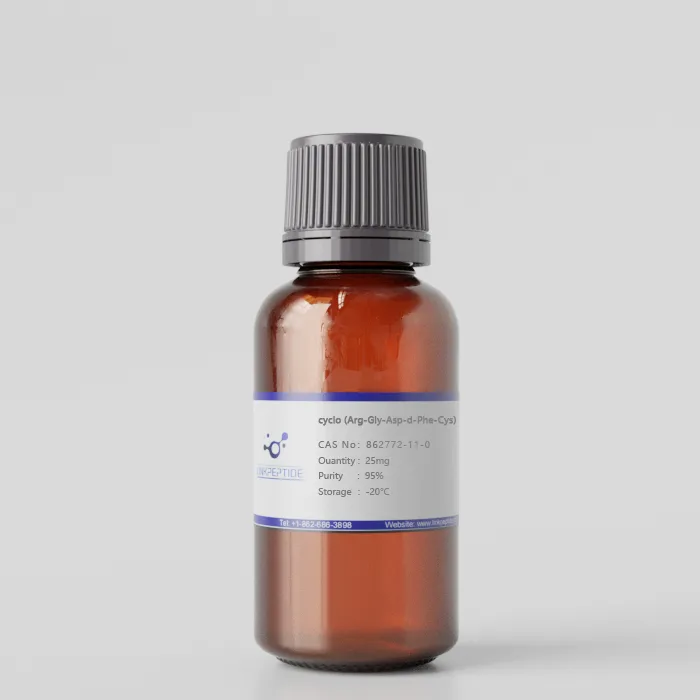
Product Name:cyclo (Arg-Gly-Asp-d-Phe-Cys)
Synonyms:Cyclo(RGDfC
CAS No:862772-11-0
Purity:95%
Molar Mass:578.64
Chemical Formula:C24H34N8O7S
Storage:Store at -20 degrees Celsius
Sequence:cyclo(RGDfC)
Target:αvβ3
Application:
Cyclo (Arg-Gly-Asp-d-Phe-Cys), commonly referred to as a cyclic RGD peptide, is a synthetic peptide known for its high affinity for integrin receptors, particularly αvβ3 integrin. This peptide is often used in research related to cell adhesion, angiogenesis, and cancer metastasis due to its ability to inhibit integrin-mediated cell signaling pathways. The cyclic structure, formed by the disulfide bridge between the arginine and cysteine residues, enhances its stability and binding affinity compared to linear RGD peptides. Cyclo (Arg-Gly-Asp-d-Phe-Cys) is valuable in studies aimed at developing integrin-targeted therapies, such as anti-angiogenic treatments for cancer or diagnostic imaging agents.
Current Research:
Cyclo(Arg-Gly-Asp-D-Phe-Cys), commonly abbreviated as c(RGDfC), is a cyclic pentapeptide known for its high affinity toward integrin αvβ3 receptors. This peptide comprises the amino acids arginine (Arg), glycine (Gly), aspartic acid (Asp), D-phenylalanine (D-Phe), and cysteine (Cys), arranged in a cyclic structure that enhances its stability and receptor-binding specificity.
Structural Characteristics
The cyclic conformation of c(RGDfC) is achieved through a disulfide bond between the cysteine residues, forming a stable ring structure. This configuration not only increases the peptide's resistance to enzymatic degradation but also optimizes its spatial orientation for effective interaction with integrin receptors.
Biological Activity
c(RGDfC) exhibits a high binding affinity for integrin αvβ3, a receptor overexpressed in various tumor cells and associated with angiogenesis and metastasis. By targeting this integrin, c(RGDfC) can disrupt cell adhesion and migration processes, making it a valuable tool in cancer research. Studies have shown that c(RGDfC) can inhibit the expression of pluripotent markers in embryonic stem cells and reduce their tumorigenic potential in vivo.
Applications in Research and Medicine
Due to its specificity for integrin αvβ3, c(RGDfC) has been utilized in various biomedical applications:
Targeted Drug Delivery: c(RGDfC) can be conjugated to therapeutic agents or nanoparticles to facilitate targeted delivery to tumor cells expressing integrin αvβ3, thereby enhancing treatment efficacy and reducing off-target effects.
Imaging: Labeling c(RGDfC) with radioactive isotopes or fluorescent markers enables the visualization of integrin expression in tumors, aiding in diagnosis and monitoring of cancer progression.
Anti-Angiogenic Therapy: By inhibiting integrin αvβ3, c(RGDfC) can interfere with angiogenesis, the formation of new blood vessels, which is crucial for tumor growth and metastasis.
Handling and Storage
c(RGDfC) is typically supplied as a lyophilized powder and should be stored at -20°C to maintain its stability. Reconstitution should be performed using sterile, distilled water or appropriate buffer solutions. It is essential to avoid repeated freeze-thaw cycles to preserve peptide integrity.
Conclusion
Cyclo(Arg-Gly-Asp-D-Phe-Cys) is a potent cyclic peptide with significant applications in cancer research and therapy. Its high affinity for integrin αvβ3 enables targeted interventions in tumor growth and metastasis, making it a valuable tool in the development of novel diagnostic and therapeutic strategies.
Reference:
Get a Quote
 LinkPeptide