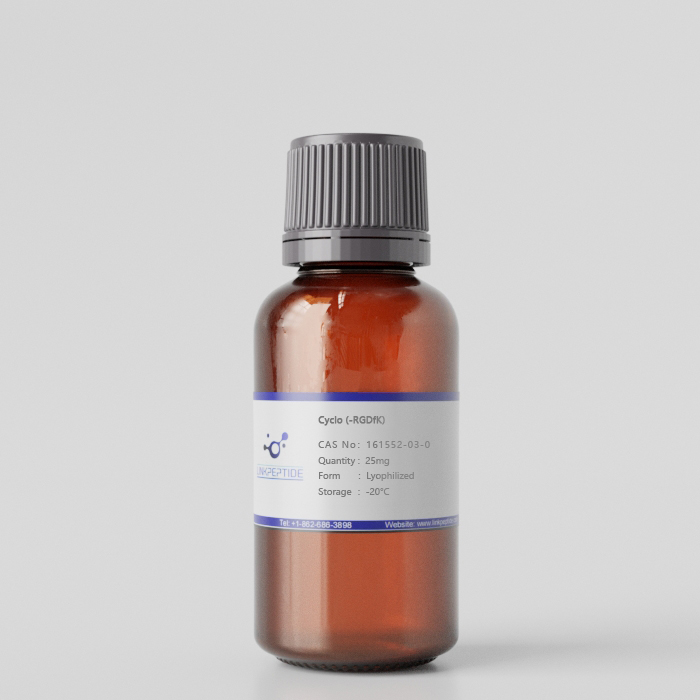
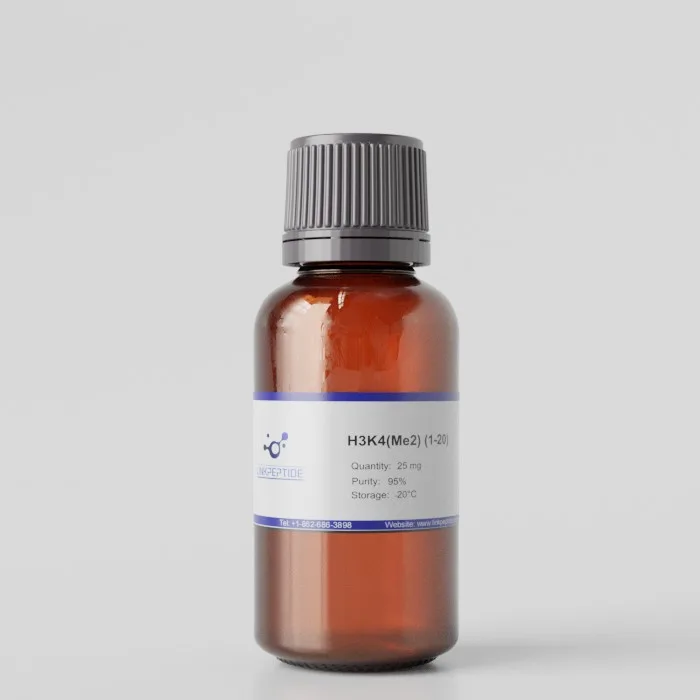
Product Name: Cyclo (-RGDfK)
Sequence One Letter Code: Cyclo(-RGDfK)
Sequence Three Letter Code: Cyclo(-Arg-Gly-Asp-D-Phe-Lys)
Cas No: 161552-03-0
Chemical Formula:C27H41N9O7
Molecular Weight: 603.7
Purity: 95%
Form: Lyophilized
Storage Conditions: - 20 °C
Research Area: Cancer Disease Research
SMILES: C1C(=O)N[C@H](C(=O)N[C@@H](C(=O)N[C@H](C(=O)N[C@H](C(=O)N1)CCCN=C(N)N)CCCCN)CC2=CC=CC=C2)CC(=O)O
IUPAC: 2-[(2S,5R,8S,11S)-8-(4-aminobutyl)-5-benzyl-11-[3-(diaminomethylideneamino)propyl]-3,6,9,12,15-pentaoxo-1,4,7,10,13-pentazacyclopentadec-2-yl]acetic acid
INCHIKEY: NVHPXYIRNJFKTE-HAGHYFMRSA-N
INCHI:
InChI=1S/C27H41N9O7/c28-11-5-4-9-18-24(41)34-17(10-6-12-31-27(29)30)23(40)32-15-21(37)33-20(14-22(38)39)26(43)36-19(25(42)35-18)13-16-7-2-1-3-8-16/h1-3,7-8,17-20H,4-6,9-15,28H2,(H,32,40)(H,33,37)(H,34,41)(H,35,42)(H,36,43)(H,38,39)(H4,29,30,31)/t17-,18-,19+,20-/m0/s1
Source / Species: synthetic
Conjugation: Unconjugated
Code Nacres: NA.26
Application: Cyclo(-RGDfK) is a cyclic peptide containing the Arg-Gly-Asp (RGD) recognition motif, a key sequence involved in integrin-mediated cell adhesion and angiogenesis. The cyclic conformation enhances structural stability and increases binding affinity and selectivity for the αvβ3 integrin, which is highly expressed on neovascular endothelial cells associated with tumor angiogenesis. Because αvβ3 integrin plays a central role in tumor vascularization and cell migration, Cyclo(-RGDfK) has become a widely used ligand in integrin research. Radiolabeled and fluorescent derivatives of this peptide have demonstrated selective binding to tumor-associated blood vessels. As a result, Cyclo(-RGDfK) is frequently applied in angiogenesis studies, tumor targeting research, and investigations of integrin-mediated signaling pathways involved in cancer progression and vascular biology.
Current Research: Cyclo(-RGDfK) is a well-characterized cyclic peptide containing the Arg-Gly-Asp (RGD) recognition motif, a short amino acid sequence that plays a critical role in integrin-mediated cell adhesion. Integrins are transmembrane receptors that mediate interactions between cells and the extracellular matrix (ECM), influencing processes such as cell migration, survival, and tissue organization. Among these receptors, the αvβ3 integrin has attracted significant attention due to its involvement in angiogenesis, tumor progression, and vascular remodeling. The cyclic structure of Cyclo(-RGDfK) enhances its structural stability, receptor affinity, and selectivity, making it one of the most widely used peptide ligands for targeting αvβ3 integrins. Because αvβ3 integrin is strongly expressed on activated endothelial cells during tumor angiogenesis, this peptide has become a valuable tool in cancer biology, vascular research, and molecular imaging studies. The RGD Motif and Integrin Recognition The RGD sequence (Arg–Gly–Asp) is a conserved tripeptide motif found in several extracellular matrix proteins, including fibronectin, vitronectin, and fibrinogen. This sequence functions as a recognition signal that allows integrins to bind ECM components and regulate cellular adhesion. Integrins that recognize the RGD motif include: αvβ3 integrin αvβ5 integrin α5β1 integrin Among these, αvβ3 integrin is particularly important in angiogenesis and tumor biology. It is highly expressed on endothelial cells that form new blood vessels, especially within the tumor microenvironment. By interacting with RGD-containing ligands, αvβ3 integrin helps regulate cell migration, proliferation, and survival during vascular development. Advantages of the Cyclic Peptide Structure Cyclo(-RGDfK) differs from linear RGD peptides due to its cyclic conformation, which is formed through peptide backbone cyclization. This structural modification provides several advantages for receptor targeting. The cyclic structure: Improves conformational stability Enhances binding affinity for αvβ3 integrin Increases selectivity toward specific integrin subtypes Improves resistance to enzymatic degradation These properties make Cyclo(-RGDfK) a reliable ligand for studying integrin interactions in both cellular and molecular research models. Targeting αvβ3 Integrin in Tumor Angiogenesis Angiogenesis—the formation of new blood vessels from existing vasculature—is essential for tumor growth and metastasis. Tumors rely on newly formed blood vessels to supply oxygen and nutrients, allowing cancer cells to expand and invade surrounding tissues. The αvβ3 integrin receptor plays a central role in this process by supporting endothelial cell migration and vascular remodeling. Because αvβ3 is highly expressed on tumor-associated endothelial cells, it has become a major target in studies of cancer angiogenesis. Cyclo(-RGDfK) selectively binds to αvβ3 integrins, allowing researchers to investigate: Endothelial cell adhesion and migration Integrin-mediated signaling pathways Tumor vascularization mechanisms Interactions between cancer cells and the tumor microenvironment These studies help clarify how integrin signaling contributes to tumor development and vascular growth. Applications in Molecular Imaging and Tumor Targeting One of the most important applications of Cyclo(-RGDfK) involves molecular imaging of tumor angiogenesis. Because the peptide selectively binds αvβ3 integrins, it can be conjugated to imaging agents to visualize integrin expression in living systems. Radiolabeled or fluorescent derivatives of Cyclo(-RGDfK) have been used in imaging technologies such as: Positron emission tomography (PET) Single-photon emission computed tomography (SPECT) Fluorescence imaging These modified peptides allow researchers to detect tumor-associated blood vessels and monitor integrin expression during disease progression. As a result, Cyclo(-RGDfK) derivatives are frequently used in preclinical imaging studies investigating tumor angiogenesis and vascular targeting strategies. Investigating Integrin-Mediated Signaling Beyond tumor imaging, Cyclo(-RGDfK) is also widely used to study integrin signaling pathways. When integrins interact with extracellular ligands, they trigger intracellular signaling cascades that regulate cell behavior. Research using Cyclo(-RGDfK) has helped scientists explore processes such as: Cell adhesion and cytoskeletal organization Endothelial cell migration Signal transduction through focal adhesion complexes Interactions between integrins and growth factor receptors These pathways are critical for understanding how cells respond to changes in their microenvironment, particularly in contexts such as cancer progression and vascular remodeling. A Versatile Tool for Angiogenesis Research Due to its strong receptor affinity and structural stability, Cyclo(-RGDfK) has become an important experimental reagent in angiogenesis and vascular biology research. It provides researchers with a reliable ligand for probing integrin function in both in vitro and in vivo systems. Typical applications include: Studies of tumor angiogenesis mechanisms Integrin receptor binding assays Molecular imaging of vascular targets Investigation of integrin signaling pathways These experimental uses have made Cyclo(-RGDfK) a widely recognized peptide in studies of cancer biology, vascular regulation, and cell adhesion. Conclusion Cyclo(-RGDfK) is a cyclic RGD-containing peptide that selectively targets the αvβ3 integrin, a receptor closely associated with angiogenesis and tumor vascularization. Its cyclic structure enhances stability and receptor binding affinity, making it an effective ligand for investigating integrin-mediated cellular processes. Because of its ability to bind tumor-associated endothelial cells, Cyclo(-RGDfK) is widely used in research focused on angiogenesis, tumor targeting, molecular imaging, and integrin signaling pathways. As studies continue to explore the role of integrins in cancer and vascular biology, this peptide remains a valuable tool for advancing our understanding of cell adhesion and tumor microenvironment dynamics.
Get a Quote
 LinkPeptide