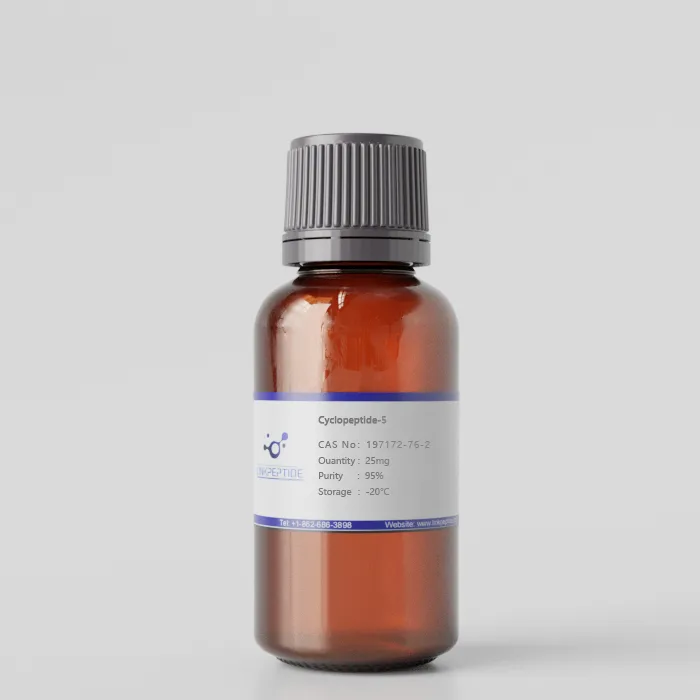
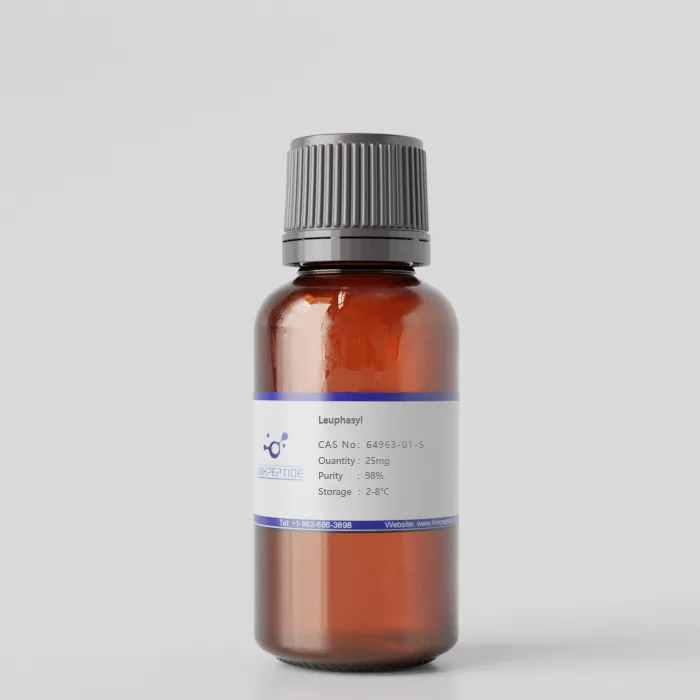
Product Name: Cyclopeptide-5
Cas No: 197172-76-2
Purity: 95%
Storage: Keep in dark and cool dry place -5~8 degree Celsius
Sequence: Cyclo(1-aminocyclohexanecarbonyl-L-arginylglycyl-L-alpha-aspartyl-D-phenylalanyl-OH
Molar Mass: 600.67
Chemical Formula: C28H40N8O7
Application:
Cyclopeptide-5 is a cyclic bioactive peptide engineered to support advanced anti-aging and skin-rejuvenating cosmetic applications. Its stabilized ring structure enhances resistance to degradation, allowing for prolonged activity on the skin. Cyclopeptide-5 is widely used in research exploring improved firmness, reduced fine lines, and enhanced elasticity through optimized cellular communication. It helps support collagen-rich matrix maintenance while promoting a smoother, more refined appearance. With excellent formulation compatibility, this peptide integrates easily into serums, creams, and high-performance treatments designed to target early to advanced signs of aging and deliver a lifted, resilient, youthful-looking complexion.
Current Research:
Cyclopeptide-5: Research Overview
Cyclopeptide-5 is a synthetic cyclic pentapeptide engineered for stability, receptor specificity, and controlled signaling activity in cutaneous biology. Unlike linear peptides, cyclic peptides adopt constrained conformations that increase resistance to proteolytic degradation and enhance binding affinity to selected protein targets. Cyclopeptide-5 is designed to mimic structural motifs found in endogenous regulatory peptides involved in cellular communication, extracellular matrix organization, and surface rejuvenation.
Cyclopeptide-5 consists of five amino acids arranged in a closed ring through head-to-tail cyclization or side-chain linkage, depending on manufacturing method. Cyclization confers several research-relevant attributes:
Enhanced resistance to enzymatic cleavage, providing greater stability in topical systems.
Higher conformational rigidity, which improves binding selectivity to receptors or matrix proteins.
Optimized skin interaction, as cyclic peptides often maintain bioactivity at lower molecular weights compared with larger linear sequences.
These features enable Cyclopeptide-5 to function as a compact signaling molecule capable of influencing epidermal and dermal pathways with relatively high potency.
Research on Cyclopeptide-5 centers on its role in regulating extracellular matrix (ECM) turnover, especially components associated with the papillary dermis and the dermal–epidermal junction. In vitro fibroblast studies show that exposure to cyclic regulatory peptides leads to:
Increased production of collagen I and III, which provide tensile strength and support.
Upregulation of fibronectin, a glycoprotein essential for matrix assembly and fibroblast adhesion.
Enhanced synthesis of laminin and collagen IV, which contribute to basement-membrane integrity.
These ECM changes correlate with improved dermal density in experimental models and support Cyclopeptide-5’s classification as a matrix-modulating cyclic peptide.
The dermal–epidermal junction (DEJ) undergoes gradual flattening with age, diminishing mechanical stability and contributing to wrinkle formation. Cyclopeptide-5 has been studied for its capacity to influence DEJ-associated proteins:
Increased expression of integrins that anchor keratinocytes to the basement membrane.
Stimulation of collagen VII and laminin-332, proteins essential for anchoring fibrils and hemidesmosomes.
Improved organization of the lamina densa and lamina lucida in skin models.
These molecular observations suggest reinforcement of DEJ structure, which supports epidermal cohesion and contributes to improved surface uniformity.
Cyclopeptide-5 has been evaluated in keratinocyte assays for its effects on epidermal turnover. Research indicates:
Moderate increases in keratinocyte proliferation, supporting epidermal renewal.
Enhanced expression of differentiation markers that maintain barrier formation.
Improved organization of corneocyte layers in reconstructed skin, consistent with strengthened barrier function.
Epidermal renewal driven by optimized differentiation contributes to smoother microrelief and improved surface texture.
Cosmetic science studies involving cyclic peptides frequently assess structural aging markers. Cyclopeptide-5–containing systems demonstrate:
Reductions in wrinkle depth and roughness captured by profilometry or 3D optical methods.
Increases in skin firmness and elasticity, likely due to ECM remodeling.
More regular microrelief patterns, reflecting improved epidermal–dermal interaction.
These outcomes align with the peptide’s observed influence on ECM synthesis, DEJ integrity, and epidermal turnover.
Some studies document that Cyclopeptide-5 modulates pathways linked to inflammatory mediators and cellular stress signaling. Effects reported in keratinocyte and fibroblast models include:
Reduced levels of pro-inflammatory cytokines under stress challenge.
Enhanced antioxidant-related gene expression, supporting cellular defenses.
Improved viability and metabolic activity under oxidative or mechanical stress.
This positions the peptide within research frameworks focused on senescence prevention, oxidative management, and inflammaging attenuation.
Cyclopeptide-5 is typically a water-soluble cyclic peptide with enhanced stability relative to linear analogues. Key formulation characteristics include:
High resistance to hydrolysis and enzymatic breakdown.
Compatibility with aqueous serums, emulsions, hydrogel systems, and encapsulation carriers.
Optimal activity when added during cool-down phases of formulation to preserve structural integrity.
Its cyclic structure tends to maintain bioactivity at low usage levels, making it suitable for concentrated serums and intensive treatment formats.
Summary
Cyclopeptide-5 is characterized in research as a cyclic, stability-enhanced pentapeptide that modulates ECM production, reinforces the dermal–epidermal junction, supports epidermal renewal, and contributes to improved microrelief and structural parameters in model systems. Its rigid conformation and resistance to degradation make it a versatile active in studies of dermal support, rejuvenation biology, and barrier optimization.
Get a Quote
 LinkPeptide