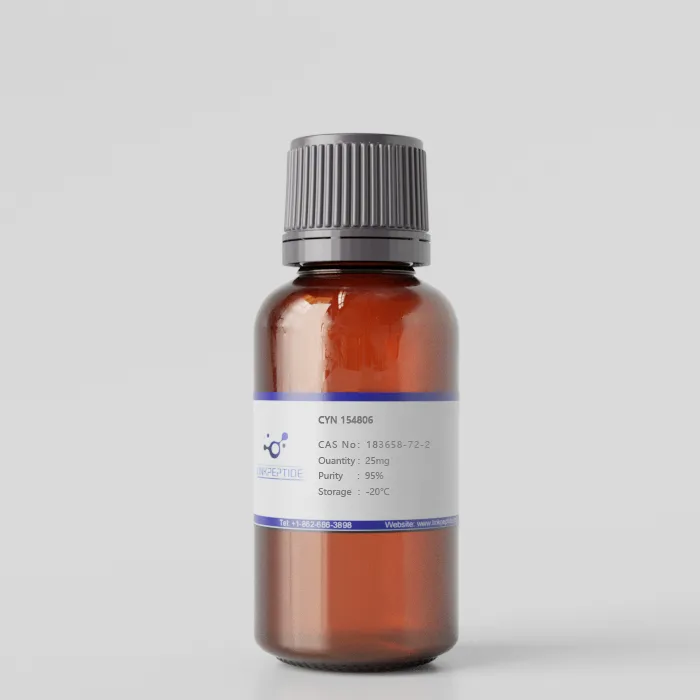
Product Name:CYN 154806
Synonyms:(4R,7S,10S,13R,16S,19S)-19-[[(2S)-2-Acetamido-3-(4-nitrophenyl)propanoyl]amino]-10-(4-aminobutyl)-N-[(2R)-1-amino-3-(4-hydroxyphenyl)-1-oxopropan-2-yl]-7-[(1R)-1-hydroxyethyl]-16-[(4-hydroxyphenyl)methyl]-13-(1H-indol-3-ylmethyl)-6,9,12,15,18-pentaoxo-1,2
CAS No:183658-72-2
Purity:95%
Molar Mass:1197.3
Chemical Formula:C56H68N12O14S2
Storage:Store at -20 degrees Celsius
Sequence:XCYWKTCY
Target:melanocortin-4 receptor (MC4R)
Application:
CYN 154806 is a selective antagonist of the melanocortin-4 receptor (MC4R), widely used in research to study the physiological functions of MC4R in energy homeostasis, appetite regulation, and metabolic processes. This peptide is particularly valuable for exploring the role of MC4R in obesity, diabetes, and related metabolic disorders. By specifically blocking MC4R activity, CYN 154806 enables researchers to dissect the complex signaling pathways involved in these conditions. With its high purity and specificity, CYN 154806 ensures accurate and reproducible results, making it an essential tool for advanced studies in neuroendocrinology and metabolic research.
Current Research:
CYN 154806 (CAS: 183658-72-2) is a synthetic cyclic octapeptide that functions as a potent and selective antagonist of the somatostatin receptor subtype 2 (sst₂). Somatostatin receptors are G protein-coupled receptors involved in regulating endocrine and neuronal signaling pathways. Among the five known subtypes (sst₁–sst₅), sst₂ plays a pivotal role in modulating hormone secretion and neuronal activity.
Chemical Structure and Selectivity
The molecular formula of CYN 154806 is C₅₆H₆₈N₁₂O₁₄S₂, with a molecular weight of approximately 1197.35 g/mol. Its sequence is Ac-(4-nitro)Phe-Cys-Tyr-D-Trp-Lys-Thr-Cys-D-Tyr-NH₂, featuring a disulfide bridge between the cysteine residues at positions 2 and 7, which stabilizes its cyclic conformation. Binding affinity studies reveal that CYN 154806 exhibits high selectivity for sst₂, with a pIC₅₀ value of 8.58, while showing significantly lower affinities for other somatostatin receptor subtypes: sst₁ (pIC₅₀ = 5.41), sst₃ (pIC₅₀ = 6.07), sst₄ (pIC₅₀ = 5.76), and sst₅ (pIC₅₀ = 6.48).
Mechanism of Action
As an sst₂ antagonist, CYN 154806 binds to the sst₂ receptor, inhibiting the action of endogenous somatostatin. This blockade prevents the receptor-mediated inhibition of adenylyl cyclase, leading to increased cyclic AMP (cAMP) levels and subsequent modulation of downstream signaling pathways. By selectively targeting sst₂, CYN 154806 allows for the dissection of sst₂-specific physiological and pathological processes.
Pharmacological Applications
CYN 154806 has been instrumental in elucidating the role of sst₂ in various biological systems. In vitro studies using Chinese hamster ovary (CHO-K1) cells expressing human sst₂ receptors have demonstrated that CYN 154806 effectively inhibits somatostatin-induced increases in extracellular acidification rates, with a pK_B value of 7.92. Additionally, it blocks somatostatin-induced [³⁵S]-GTPγS binding in membranes expressing human and rat sst₂ receptors, indicating its efficacy in preventing receptor activation.
In vivo, CYN 154806 has been utilized to investigate sst₂-mediated physiological responses. For example, in muscarinic acetylcholine receptor knockout mice, administration of CYN 154806 reversed carbachol-induced gastric acid secretion, highlighting its potential in modulating gastrointestinal functions.
Research Implications
The high selectivity and potency of CYN 154806 make it a valuable tool for probing sst₂-specific functions in both normal and disease states. Its application extends to studies on hormone secretion, neuronal excitability, and tumor growth, where sst₂ is implicated. By selectively inhibiting sst₂, researchers can delineate the receptor's contributions to complex signaling networks and explore therapeutic avenues for conditions such as neuroendocrine tumors, where somatostatin analogs are of clinical interest.
Conclusion
CYN 154806 serves as a critical agent in the pharmacological exploration of somatostatin receptor biology. Its specificity for sst₂ enables detailed studies of receptor function and aids in the development of targeted therapies for diseases involving dysregulated somatostatin signaling.
Reference:
Get a Quote
 LinkPeptide

![[Phe1Ψ(CH2-NH)Gly2]Nociceptin(1-13)NH2](https://www.linkpeptide.com/wp-content/uploads/2024/10/Phe1¶aCH2-NHGly2Nociceptin1-13NH2-jpg.webp "[Phe1Ψ(CH2-NH)Gly2]Nociceptin(1-13)NH2")