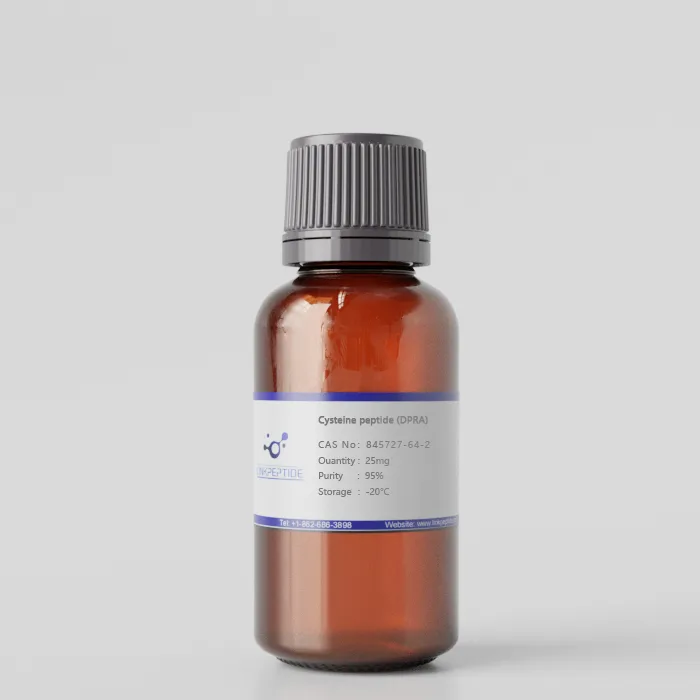
Product Name: Cysteine peptide (DPRA)
Cas No: 845727-64-2
Purity: 95%
Storage: Keep in dark and cool dry place -5~8 degree Celsius
Sequence: Ac-RFAACAA-COOH
Molar Mass: 750.9
Chemical Formula: C32H50N10O9S
Synonyms: EX-A10558
IUPAC Name: (2S)-2-[[(2S)-2-[[(2R)-2-[[(2S)-2-[[(2S)-2-[[(2S)-2-[[(2S)-2-acetamido-5-(diaminomethylideneamino)pentanoyl]amino]-3-phenylpropanoyl]amino]propanoyl]amino]propanoyl]amino]-3-sulfanylpropanoyl]amino]propanoyl]amino]propanoic acid
SMILES: C[C@@H](C(=O)N[C@@H](CS)C(=O)N[C@@H](C)C(=O)N[C@@H](C)C(=O)O)NC(=O)[C@H](C)NC(=O)[C@H](CC1=CC=CC=C1)NC(=O)[C@H](CCCN=C(N)N)NC(=O)C
InChIKey: CUPGQWLYBZAEJW-NWFWWTBRSA-N
InChI: InChI=1S/C32H50N10O9S/c1-16(25(44)36-18(3)27(46)42-24(15-52)30(49)38-17(2)26(45)39-19(4)31(50)51)37-29(48)23(14-21-10-7-6-8-11-21)41-28(47)22(40-20(5)43)12-9-13-35-32(33)34/h6-8,10-11,16-19,22-24,52H,9,12-15H2,1-5H3,(H,36,44)(H,37,48)(H,38,49)(H,39,45)(H,40,43)(H,41,47)(H,42,46)(H,50,51)(H4,33,34,35)/t16-,17-,18-,19-,22-,23-,24-/m0/s1
Application:
Cysteine Peptide (DPRA) is a synthetic heptapeptide specifically designed for use in the Direct Peptide Reactivity Assay, a validated in vitro method for assessing skin sensitization potential. Featuring a reactive cysteine residue, this peptide serves as a key nucleophilic probe for measuring peptide depletion when exposed to electrophilic test substances. Its defined sequence, stability, and assay-ready format support reliable quantification and reproducible DPRA performance. Ideal for cosmetic, chemical, and toxicology research workflows, this peptide enables consistent evaluation of electrophile?Cnucleophile interactions and supports regulatory-aligned safety testing strategies
Current Research:
Current Research on Cysteine Peptide (DPRA) in Cosmetic Safety Assessment
Cysteine peptide, as used in the Direct Peptide Reactivity Assay (DPRA), is one of the most important tools in today’s modern non-animal cosmetic safety testing. Current research continues to strengthen its role as a validated, mechanistic, and internationally accepted in chemico method for predicting the skin sensitization potential of cosmetic ingredients.
Cosmetic safety assessment has shifted dramatically toward alternative methods that avoid animal testing. DPRA has become a global standard due to its mechanistic alignment with the skin sensitization Adverse Outcome Pathway (AOP). In this AOP, the molecular initiating event is the covalent binding of electrophilic substances to nucleophilic skin proteins—an event that cysteine-containing peptides perfectly model.
Regulatory authorities increasingly encourage or require non-animal methods. The assay is recognized in international guidelines because it generates reproducible, quantitative data that support hazard classification and risk evaluation. As a result, cosmetic companies rely heavily on consistent, high-quality cysteine peptides to ensure accurate testing.
Recent research highlights the critical factors that influence DPRA performance: peptide purity, stability, solubility, and batch consistency. Many studies show that minor variations in peptide composition or degradation can significantly affect depletion measurements. Because DPRA results feed into regulatory decisions, ensuring the performance of the cysteine peptide reagent has become a central focus.
Laboratories are increasingly implementing more rigorous quality-control systems for peptide preparation. There is also ongoing development of reference materials and standardized protocols aimed at reducing interlaboratory variability. This has pushed suppliers to enhance peptide characterization, including more advanced chromatographic and mass spectrometric confirmation.
Several recent research projects focus on improving the throughput and analytical sensitivity of DPRA. Traditional DPRA uses HPLC-UV to quantify peptide depletion. However, new methods incorporate liquid chromatography–mass spectrometry (LC-MS) to enhance detection of subtle peptide changes and to analyse multiple peptide adducts simultaneously. This is particularly useful for screening large cosmetic ingredient libraries, including fragrance components, preservatives, surfactants, and botanical extracts.
Miniaturised and automated DPRA platforms are also being developed. These allow rapid evaluation of new cosmetic formulations during early R&D stages, helping formulators select ingredients with lower sensitization risks and reduce downstream regulatory hurdles.
A major direction in current research is moving from simple hazard identification to potency ranking. This is where the cysteine peptide becomes especially important. Kinetic DPRA (kDPRA) measures peptide depletion over time rather than at a single endpoint, providing dynamic information about reaction rates. Because cysteine is more reactive than lysine, it offers more precise resolution in identifying strong sensitizers versus moderate ones.
Studies show that kDPRA helps differentiate substances falling into different regulatory skin sensitization categories. This is particularly relevant for cosmetic raw materials that may appear borderline in other assays. The increased use of kDPRA has led to the development of improved cysteine peptides optimized for rapid reaction kinetics and stable performance across timepoints.
Modern cosmetic safety assessment rarely relies on a single test. Instead, DPRA is integrated into a wider non-animal battery that includes keratinocyte activation assays (such as KeratinoSens), dendritic cell assays (such as h-CLAT), and in vitro reconstructed human skin models. Because DPRA targets the earliest key event in the sensitization pathway, it often serves as the first screening step.
This integration has increased the demand for cysteine peptide reagents that are consistent, well-documented, and compatible with multi-assay data interpretation. In practice, cosmetic companies rely on DPRA early in formulation development to eliminate high-reactivity candidates before investing in more complex and expensive in vitro systems.
High-quality cysteine peptides specifically prepared for DPRA support more reliable skin-sensitization predictions, reinforce compliance with international regulations, and enable cosmetic developers to innovate without animal testing. Because research continues to refine assay sensitivity, throughput, and mechanistic resolution, the value of well-designed cysteine peptide reagents remains central to modern cosmetic science.
Get a Quote
 LinkPeptide