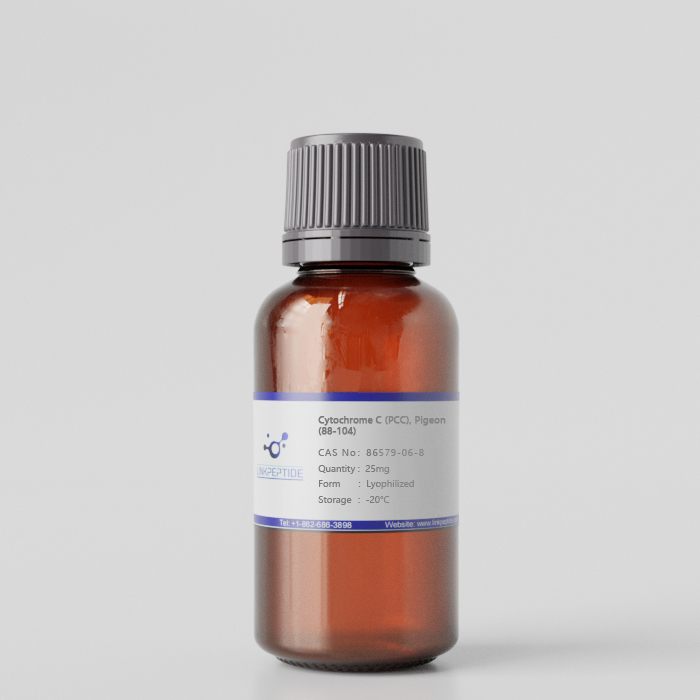
Product Name: Cytochrome C (PCC), Pigeon (88-104)
Sequence One Letter Code: KAERADLIAYLKQATAK
Sequence Three Letter Code: H-Lys-Ala-Glu-Arg-Ala-Asp-Leu-Ile-Ala-Tyr-Leu-Lys-Gln-Ala-Thr-Ala-Lys-OH
Cas No: 86579-06-8
Chemical Formula:C84H144N24O25
Molecular Weight: 1890.4
Purity: 95%
Form: Lyophilized
Storage Conditions: - 20 °C
Research Area: Inflammation and Immunology Research
SMILES: CCC(C)C(C(=O)NC(C)C(=O)NC(CC1=CC=C(C=C1)O)C(=O)NC(CC(C)C)C(=O)NC(CCCCN)C(=O)NC(CCC(=O)N)C(=O)NC(C)C(=O)NC(C(C)O)C(=O)NC(C)C(=O)NC(CCCCN)C(=O)O)NC(=O)C(CC(C)C)NC(=O)C(CC(=O)O)NC(=O)C(C)NC(=O)C(CCCNC(=N)N)NC(=O)C(CCC(=O)O)NC(=O)C(C)NC(=O)C(CCCCN)N
IUPAC: 6-amino-2-[2-[[2-[2-[[5-amino-2-[[6-amino-2-[[2-[[2-[2-[[2-[[2-[[2-[2-[[5-carbamimidamido-2-[[4-carboxy-2-[2-(2,6-diaminohexanoylamino)propanoylamino]butanoyl]amino]pentanoyl]amino]propanoylamino]-3-carboxypropanoyl]amino]-4-methylpentanoyl]amino]-3-methylpentanoyl]amino]propanoylamino]-3-(4-hydroxyphenyl)propanoyl]amino]-4-methylpentanoyl]amino]hexanoyl]amino]-5-oxopentanoyl]amino]propanoylamino]-3-hydroxybutanoyl]amino]propanoylamino]hexanoic acid
INCHIKEY: UZAAFHHXLLVUAZ-UHFFFAOYSA-N
INCHI:
InChI=1S/C84H144N24O25/c1-13-43(6)65(107-80(129)59(38-42(4)5)106-79(128)61(40-64(114)115)104-69(118)45(8)94-73(122)54(24-20-36-92-84(90)91)99-76(125)56(30-32-63(112)113)98-67(116)44(7)93-72(121)52(88)21-14-17-33-85)81(130)96-47(10)70(119)103-60(39-50-25-27-51(110)28-26-50)78(127)105-58(37-41(2)3)77(126)100-53(22-15-18-34-86)75(124)101-55(29-31-62(89)111)74(123)95-48(11)71(120)108-66(49(12)109)82(131)97-46(9)68(117)102-57(83(132)133)23-16-19-35-87/h25-28,41-49,52-61,65-66,109-110H,13-24,29-40,85-88H2,1-12H3,(H2,89,111)(H,93,121)(H,94,122)(H,95,123)(H,96,130)(H,97,131)(H,98,116)(H,99,125)(H,100,126)(H,101,124)(H,102,117)(H,103,119)(H,104,118)(H,105,127)(H,106,128)(H,107,129)(H,108,120)(H,112,113)(H,114,115)(H,132,133)(H4,90,91,92)
Source / Species: pigeon
Conjugation: Unconjugated
Code Nacres: NA.26
Application: Cytochrome c (PCC) (88–104) is a 17-amino acid peptide derived from pigeon cytochrome c and widely used as a model antigen in immunology. It elicits strong antigen-specific T cell proliferative responses and has been extensively applied to study MHC-restricted antigen presentation, T cell receptor recognition, and immune tolerance. PCC (88–104) serves as a benchmark epitope in investigations of T cell activation and signaling mechanisms in experimental immunology.
Current Research: Cytochrome c (PCC) (88–104) is a 17–amino acid peptide derived from pigeon cytochrome c, extensively used as a model antigen in experimental immunology. This peptide represents one of the most thoroughly characterized epitopes for studying MHC-restricted antigen presentation and CD4⁺ T cell responses, particularly in murine systems. PCC (88–104) elicits robust antigen-specific T cell proliferative and cytokine responses when presented by compatible MHC class II molecules, making it a foundational tool for dissecting mechanisms of adaptive immunity. Immunological Significance The PCC (88–104) epitope is classically presented in the context of MHC class II molecules (e.g., I-Eᵏ in certain mouse strains) and recognized by specific T cell receptor (TCR) transgenic models. It has been instrumental in: Defining peptide–MHC binding determinants Characterizing TCR–peptide–MHC structural interactions Investigating clonal selection and T cell repertoire development Because the peptide is foreign to mouse immune systems yet structurally well-defined, it provides a reproducible antigenic stimulus for controlled immunological studies. Applications in T Cell Biology 1. MHC Class II Antigen Presentation PCC (88–104) has been widely used to study: Peptide loading onto MHC class II molecules Stability of peptide–MHC complexes Antigen processing requirements Influence of co-stimulatory signals on T cell activation 2. T Cell Receptor Recognition Structural and functional analyses of PCC-specific TCRs have contributed significantly to understanding: TCR docking geometry Peptide anchor residue importance Affinity versus functional avidity relationships Altered peptide ligand (APL) responses 3. T Cell Activation and Signaling PCC stimulation supports evaluation of early and late activation events, including: Calcium flux MAPK signaling cascades Cytokine production (e.g., IL-2, IFN-γ) Proliferation assays It is frequently used in conjunction with TCR-transgenic mouse models to ensure antigen specificity. 4. Immune Tolerance and Selection Studies Because of its defined specificity, PCC (88–104) is a benchmark antigen in investigations of: Thymic selection mechanisms Peripheral tolerance Anergy induction Regulatory T cell responses Experimental Utility The peptide is compatible with: In vitro T cell proliferation assays ELISPOT and intracellular cytokine staining Tetramer-based T cell tracking Structural and crystallographic analyses of peptide–MHC–TCR complexes Its extensive historical use makes it a reference epitope for comparative immunological studies. Experimental Considerations Effective responses depend on appropriate MHC compatibility in the experimental model. Peptide concentration and antigen-presenting cell type should be optimized for reproducible T cell activation. Inclusion of appropriate negative controls is recommended to account for background stimulation.
Get a Quote
 LinkPeptide