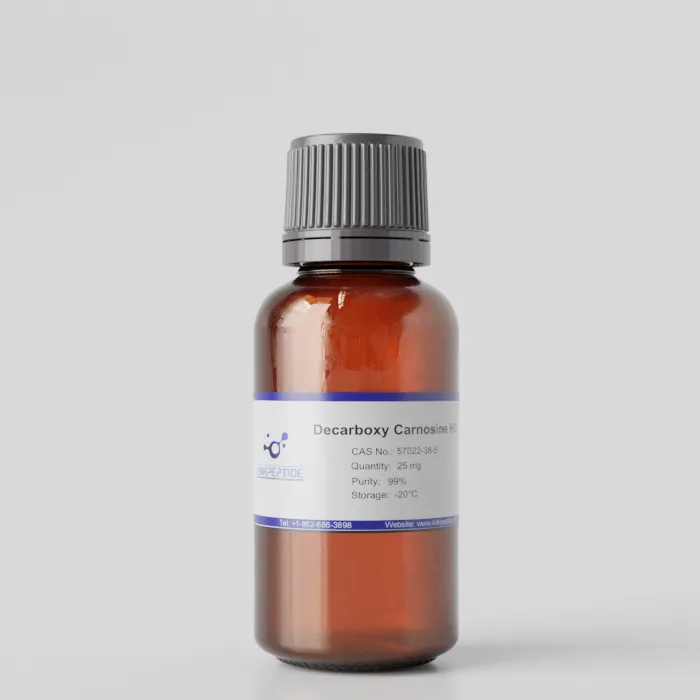
Product Name: Decarboxy Carnosine HCl
Cas No: 57022-38-5
Purity: 99%
Form: HCI Salt
Chemical Formula: C8H14N4O.2ClH
Molar Mass: 255.14
Synonyms: Decarboxy carnosine hydrochloride; Decarboxy carnosine HCl
IUPAC Name: 3-amino-N-[2-(1H-imidazol-5-yl)ethyl]propanamide;dihydrochloride
SMILES: C1=C(NC=N1)CCNC(=O)CCN.Cl.Cl
InChIKey: ZQTUNIWBUQUKAM-UHFFFAOYSA-N
InChI: InChI=1S/C8H14N4O.2ClH/c9-3-1-8(13)11-4-2-7-5-10-6-12-7;;/h5-6H,1-4,9H2,(H,10,12)(H,11,13);2*1H
Storage: -20 degree Celsius
Application:
Decarboxy Carnosine HCl is a modified dipeptide known for its multi-targeted protective benefits in cosmetic formulations. Its structure enables strong antioxidant, anti-glycation, and anti-carbonylation activity, helping preserve skin elasticity and reduce dullness caused by environmental stress. This peptide supports a brighter, more youthful-looking complexion while contributing to long-term firmness and resilience. Because it addresses both oxidative and sugar-induced aging pathways, Decarboxy Carnosine HCl is highly valued in daily defense serums, pollution-shield formulas, and advanced anti-aging treatments. It blends well with vitamins, hyaluronic acid, and soothing actives for comprehensive skin protection and revitalization.
Current Research:
Decarboxy Carnosine HCl – Current Research Overview
Decarboxy Carnosine HCl is a modified dipeptide derived from carnosine, typically described as a β-alanine–histamine analogue in its hydrochloride salt form. In cosmetic science, it is positioned as a multifunctional anti-aging and protective active, targeting oxidative stress, glycation, and carbonylation processes that progressively damage proteins and lipids in the skin. By intervening in these fundamental biochemical pathways, Decarboxy Carnosine HCl helps preserve skin elasticity, clarity, and overall vitality, particularly under conditions of environmental and metabolic stress.
Carnosine itself is a naturally occurring dipeptide (β-alanyl-L-histidine) found in muscle and nervous tissue, known for its antioxidant and anti-glycation properties. Decarboxy Carnosine is structurally related but modified to improve certain functional aspects for topical use, such as stability, reactivity, and compatibility in cosmetic formulations. The hydrochloride form enhances water solubility and ease of incorporation into aqueous phases, serums, and emulsions.
The rationale behind Decarboxy Carnosine is to retain and optimize the carbonyl-trapping and antioxidant capacity of carnosine while adapting it for high-performance, long-term cosmetic application.
A central focus of current research is its role as an anti-glycation and anti-carbonylation agent. Glycation is a non-enzymatic reaction where sugars bind to proteins, forming advanced glycation end-products (AGEs). In skin, this process stiffens collagen, reduces elasticity, and contributes to yellowing and dullness. Carbonylation involves the modification of proteins and lipids by reactive carbonyl species produced during oxidative and metabolic stress.
In vitro studies and biochemical assays demonstrate that Decarboxy Carnosine HCl can:
React with reactive carbonyls, thereby reducing their ability to damage proteins and lipids.
Help limit the formation of AGEs and related cross-links in collagen and elastin.
This carbonyl scavenging capacity translates into a protective effect on the dermal matrix, delaying or reducing stiffness and loss of elasticity associated with intrinsic and extrinsic aging.
Alongside its anti-glycation activity, Decarboxy Carnosine HCl exhibits antioxidant properties. It has been reported to scavenge reactive oxygen species (ROS) and contribute to the stabilization of cell membranes and biomolecules under oxidative stress. By buffering oxidative insults generated by UV radiation, pollution, or metabolic processes, the peptide helps maintain a more balanced redox environment in skin.
In cellular models, the combination of antioxidant and anti-carbonylation actions leads to reduced oxidative damage markers and improved cell viability under stress conditions. This dual function—intercepting both ROS and reactive carbonyls—makes Decarboxy Carnosine HCl particularly appealing for urban, pollution-exposed, and mature skin.
Cosmetic evaluations and supplier-sponsored studies describe visible benefits aligned with its biochemical profile. Formulations containing Decarboxy Carnosine HCl have been associated with:
Improved skin firmness and elasticity, linked to better preservation of collagen and elastin from glycation-related crosslinking.
A brighter, more uniform complexion, due to reduced sallowness and yellowing often tied to AGE accumulation.
Smoother texture and enhanced radiance, as long-term glyco-oxidative damage is mitigated.
While these results vary depending on formulation, concentration, and study design, they support positioning the peptide as a deep-level “anti-aging shield” that works by preventing structural degradation rather than merely masking surface imperfections.
Research and formulation practice suggest that Decarboxy Carnosine HCl displays strong synergy with other protective and regenerative ingredients, including:
Antioxidant vitamins (such as vitamin C and E derivatives)
Niacinamide, which supports barrier and anti-yellowing benefits
Peptides that stimulate collagen synthesis or enhance repair
Sunscreens and anti-pollution complexes
By addressing glycation and carbonylation, Decarboxy Carnosine HCl complements these actives, creating multi-layered protection against both oxidative and sugar-related aging mechanisms. This makes it a key candidate for comprehensive “anti-stress” or “advanced anti-aging” formulations.
Available information indicates that Decarboxy Carnosine HCl is well tolerated in topical use at typical cosmetic concentrations. Standard irritation and sensitization tests show a low risk profile in both rinse-off and leave-on formats. As a small, water-soluble molecule, it is straightforward to formulate into serums, gels, lotions, and creams, and it remains compatible with a wide range of pH values common in skincare.
Because of its broad protective role, it is frequently used in:
Daily defense serums targeting environmental and lifestyle aging
Anti-glycation night creams designed to work during nocturnal repair cycles
Specialized products for smokers’ skin or dull, sallow complexions
High-tech anti-aging lines focused on collagen preservation
Future work on Decarboxy Carnosine HCl is likely to deepen understanding of its interactions with collagen, elastin, and cellular antioxidant systems in complex skin models. There is growing interest in tracking its impact on specific AGE markers, biomechanical properties, and long-term skin color changes in extended clinical studies. Potential exploration in areas like photoaging, diabetic skin care, and pollution-induced aging may further establish it as a core ingredient for next-generation protective skincare.
Reference:
Get a Quote
 LinkPeptide