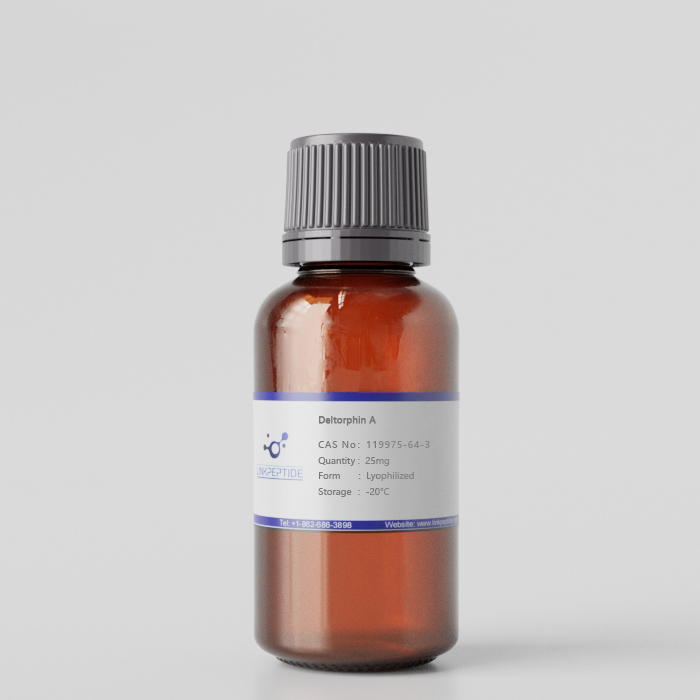
Product Name: Deltorphin A
Sequence One Letter Code: YmFHLMD-NH2
Sequence Three Letter Code: H-Tyr-D-Met-Phe-His-Leu-Met-Asp-NH2
Cas No: 119975-64-3
Chemical Formula:C44H62N10O10S2
Molecular Weight: 955.2
Purity: 95%
Form: Lyophilized
Storage Conditions: - 20 °C
Research Area: Neurological Disease Research
SMILES: CC(C)C[C@@H](C(=O)N[C@@H](CCSC)C(=O)N[C@@H](CC(=O)O)C(=O)N)NC(=O)[C@H](CC1=CN=CN1)NC(=O)[C@H](CC2=CC=CC=C2)NC(=O)[C@@H](CCSC)NC(=O)[C@H](CC3=CC=C(C=C3)O)N
IUPAC: (3S)-4-amino-3-[[(2S)-2-[[(2S)-2-[[(2S)-2-[[(2S)-2-[[(2R)-2-[[(2S)-2-amino-3-(4-hydroxyphenyl)propanoyl]amino]-4-methylsulfanylbutanoyl]amino]-3-phenylpropanoyl]amino]-3-(1H-imidazol-5-yl)propanoyl]amino]-4-methylpentanoyl]amino]-4-methylsulfanylbutanoyl]amino]-4-oxobutanoic acid
INCHIKEY: BHSURCCZOBVHJJ-NWOHMYAQSA-N
INCHI:
InChI=1S/C44H62N10O10S2/c1-25(2)18-34(42(62)50-32(15-17-66-4)40(60)51-33(38(46)58)22-37(56)57)52-44(64)36(21-28-23-47-24-48-28)54-43(63)35(20-26-8-6-5-7-9-26)53-41(61)31(14-16-65-3)49-39(59)30(45)19-27-10-12-29(55)13-11-27/h5-13,23-25,30-36,55H,14-22,45H2,1-4H3,(H2,46,58)(H,47,48)(H,49,59)(H,50,62)(H,51,60)(H,52,64)(H,53,61)(H,54,63)(H,56,57)/t30-,31+,32-,33-,34-,35-,36-/m0/s1
Source / Species: frog
Conjugation: Unconjugated
Code Nacres: NA.26
Application: Deltorphin A is a naturally derived peptide originally isolated from the skin of the South American frog Phyllomedusa sauvagei and is recognized as a highly potent and selective delta-opioid receptor agonist. It demonstrates markedly greater selectivity for delta-opioid receptors compared to many endogenous opioid peptides, making it a valuable pharmacological probe. Deltorphin A is widely used in neuropharmacology to investigate receptor binding, signaling specificity, and downstream modulation of pain pathways. Its strong receptor selectivity enables detailed analysis of delta-opioid–mediated physiological processes without significant cross-reactivity with mu- or kappa-opioid receptors. This peptide supports research in pain modulation, receptor pharmacodynamics, and G protein–coupled receptor signaling. It is also employed in therapeutic development efforts aimed at designing receptor-selective ligands for pain management and neurological disorders.
Current Research: Deltorphin A is a naturally occurring heptapeptide originally isolated from the skin secretions of the South American frog Phyllomedusa sauvagei. It is recognized as one of the most potent and selective agonists of the delta-opioid receptor (DOR), a member of the G protein–coupled receptor (GPCR) family involved in modulation of pain, mood, and neuroendocrine signaling. Compared with many endogenous opioid peptides such as enkephalins, deltorphin A exhibits markedly higher selectivity for DOR over mu-opioid (MOR) and kappa-opioid (KOR) receptors. This pronounced receptor specificity makes it a valuable pharmacological probe for dissecting delta-opioid–mediated physiological and signaling mechanisms. The opioid receptor family comprises three primary subtypes—mu, delta, and kappa—each mediating distinct but overlapping biological effects. While mu-opioid receptor activation is strongly associated with analgesia as well as adverse effects such as respiratory depression and dependence, delta-opioid receptors are implicated in modulation of nociception, emotional behavior, and neuroprotection. Deltorphin A’s high affinity and selectivity for DOR enable researchers to investigate delta-specific signaling pathways without significant cross-activation of mu or kappa receptors, thereby improving experimental precision. At the molecular level, DOR activation by deltorphin A triggers coupling to Gi/o proteins, leading to inhibition of adenylate cyclase, decreased cyclic AMP production, and modulation of ion channel activity. This includes opening of inwardly rectifying potassium channels and inhibition of voltage-gated calcium channels, collectively contributing to reduced neuronal excitability. Using deltorphin A, researchers can characterize DOR-mediated intracellular signaling cascades, including β-arrestin recruitment, receptor internalization, and downstream kinase activation. These studies are central to understanding biased signaling and receptor desensitization phenomena in GPCR biology. In neuropharmacology, deltorphin A is widely used to explore delta-opioid–mediated modulation of pain pathways. Experimental models of acute and chronic pain employ the peptide to assess analgesic efficacy through spinal and supraspinal mechanisms. Because of its receptor specificity, deltorphin A allows detailed analysis of DOR contribution to antinociception independent of MOR-driven effects. This distinction is important for evaluating alternative analgesic strategies that may reduce the risk of opioid-related adverse outcomes. Beyond analgesia, delta-opioid receptors have been implicated in mood regulation, stress responses, and neuroprotective processes. Deltorphin A has been used in experimental systems to examine the role of DOR activation in anxiety-like behavior, depressive phenotypes, and ischemic tolerance. Its application enables controlled activation of DOR signaling to clarify how receptor engagement influences neuronal survival pathways and synaptic plasticity. The peptide also serves as a reference ligand in receptor binding assays. Radioligand competition studies and functional assays measuring G protein activation or second messenger changes frequently employ deltorphin A to establish maximal DOR activation benchmarks. Such assays contribute to structure–activity relationship (SAR) analysis and validation of newly synthesized delta-selective ligands. In therapeutic development, interest in delta-opioid receptor agonists stems from the potential to achieve analgesia and mood modulation with reduced liability for respiratory depression and addiction compared to mu-opioid agonists. Deltorphin A provides a high-affinity template for designing receptor-selective compounds and evaluating pharmacodynamic properties. Its well-defined selectivity profile supports comparative studies aimed at identifying ligands with improved stability, bioavailability, and safety. In summary, deltorphin A is a potent and highly selective delta-opioid receptor agonist that serves as a critical tool in neuropharmacology. By enabling precise interrogation of DOR signaling, receptor pharmacodynamics, and pain modulation mechanisms, it supports fundamental research and therapeutic development targeting GPCR-mediated pathways in pain and neurological disorders.
Get a Quote
 LinkPeptide