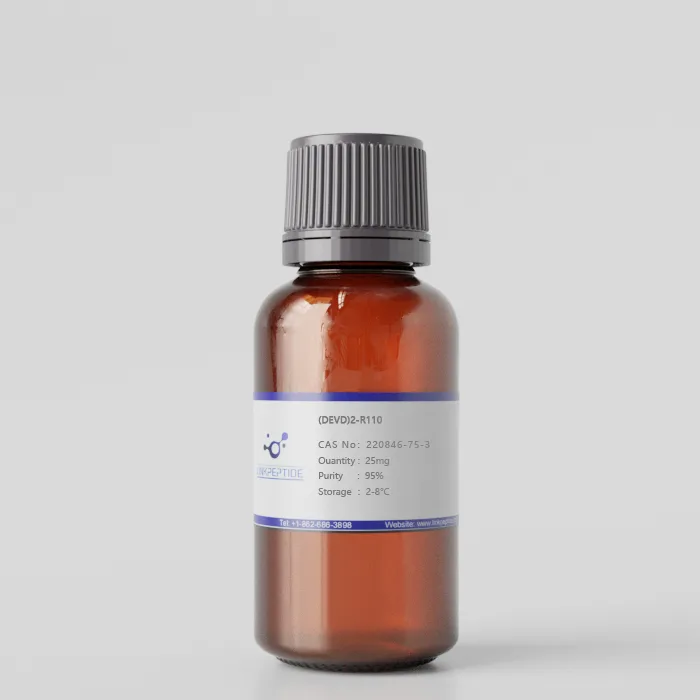
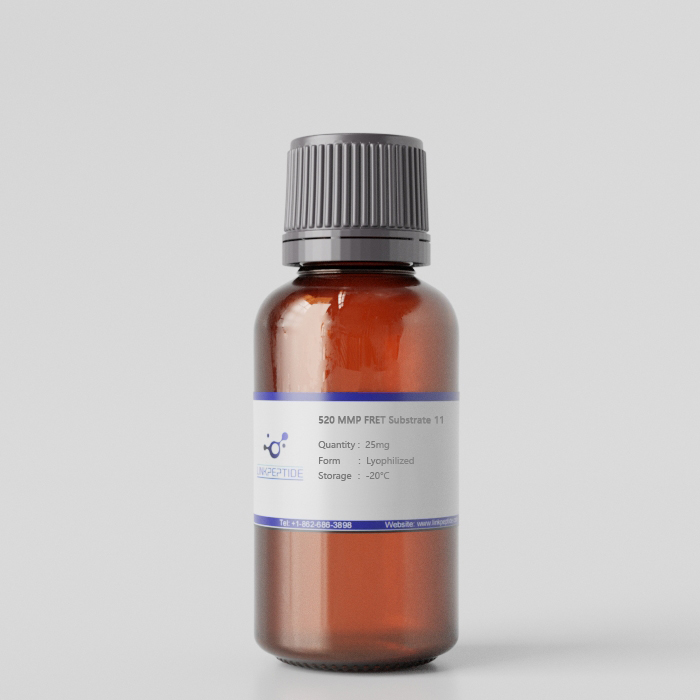
Product Name:(DEVD)2-R110
Form:TFA salt
Purity:95%
Storage:2-8 degree Celsius
Cas No:220846-75-3
Molar Mass:1247.2
Chemical Formula:C56H66N10O23
IUPAC Name:(4S)-4-[[(2S)-2-amino-3-carboxypropanoyl]amino]-5-[[(2S)-1-[[(2S)-1-[[6'-[[(2S)-2-[[(2S)-2-[[(2S)-2-[[(2S)-2-amino-3-carboxypropanoyl]amino]-4-carboxybutanoyl]amino]-3-methylbutanoyl]amino]-3-carboxypropanoyl]amino]-3-oxospiro[2-benzofuran-1,9'-xanthene]-3'-yl]amino]-3-carboxy-1-oxopropan-2-yl]amino]-3-methyl-1-oxobutan-2-yl]amino]-5-oxopentanoic acid
SMILES:CC(C)[C@@H](C(=O)N[C@@H](CC(=O)O)C(=O)NC1=CC2=C(C=C1)C3(C4=C(O2)C=C(C=C4)NC(=O)[C@H](CC(=O)O)NC(=O)[C@H](C(C)C)NC(=O)[C@H](CCC(=O)O)NC(=O)[C@H](CC(=O)O)N)C5=CC=CC=C5C(=O)O3)NC(=O)[C@H](CCC(=O)O)NC(=O)[C@H](CC(=O)O)N
InChIKey:NBDFNNHYGGESSN-DFRKUSGVSA-N
InChI:InChI=1S/C56H66N10O23/c1-23(2)45(65-49(81)33(13-15-39(67)68)61-47(79)31(57)19-41(71)72)53(85)63-35(21-43(75)76)51(83)59-25-9-11-29-37(17-25)88-38-18-26(10-12-30(38)56(29)28-8-6-5-7-27(28)55(87)89-56)60-52(84)36(22-44(77)78)64-54(86)46(24(3)4)66-50(82)34(14-16-40(69)70)62-48(80)32(58)20-42(73)74/h5-12,17-18,23-24,31-36,45-46H,13-16,19-22,57-58H2,1-4H3,(H,59,83)(H,60,84)(H,61,79)(H,62,80)(H,63,85)(H,64,86)(H,65,81)(H,66,82)(H,67,68)(H,69,70)(H,71,72)(H,73,74)(H,75,76)(H,77,78)/t31-,32-,33-,34-,35-,36-,45-,46-/m0/s1
Sequence:(Asp-Glu-Val-Asp)2-Rhodamine 110
Application:
(DEVD)₂-R110 is a fluorogenic substrate used to measure caspase-3 and caspase-7 activity in apoptosis research. It consists of two DEVD (Asp-Glu-Val-Asp) sequences linked to Rhodamine 110 (R110), a highly fluorescent dye. Upon cleavage by caspase-3/-7, the non-fluorescent substrate releases R110, producing a strong green fluorescence signal (Ex/Em: ~496/520 nm). This substrate is widely utilized in apoptosis assays, high-throughput drug screening, and studies of programmed cell death in cancer, neurodegeneration, and inflammation research. (DEVD)₂-R110 enables sensitive, real-time monitoring of caspase activation, making it an essential tool for studying cell death mechanisms and evaluating apoptosis-modulating compounds.
Current Research:
Caspases play a crucial role in apoptosis, the programmed cell death process essential for maintaining tissue homeostasis and eliminating damaged or diseased cells. Among them, caspase-3 and caspase-7 are key executioner caspases, responsible for the cleavage of structural and regulatory proteins that drive apoptosis. (DEVD)₂-R110 has become an essential fluorogenic substrate in apoptosis research, allowing real-time and high-throughput detection of caspase-3/-7 activity in various disease models.
High-throughput drug screening programs also employ this substrate to identify novel pro-apoptotic compounds, such as Bcl-2 inhibitors and proteasome inhibitors, which can restore apoptotic signaling in resistant cancer cells.
Similarly, in PD research, (DEVD)₂-R110 has been utilized to study dopaminergic neuron loss induced by mitochondrial dysfunction and oxidative stress. The substrate helps assess the effectiveness of neuroprotective compounds targeting apoptosis pathways in neurodegenerative conditions.
Conclusion
(DEVD)₂-R110 is a powerful fluorogenic substrate that has significantly advanced apoptosis research. Its application in cancer, neurodegeneration, autoimmune diseases, and drug toxicity studies underscores its value in biomedical research and drug discovery. By enabling real-time, sensitive caspase detection, it continues to facilitate breakthroughs in understanding cell death mechanisms and identifying novel therapeutic strategies.
Get a Quote
 LinkPeptide