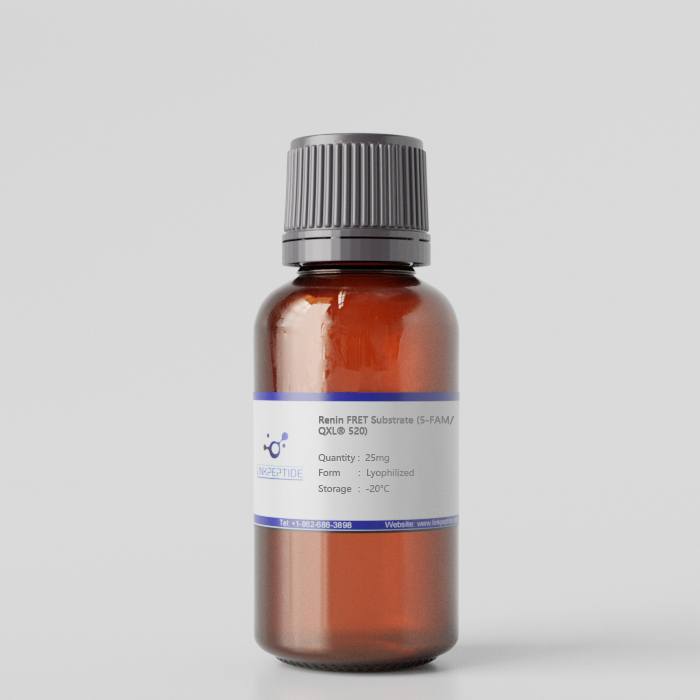
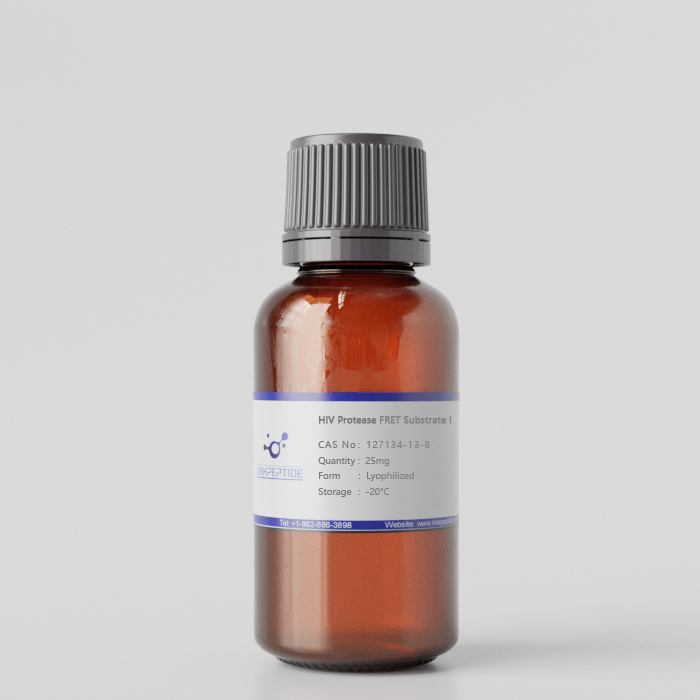
Product Name: Renin FRET Substrate (5-FAM/QXL® 520)
Molecular Weight: 2000 - 2200
Purity: 95%
Form: Lyophilized
Storage Conditions: - 20 °C Protected from light
Research Area: peptide substrate
Conjugation: Conjugated
Conjugation Type: Double dyes
Code Nacres: NA.26
Application: This fluorogenic peptide is a sensitive substrate for renin and incorporates a 5-FAM/QXL® 520 fluorescence resonance energy transfer (FRET) pair. In the intact peptide, fluorescence from the FAM donor is quenched by the QXL acceptor. Cleavage by renin separates the fluorophore and quencher, restoring fluorescence and enabling real-time detection of enzymatic activity. Because renin is the initiating enzyme of the renin–angiotensin system that regulates blood pressure and fluid balance, this substrate is particularly valuable for cardiovascular research. The peptide is well suited for kinetic assays, enzyme activity measurements, and high-throughput screening of renin inhibitors. It supports studies of hypertension, drug discovery targeting the renin–angiotensin pathway, and biochemical characterization of renin activity.
Current Research: Renin is a key regulatory enzyme in the renin–angiotensin system (RAS), a hormonal cascade that plays a central role in controlling blood pressure, electrolyte balance, and fluid homeostasis. Because renin catalyzes the initial and rate-limiting step of this pathway, monitoring its activity is essential for understanding cardiovascular physiology and for developing therapeutic strategies targeting hypertension. Fluorogenic peptide substrates incorporating fluorescence resonance energy transfer (FRET) technology have become powerful tools for studying protease activity. The FAM/QXL® 520 renin substrate is one such probe designed for sensitive and real-time measurement of renin enzymatic activity. Principle of FRET-Based Protease Detection FRET-based substrates are engineered peptides that contain two fluorescent components: a fluorophore (donor) and a quencher (acceptor). When the two molecules are positioned close together within an intact peptide, fluorescence emitted by the donor is absorbed by the quencher through resonance energy transfer. As a result, the fluorescence signal is effectively suppressed. In the FAM/QXL® 520 renin substrate, the donor fluorophore is 5-carboxyfluorescein (5-FAM), while the quencher is QXL® 520. When the peptide remains intact, the proximity of these two molecules keeps fluorescence from the FAM donor in a quenched state. Upon cleavage of the peptide by renin, the fluorophore and quencher become physically separated. This disruption of the FRET interaction restores fluorescence emission from the FAM donor, producing a measurable signal that is directly proportional to enzyme activity. Monitoring Renin Activity in Real Time The restoration of fluorescence after enzymatic cleavage enables continuous monitoring of renin activity in real time. Unlike endpoint assays, which require stopping the reaction and measuring product formation afterward, FRET-based substrates allow researchers to follow the reaction dynamically as it occurs. This real-time detection provides several experimental advantages. It allows accurate determination of enzyme kinetics, including parameters such as reaction rates and substrate turnover. Additionally, fluorescence signals can be recorded continuously in microplate-based assays, making the system compatible with automated experimental platforms. Because fluorescence intensity increases as cleavage proceeds, the assay provides a direct and sensitive readout of renin activity without the need for additional detection reagents or complex processing steps. Role of Renin in the Renin–Angiotensin System Renin functions as the initiating enzyme in the renin–angiotensin system, a signaling pathway that regulates cardiovascular and renal physiology. It catalyzes the cleavage of angiotensinogen, a circulating precursor protein, to produce angiotensin I. This peptide is subsequently converted by angiotensin-converting enzyme (ACE) into angiotensin II, a potent regulator of blood vessel constriction and aldosterone secretion. Through this cascade, renin activity ultimately influences vascular tone, sodium retention, and fluid balance, all of which contribute to the regulation of systemic blood pressure. Dysregulation of this pathway is associated with conditions such as hypertension, heart failure, and kidney disease. Because renin controls the first step in the pathway, it has become an important target for pharmacological intervention. Monitoring renin activity is therefore critical in research focused on cardiovascular disease mechanisms and therapeutic development. Applications in Enzyme Kinetics and Drug Discovery The FAM/QXL® 520 renin substrate is particularly well suited for kinetic enzyme assays. By measuring fluorescence changes over time, researchers can quantify enzymatic activity and determine parameters such as substrate specificity and catalytic efficiency. In addition, the fluorogenic nature of the assay makes it ideal for high-throughput screening (HTS). Pharmaceutical and biochemical research laboratories frequently use FRET-based substrates to evaluate large compound libraries for potential inhibitors of renin. Inhibitors that block renin-mediated cleavage prevent fluorescence recovery, allowing rapid identification of candidate molecules that interfere with the enzyme’s activity. Such screening approaches are essential in the development of renin inhibitors, a class of drugs designed to suppress activation of the renin–angiotensin system and reduce blood pressure. Supporting Cardiovascular and Biochemical Research Beyond inhibitor screening, the FAM/QXL® 520 renin substrate is useful in many experimental contexts, including biochemical characterization of renin, analysis of enzyme regulation, and validation of protease activity in biological samples. The sensitivity of fluorescence detection allows accurate measurement even at low enzyme concentrations. Because the assay can be performed in microplate formats and monitored continuously, it is compatible with both small-scale mechanistic studies and larger screening workflows. A Versatile Probe for Renin–Angiotensin Pathway Studies Fluorogenic FRET substrates provide a highly efficient approach for monitoring protease activity, and the FAM/QXL® 520 renin substrate exemplifies this strategy. By coupling a renin-cleavable peptide sequence with a sensitive fluorescence reporting system, the probe enables rapid, real-time detection of renin activity. This capability supports a wide range of investigations, from fundamental studies of enzyme function to applied research in hypertension, cardiovascular physiology, and drug discovery targeting the renin–angiotensin pathway. As research into cardiovascular regulation continues to evolve, tools such as this fluorogenic substrate remain valuable for advancing our understanding of renin-mediated signaling and therapeutic intervention strategies.
Get a Quote
 LinkPeptide