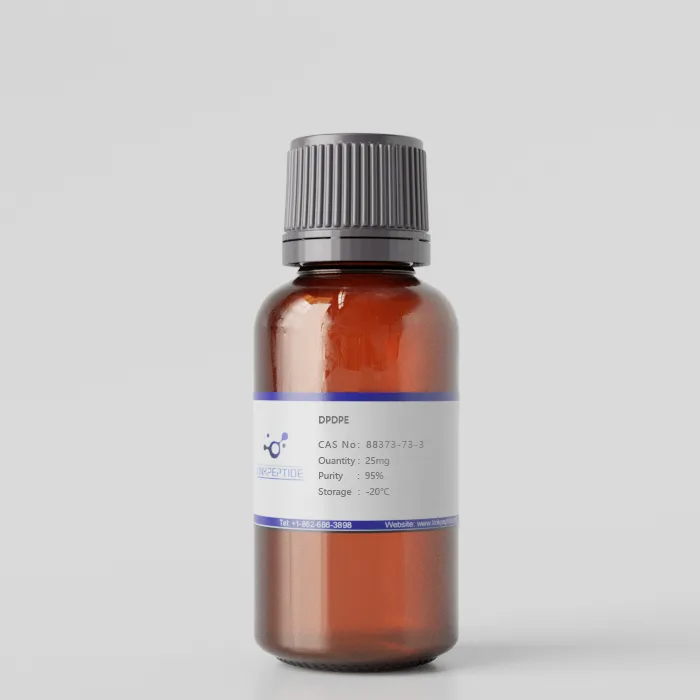
Product Name:DPDPE
CAS No:88373-73-3
Purity:95%
Molar Mass:645.8
Chemical Formula:C30H39N5O7S2
Storage:Store at -20 degrees Celsius
Sequence:YXGFX
Application:
DPDPE (D-Pen2, D-Pen5-enkephalin) is a synthetic peptide and a selective agonist for the delta-opioid receptor (DOR). It is derived from enkephalins, which are naturally occurring peptides involved in pain modulation. The sequence features two D-penicillamine (D-Pen) residues at positions 2 and 5, which contribute to its high affinity and selectivity for the delta-opioid receptor. DPDPE is widely used in research to study the role of delta-opioid receptors in pain regulation, analgesia, and other physiological functions. Its selectivity makes it a valuable tool in exploring the therapeutic potential of targeting DORs for pain management and other conditions like mood disorders.
Current Research:
DPDPE (CAS: 88373-73-3), chemically known as [D-Pen², D-Pen⁵]-Enkephalin, is a synthetic cyclic peptide with high selectivity for δ-opioid receptors (DOR). Its sequence is H-Tyr-D-Pen-Gly-Phe-D-Pen-OH, where D-Pen represents D-penicillamine. The cyclic structure formed by a disulfide bridge between the D-penicillamine residues contributes to its receptor specificity and enhanced stability.
Mechanism of Action
Receptor Selectivity: DPDPE binds selectively to δ-opioid receptors, a subclass of G protein-coupled receptors (GPCRs), with minimal activity at μ-opioid or κ-opioid receptors.
Agonistic Activity: Upon binding, DPDPE activates δ-opioid receptors, leading to downstream effects such as the inhibition of adenylyl cyclase and modulation of ion channel activity. These actions result in antinociceptive (pain-relieving) effects.
Physiological and Research Applications
Pain Research:
DPDPE is widely used to study the role of δ-opioid receptors in pain modulation. Its selective activation allows researchers to investigate the distinct contributions of δ-opioid signaling compared to other opioid receptors.
Neuroprotection:
δ-Opioid receptors are implicated in neuroprotection during ischemic and hypoxic conditions. DPDPE is used to explore these protective mechanisms in experimental models.
Drug Development:
The peptide serves as a reference compound for developing selective δ-opioid receptor agonists and antagonists, with potential therapeutic applications in pain management and neurological disorders.
Addiction Studies:
DPDPE is employed in research to understand the role of δ-opioid receptors in modulating addiction-related behaviors and their interplay with other opioid receptors.
Handling and Storage
Form: Typically supplied as a lyophilized powder.
Storage: Store at -20°C in a desiccated environment to maintain stability.
Reconstitution: Reconstitute in sterile water or a suitable buffer for experimental use.
Conclusion
DPDPE is a potent and selective δ-opioid receptor agonist, making it a valuable tool for studying δ-opioid signaling in pain modulation, neuroprotection, and addiction. Its receptor specificity and stability enhance its utility in pharmacological research and drug development.
Reference:
Get a Quote
 LinkPeptide


![[Ala17]-MCH](https://www.linkpeptide.com/wp-content/uploads/2024/08/Ala17-MCH-jpg.webp "[Ala17]-MCH")