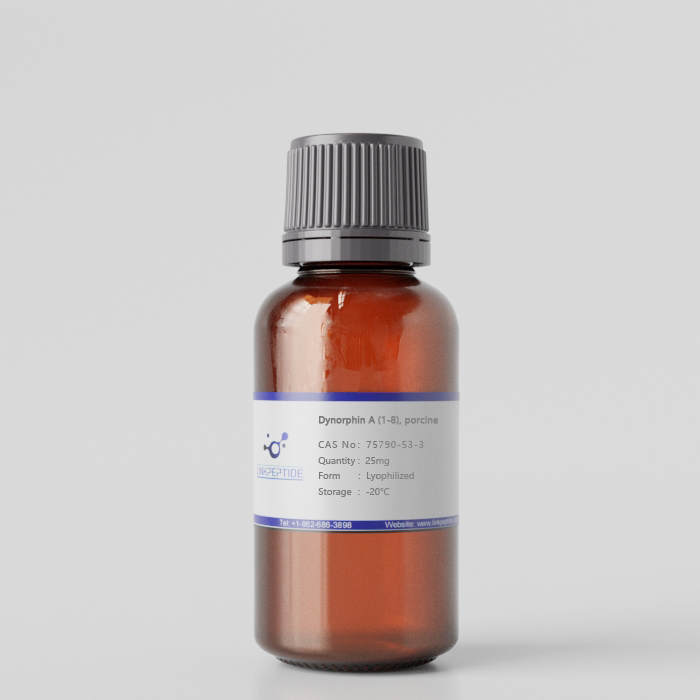
Product Name: Dynorphin A (1-8), porcine
Sequence One Letter Code: YGGFLRRI
Sequence Three Letter Code: H-Tyr-Gly-Gly-Phe-Leu-Arg-Arg-Ile-OH
Cas No: 75790-53-3
Chemical Formula:C46H72N14O10
Molecular Weight: 981.2
Purity: 95%
Form: Lyophilized
Storage Conditions: - 20 °C
Research Area: Neurological Disease Research
SMILES: CC[C@H](C)[C@@H](C(=O)O)NC(=O)C(CCCN=C(N)N)NC(=O)[C@H](CCCN=C(N)N)NC(=O)[C@H](CC(C)C)NC(=O)[C@H](CC1=CC=CC=C1)NC(=O)CNC(=O)CNC(=O)[C@H](CC2=CC=C(C=C2)O)N
IUPAC: (2S,3S)-2-[[2-[[(2S)-2-[[(2S)-2-[[(2S)-2-[[2-[[2-[[(2S)-2-amino-3-(4-hydroxyphenyl)propanoyl]amino]acetyl]amino]acetyl]amino]-3-phenylpropanoyl]amino]-4-methylpentanoyl]amino]-5-(diaminomethylideneamino)pentanoyl]amino]-5-(diaminomethylideneamino)pentanoyl]amino]-3-methylpentanoic acid
INCHIKEY: WRPLGMBDXVBPEG-ZFBBIHQWSA-N
INCHI:
InChI=1S/C46H72N14O10/c1-5-27(4)38(44(69)70)60-41(66)33(14-10-20-53-46(50)51)57-40(65)32(13-9-19-52-45(48)49)58-42(67)34(21-26(2)3)59-43(68)35(23-28-11-7-6-8-12-28)56-37(63)25-54-36(62)24-55-39(64)31(47)22-29-15-17-30(61)18-16-29/h6-8,11-12,15-18,26-27,31-35,38,61H,5,9-10,13-14,19-25,47H2,1-4H3,(H,54,62)(H,55,64)(H,56,63)(H,57,65)(H,58,67)(H,59,68)(H,60,66)(H,69,70)(H4,48,49,52)(H4,50,51,53)/t27-,31-,32-,33?,34-,35-,38-/m0/s1
Source / Species: porcine
Conjugation: Unconjugated
Code Nacres: NA.26
Application: Dynorphin A (1–8), porcine, is a biologically active N-terminal fragment derived from the prodynorphin precursor via proprotein convertase 2 processing. As an endogenous opioid peptide, it preferentially activates the κ-opioid receptor (KOR), a G protein–coupled receptor involved in neuromodulatory signaling. This peptide is widely used in neuroscience and pharmacology research to investigate mechanisms of pain modulation, stress adaptation, addiction pathways, and appetite regulation, serving as a valuable tool for studying KOR-mediated signal transduction and opioid peptide biology. Current Research: Dynorphin A (1–8), porcine is a biologically active N-terminal fragment of the endogenous opioid peptide dynorphin A, generated from the prodynorphin precursor through proteolytic processing by proprotein convertase 2. This octapeptide retains the core opioid pharmacophore required for receptor activation and exhibits preferential agonist activity at the κ-opioid receptor (KOR), a Gi/o-coupled G protein–coupled receptor (GPCR) widely expressed in the central and peripheral nervous systems. As a truncated yet functionally potent fragment, Dynorphin A (1–8) is extensively used in neuroscience, pain research, and opioid pharmacology to dissect κ-opioid receptor signaling and endogenous opioid system regulation. Biological and Pharmacological Context Dynorphins constitute a major class of endogenous opioid peptides, alongside enkephalins and endorphins. The N-terminal region of dynorphin A contains the conserved Tyr-Gly-Gly-Phe motif characteristic of opioid receptor–binding peptides. The (1–8) fragment preserves sufficient structural determinants to activate KOR with high efficacy. Activation of KOR leads to: Inhibition of adenylyl cyclase activity Reduction of intracellular cAMP levels Opening of GIRK (G protein–gated inwardly rectifying potassium) channels Inhibition of voltage-gated calcium channels Modulation of MAPK signaling pathways These intracellular events mediate downstream neuromodulatory and behavioral effects. Functional Applications 1. Pain Modulation Studies KOR activation produces antinociceptive effects in various experimental models. Dynorphin A (1–8) is used to evaluate spinal and supraspinal mechanisms of pain regulation, including inflammatory and neuropathic pain paradigms. 2. Stress and Affective Regulation The dynorphin–KOR system plays a key role in stress responsiveness and dysphoric states. This peptide is applied in studies examining stress adaptation, hypothalamic signaling, and behavioral responses to acute or chronic stress. 3. Addiction and Reward Pathways KOR signaling modulates dopaminergic transmission in mesolimbic circuits. Dynorphin A (1–8) is used to investigate mechanisms underlying substance use disorders, reward processing, and stress-induced relapse. 4. Appetite and Neuroendocrine Control Dynorphin peptides influence feeding behavior and hypothalamic regulation. The (1–8) fragment supports mechanistic studies of appetite modulation and metabolic signaling. 5. Receptor Signaling and Pharmacological Profiling In vitro systems expressing KOR utilize Dynorphin A (1–8) to characterize: Receptor activation potency β-arrestin recruitment Desensitization and internalization Ligand bias and signaling selectivity Advantages of the (1–8) Fragment Retains opioid receptor–binding core Smaller size facilitates synthesis and experimental handling Suitable for receptor binding and functional assays Enables focused study of κ-opioid receptor–mediated mechanisms Experimental Considerations Peptide activity may be influenced by buffer composition and proteolytic degradation in biological systems; appropriate controls and storage conditions are recommended. Comparative testing with full-length dynorphin A can help delineate differences in potency or signaling bias.
Get a Quote
 LinkPeptide