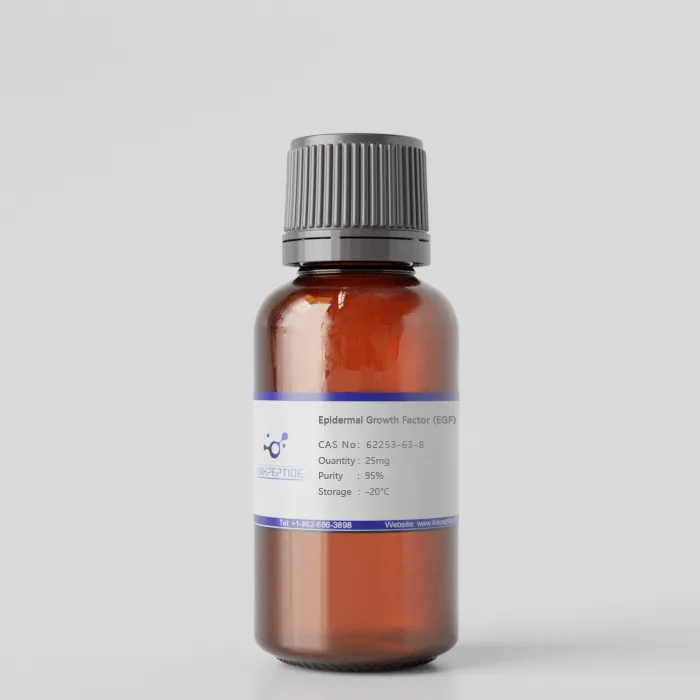
Product Name: Epidermal Growth Factor (EGF)
Cas No: 62253-63-8
Purity: 95%
Storage: Keep in dark and cool dry place -5~8 degree Celsius
Sequence: Recombinant protein (53AA)
Molar Mass: 6222
Chemical Formula: C270H401N73O83S7
IUPAC Name: (4S)-5-[[(2S)-1-[[(2R)-1-[[(2S)-5-amino-1-[[(2S)-1-[[(2S)-1-[[(2S)-1-[[(2S)-1-[[(2S)-6-amino-1-[[(2S)-1-[[(2S)-1-[[(2S)-1-[[(2S)-1-[[(1S)-4-carbamimidamido-1-carboxybutyl]amino]-4-methyl-1-oxopentan-2-yl]amino]-4-carboxy-1-oxobutan-2-yl]amino]-3-(1H-indol-3-yl)-1-oxopropan-2-yl]amino]-3-(1H-indol-3-yl)-1-oxopropan-2-yl]amino]-1-oxohexan-2-yl]amino]-4-methyl-1-oxopentan-2-yl]amino]-3-carboxy-1-oxopropan-2-yl]amino]-5-carbamimidamido-1-oxopentan-2-yl]amino]-3-(4-hydroxyphenyl)-1-oxopropan-2-yl]amino]-1,5-dioxopentan-2-yl]amino]-1-oxo-3-sulfanylpropan-2-yl]amino]-5-carbamimidamido-1-oxopentan-2-yl]amino]-4-[[2-[[(2S,3S)-2-[[(2S)-2-[[2-[[(2S)-2-[[(2S)-2-[[(2R)-2-[[(2S)-4-amino-2-[[(2R)-2-[[(2S)-2-[[(2S)-2-[[(2S)-6-amino-2-[[(2S)-3-carboxy-2-[[(2S)-2-[[(2S)-2-[[(2S)-4-carboxy-2-[[(2S,3S)-2-[[(2S)-2-[[(2S)-2-[[(2R)-2-[[(2S)-2-[[2-[[(2S)-3-carboxy-2-[[(2S)-2-[[(2S)-2-[[(2R)-2-[[(2S)-2-[[2-[[(2S)-3-carboxy-2-[[(2S)-2-[[(2S)-2-[[(2S)-2-[[(2S)-1-[(2R)-2-[[(2S)-4-carboxy-2-[[(2S)-2-[[(2S)-3-carboxy-2-[[(2S)-2-[[(2S)-2,4-diamino-4-oxobutanoyl]amino]-3-hydroxypropanoyl]amino]propanoyl]amino]-3-hydroxypropanoyl]amino]butanoyl]amino]-3-sulfanylpropanoyl]pyrrolidine-2-carbonyl]amino]-4-methylpentanoyl]amino]-3-hydroxypropanoyl]amino]-3-(1H-imidazol-5-yl)propanoyl]amino]propanoyl]amino]acetyl]amino]-3-(4-hydroxyphenyl)propanoyl]amino]-3-sulfanylpropanoyl]amino]-4-methylpentanoyl]amino]-3-(1H-imidazol-5-yl)propanoyl]amino]propanoyl]amino]acetyl]amino]-3-methylbutanoyl]amino]-3-sulfanylpropanoyl]amino]-4-methylsulfanylbutanoyl]amino]-3-(4-hydroxyphenyl)propanoyl]amino]-3-methylpentanoyl]amino]butanoyl]amino]propanoyl]amino]-4-methylpentanoyl]amino]propanoyl]amino]hexanoyl]amino]-3-(4-hydroxyphenyl)propanoyl]amino]propanoyl]amino]-3-sulfanylpropanoyl]amino]-4-oxobutanoyl]amino]-3-sulfanylpropanoyl]amino]-3-methylbutanoyl]amino]-3-methylbutanoyl]amino]acetyl]amino]-3-(4-hydroxyphenyl)propanoyl]amino]-3-methylpentanoyl]amino]acetyl]amino]-5-oxopentanoic acid
SMILES: CC[C@H](C)[C@@H](C(=O)NCC(=O)N[C@@H](CCC(=O)O)C(=O)N[C@@H](CCCNC(=N)N)C(=O)N[C@@H](CS)C(=O)N[C@@H](CCC(=O)N)C(=O)N[C@@H](CC1=CC=C(C=C1)O)C(=O)N[C@@H](CCCNC(=N)N)C(=O)N[C@@H](CC(=O)O)C(=O)N[C@@H](CC(C)C)C(=O)N[C@@H](CCCCN)C(=O)N[C@@H](CC2=CNC3=CC=CC=C32)C(=O)N[C@@H](CC4=CNC5=CC=CC=C54)C(=O)N[C@@H](CCC(=O)O)C(=O)N[C@@H](CC(C)C)C(=O)N[C@@H](CCCNC(=N)N)C(=O)O)NC(=O)[C@H](CC6=CC=C(C=C6)O)NC(=O)CNC(=O)[C@H](C(C)C)NC(=O)[C@H](C(C)C)NC(=O)[C@H](CS)NC(=O)[C@H](CC(=O)N)NC(=O)[C@H](CS)NC(=O)[C@H](C)NC(=O)[C@H](CC7=CC=C(C=C7)O)NC(=O)[C@H](CCCCN)NC(=O)[C@H](CC(=O)O)NC(=O)[C@H](CC(C)C)NC(=O)[C@H](C)NC(=O)[C@H](CCC(=O)O)NC(=O)[C@H]([C@@H](C)CC)NC(=O)[C@H](CC8=CC=C(C=C8)O)NC(=O)[C@H](CCSC)NC(=O)[C@H](CS)NC(=O)[C@H](C(C)C)NC(=O)CNC(=O)[C@H](CC(=O)O)NC(=O)[C@H](CC9=CN=CN9)NC(=O)[C@H](CC(C)C)NC(=O)[C@H](CS)NC(=O)[C@H](CC1=CC=C(C=C1)O)NC(=O)CNC(=O)[C@H](CC(=O)O)NC(=O)[C@H](CC1=CN=CN1)NC(=O)[C@H](CO)NC(=O)[C@H](CC(C)C)NC(=O)[C@@H]1CCCN1C(=O)[C@H](CS)NC(=O)[C@H](CCC(=O)O)NC(=O)[C@H](CO)NC(=O)[C@H](CC(=O)O)NC(=O)[C@H](CO)NC(=O)[C@H](CC(=O)N)N
InChIKey: GVUGOAYIVIDWIO-UFWWTJHBSA-N
InChI: InChI=1S/C270H401N73O83S7/c1-24-134(19)217(262(420)293-112-201(355)298-161(69-74-205(359)360)229(387)301-160(45-35-82-286-269(279)280)228(386)333-192(119-428)255(413)307-162(68-73-198(274)352)230(388)316-176(94-141-54-64-150(350)65-55-141)241(399)304-159(44-34-81-285-268(277)278)227(385)325-186(105-212(373)374)248(406)313-169(87-127(5)6)235(393)302-158(43-31-33-80-272)226(384)318-179(97-144-108-289-156-41-29-27-39-153(144)156)243(401)319-178(96-143-107-288-155-40-28-26-38-152(143)155)242(400)305-164(71-76-207(363)364)231(389)312-170(88-128(7)8)236(394)310-167(267(425)426)46-36-83-287-270(281)282)341-250(408)174(92-139-50-60-148(348)61-51-139)300-203(357)113-292-261(419)214(131(13)14)340-264(422)216(133(17)18)339-259(417)195(122-431)335-246(404)182(101-200(276)354)322-257(415)191(118-427)332-220(378)137(22)297-234(392)175(93-140-52-62-149(349)63-53-140)315-225(383)157(42-30-32-79-271)303-247(405)185(104-211(371)372)326-237(395)168(86-126(3)4)311-219(377)136(21)296-224(382)163(70-75-206(361)362)309-265(423)218(135(20)25-2)342-251(409)177(95-142-56-66-151(351)67-57-142)317-233(391)166(78-85-433-23)308-256(414)194(121-430)336-263(421)215(132(15)16)338-204(358)114-291-223(381)184(103-210(369)370)323-244(402)180(98-145-109-283-124-294-145)320-238(396)171(89-129(9)10)314-258(416)193(120-429)334-240(398)173(91-138-48-58-147(347)59-49-138)299-202(356)111-290-222(380)183(102-209(367)368)324-245(403)181(99-146-110-284-125-295-146)321-254(412)190(117-346)330-239(397)172(90-130(11)12)328-260(418)197-47-37-84-343(197)266(424)196(123-432)337-232(390)165(72-77-208(365)366)306-252(410)189(116-345)331-249(407)187(106-213(375)376)327-253(411)188(115-344)329-221(379)154(273)100-199(275)353/h26-29,38-41,48-67,107-110,124-137,154,157-197,214-218,288-289,344-351,427-432H,24-25,30-37,42-47,68-106,111-123,271-273H2,1-23H3,(H2,274,352)(H2,275,353)(H2,276,354)(H,283,294)(H,284,295)(H,290,380)(H,291,381)(H,292,419)(H,293,420)(H,296,382)(H,297,392)(H,298,355)(H,299,356)(H,300,357)(H,301,387)(H,302,393)(H,303,405)(H,304,399)(H,305,400)(H,306,410)(H,307,413)(H,308,414)(H,309,423)(H,310,394)(H,311,377)(H,312,389)(H,313,406)(H,314,416)(H,315,383)(H,316,388)(H,317,391)(H,318,384)(H,319,401)(H,320,396)(H,321,412)(H,322,415)(H,323,402)(H,324,403)(H,325,385)(H,326,395)(H,327,411)(H,328,418)(H,329,379)(H,330,397)(H,331,407)(H,332,378)(H,333,386)(H,334,398)(H,335,404)(H,336,421)(H,337,390)(H,338,358)(H,339,417)(H,340,422)(H,341,408)(H,342,409)(H,359,360)(H,361,362)(H,363,364)(H,365,366)(H,367,368)(H,369,370)(H,371,372)(H,373,374)(H,375,376)(H,425,426)(H4,277,278,285)(H4,279,280,286)(H4,281,282,287)/t134-,135-,136-,137-,154-,157-,158-,159-,160-,161-,162-,163-,164-,165-,166-,167-,168-,169-,170-,171-,172-,173-,174-,175-,176-,177-,178-,179-,180-,181-,182-,183-,184-,185-,186-,187-,188-,189-,190-,191-,192-,193-,194-,195-,196-,197-,214-,215-,216-,217-,218-/m0/s1
Application:
Epidermal Growth Factor (EGF) is a bioactive polypeptide renowned for its ability to support skin renewal, firmness, and visible rejuvenation. By interacting with epidermal receptors, EGF helps promote natural regenerative processes, encouraging smoother texture and improved elasticity. In cosmetic research, it is widely used to explore reduced appearance of fine lines, enhanced skin density, and overall revitalization. Its high potency at low concentrations makes it ideal for premium serums, ampoules, and advanced anti-aging formulations targeting dullness, thinning skin, and early to advanced signs of aging. EGF delivers a targeted approach to achieving a firmer, youthful-looking complexion.
Current Research:
Epidermal Growth Factor (EGF): Research Overview
Epidermal Growth Factor (EGF) is a polypeptide growth factor originally identified as a regulator of epithelial tissue development and regeneration. Human EGF is a 53–amino acid protein containing three intramolecular disulfide bonds that stabilize its compact tertiary structure. In skin research, EGF is primarily studied for its role in keratinocyte and fibroblast signaling, regulation of epidermal proliferation and differentiation, and extracellular matrix remodeling in the dermis.
EGF exerts its biological effects by binding to the Epidermal Growth Factor Receptor (EGFR), a transmembrane receptor tyrosine kinase expressed on keratinocytes, fibroblasts, and various other cell types. Ligand binding induces receptor dimerization and autophosphorylation of intracellular tyrosine residues, which then recruit downstream signaling molecules.
Major signaling cascades activated by EGF–EGFR interaction include:
RAS–RAF–MEK–ERK (MAPK) pathway: regulates cell proliferation, differentiation, and survival.
PI3K–Akt pathway: contributes to cell survival, metabolism, and resistance to stress.
JAK–STAT pathway: modulates gene transcription related to growth and repair.
PLCγ–PKC pathway: influences calcium signaling and cytoskeletal organization.
The net effect in skin models is enhanced cellular proliferation, migration, and modulation of gene expression profiles involved in tissue repair and matrix turnover.
Keratinocytes in the basal and suprabasal layers of the epidermis express functional EGFR. In vitro studies show that EGF:
Stimulates keratinocyte proliferation, increasing cell numbers in monolayer and reconstructed-epidermis models.
Enhances keratinocyte migration, which is critical for re-epithelialization in wounded or disrupted epidermis.
Modulates differentiation markers, including keratins, involucrin, and filaggrin, in a dose- and context-dependent manner.
These effects are central to epidermal regeneration and maintenance of barrier integrity. EGF exposure is associated with faster closure of artificial wounds in scratch assays and improved organization of the stratified epithelium in organotypic cultures.
Dermal fibroblasts also respond to EGF signaling. Observed effects in cell and tissue models include:
Increased fibroblast proliferation and metabolic activity.
Stimulated synthesis of extracellular matrix components such as collagen type I, collagen type III, and fibronectin.
Regulation of matrix metalloproteinases (MMPs) and their inhibitors (TIMPs), affecting matrix degradation and remodeling.
Through these mechanisms, EGF contributes to matrix renewal and dermal remodeling, supporting structural integrity and mechanical properties of the skin. In ex vivo skin models, EGF-treated samples often show denser collagen networks and improved dermal–epidermal junction morphology.
EGF is a widely studied factor in cutaneous wound-healing research. Key roles documented in experimental models include:
Promotion of early keratinocyte migration over the wound bed.
Stimulation of fibroblast proliferation and granulation tissue formation.
Enhancement of angiogenic signaling via cross-talk with other growth factors such as VEGF.
These processes collectively accelerate re-epithelialization and matrix deposition in preclinical systems. In cosmetic science, this knowledge is used to support interest in EGF as a regeneration-associated growth factor for skin subjected to environmental stress or procedural disruption, while remaining within non-therapeutic, appearance-focused framing.
With chronological and photo-induced aging, epidermal turnover slows and dermal matrix organization deteriorates. EGF-related pathways intersect with several aging-relevant processes:
Support of basal keratinocyte proliferation, contributing to maintenance of epidermal thickness.
Stimulation of collagen and fibronectin synthesis, with potential to counteract dermal thinning in model systems.
Modulation of MMP/TIMP balance, which can influence collagen fragmentation.
In in vitro and ex vivo aging models, EGF supplementation is associated with improved structural markers, smoother epidermal–dermal interfaces, and normalized expression of repair-related genes.
For cosmetic and research applications, EGF is produced recombinantly, typically in microbial, yeast, or plant-based expression systems, yielding a sequence-identical or highly similar protein to human EGF. As a relatively large and structurally sensitive peptide:
EGF is susceptible to denaturation and proteolysis, requiring controlled pH, temperature, and minimal oxidative stress.
Stabilization strategies include inclusion of antioxidants, chelators, and protein-stabilizing excipients, as well as lyophilization.
Topical penetration is limited by molecular size; research explores encapsulation (liposomes, polymeric particles), microemulsions, and targeted delivery systems to increase access to viable epidermal layers.
These formulation aspects are critical for preserving bioactivity and enabling interaction with EGFR in cutaneous tissues.
In cosmetic contexts, EGF is used at low concentrations and framed as a skin-conditioning and regenerating ingredient. Non-clinical data generally characterize EGF as non-mutagenic and non-irritating at cosmetic-use levels, though its potent biological activity requires careful dose control and appropriate product claims restricted to appearance and wellbeing of the skin.
Overall, Epidermal Growth Factor is defined in skin research as a key epithelial and fibroblast growth factor acting via EGFR and downstream signaling pathways to regulate proliferation, migration, differentiation, and extracellular matrix remodeling—mechanisms that underpin epidermal homeostasis, dermal structure, and regeneration-associated processes in cutaneous models.
Get a Quote
 LinkPeptide