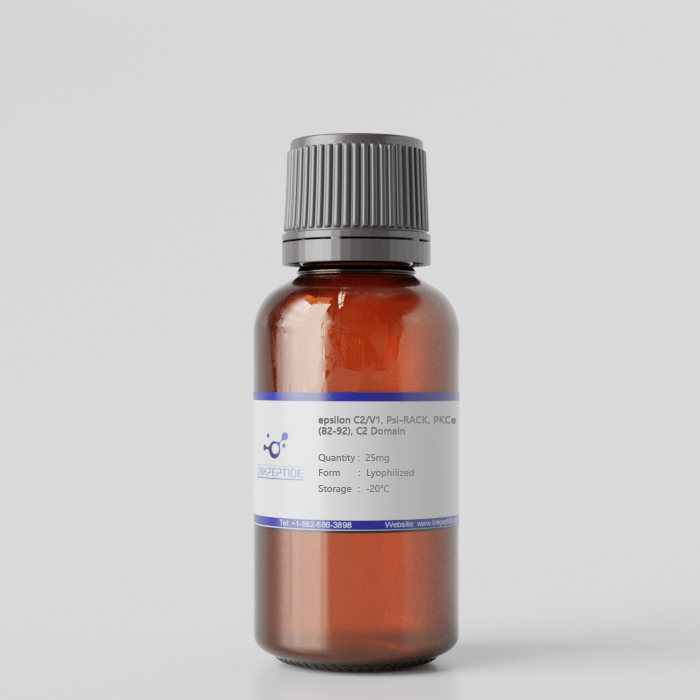
Product Name: epsilon C2/V1, Psi-RACK, PKCe (82-92), C2 Domain
Sequence One Letter Code: HDAPIGYD
Sequence Three Letter Code: H-His-Asp-Ala-Pro-Ile-Gly-Tyr-Asp-OH
Chemical Formula:C39H54N10O14
Molecular Weight: 887
Purity: 95%
Form: Lyophilized
Storage Conditions: - 20 °C
Research Area: Cancer Disease Research
Source / Species: Human, mouse, rat, bovine, zebrafish
Conjugation: Unconjugated
Code Nacres: NA.26
Application: εC2/V1 (Psi-RACK) is a peptide derived from residues 82–92 of the C2 domain of protein kinase C epsilon (PKCε). It functions as a selective activator by mimicking PKCε interaction with its receptor for activated C kinase (RACK). The peptide promotes PKCε signaling and induces phosphorylation of downstream targets such as MARCKS in wild-type but not PKCε-deficient cells. εC2/V1 is widely used to investigate PKCε-specific pathways involved in cell survival, differentiation, and stress responses. It provides a targeted tool for dissecting isoform-selective PKC signaling mechanisms.
Current Research: Protein kinase C epsilon (PKCε) is a member of the novel PKC (nPKC) subfamily and plays a central role in regulating cellular processes such as proliferation, differentiation, cytoskeletal remodeling, and stress adaptation. Like other PKC isoforms, PKCε activity depends not only on catalytic activation but also on precise subcellular localization mediated by scaffold proteins known as receptors for activated C kinase (RACKs). The interaction between PKCε and its cognate RACK is critical for directing the kinase to specific intracellular compartments where it phosphorylates defined substrates. εC2/V1, also referred to as Ψ-RACK (pseudo-RACK), is a synthetic peptide derived from residues 82–92 of the C2 domain of PKCε that selectively enhances PKCε signaling by mimicking this anchoring interaction. The Ψ-RACK concept is based on the observation that PKC isoforms contain intramolecular sequences resembling their corresponding RACK-binding domains. In the inactive state, these internal pseudosubstrate-like regions help maintain the kinase in a constrained conformation. The εC2/V1 peptide replicates a portion of the PKCε C2 domain that participates in RACK binding. By acting as a molecular surrogate for the endogenous anchoring interface, εC2/V1 promotes PKCε translocation to its physiological targets, thereby facilitating selective activation of PKCε-dependent pathways. Importantly, εC2/V1 does not broadly activate other PKC isoforms, underscoring its isoform selectivity. Experimental studies have shown that treatment with εC2/V1 induces phosphorylation of established PKC substrates such as myristoylated alanine-rich C kinase substrate (MARCKS) in wild-type cells. In contrast, this phosphorylation response is absent in PKCε-deficient cells, confirming that the peptide’s effects are specifically mediated through PKCε. This genetic validation highlights the peptide’s utility in dissecting isoform-resolved signaling mechanisms. In cardiovascular biology, PKCε has been extensively implicated in cardioprotection, particularly in ischemic preconditioning (IPC). Activation and mitochondrial translocation of PKCε contribute to protective signaling cascades that limit infarct size and preserve myocardial function. Application of εC2/V1 in experimental cardiac models has been shown to reproduce protective effects similar to IPC, supporting the concept that targeted PKCε activation is sufficient to initiate cardioprotective signaling. These findings have provided mechanistic clarity regarding the distinct roles of PKC isoforms in cardiac stress responses. Beyond the heart, PKCε regulates cell survival and stress signaling pathways in diverse tissues. It modulates MAPK cascades, Akt signaling, and cytoskeletal organization, influencing apoptosis resistance and cellular adaptation to oxidative or metabolic stress. εC2/V1 serves as a precise pharmacological tool to enhance PKCε signaling in vitro and in vivo without engaging parallel PKC pathways. When conjugated to cell-penetrating sequences, the peptide can be delivered intracellularly, enabling temporal control of activation in cultured cells or animal models. In studies of differentiation and development, PKCε contributes to lineage specification and cytoskeletal dynamics. Use of εC2/V1 allows researchers to selectively augment PKCε activity and monitor downstream transcriptional and structural changes. This approach helps clarify how spatially restricted kinase activation translates into defined cellular outcomes. The peptide is also instrumental in elucidating the importance of subcellular targeting in kinase signaling. Because PKC function depends heavily on localization to membrane compartments, cytoskeletal structures, or organelles, mimicking RACK engagement provides insight into how compartmentalization dictates substrate specificity and signaling fidelity. εC2/V1 thus enables separation of activation-dependent and localization-dependent aspects of PKCε regulation. In summary, εC2/V1 (Ψ-RACK) is a selective PKCε-activating peptide derived from the C2 domain that mimics RACK-mediated anchoring. By promoting PKCε translocation and downstream substrate phosphorylation in an isoform-specific manner, it provides a targeted strategy for studying PKCε-dependent pathways. Widely used in cardiovascular, cellular stress, and differentiation research, εC2/V1 remains a valuable tool for dissecting isoform-selective PKC signaling mechanisms and their physiological consequences.
Get a Quote
 LinkPeptide