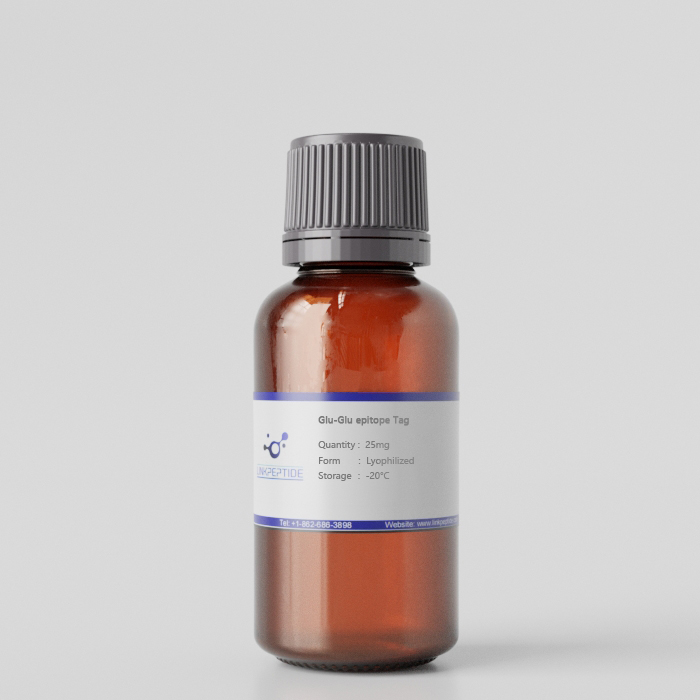
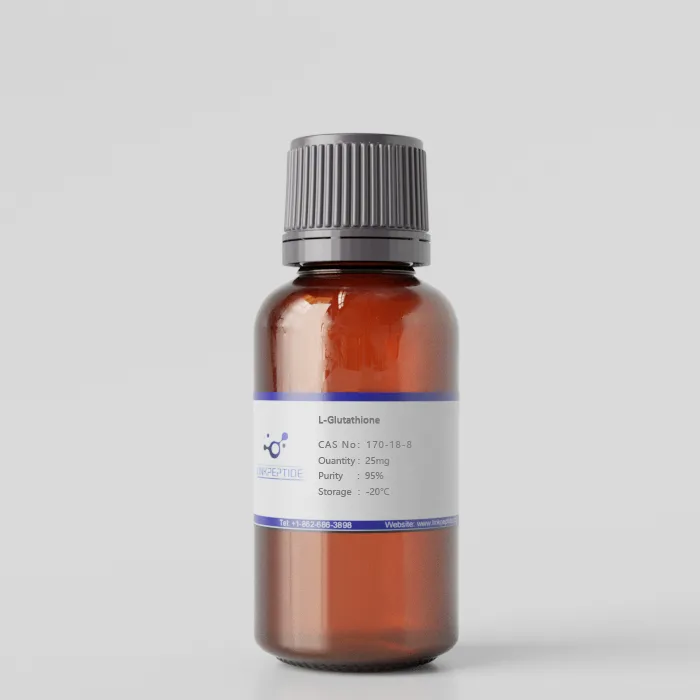
Product Name: Glu-Glu epitope Tag
Sequence One Letter Code: EYMPME
Sequence Three Letter Code: H-Glu-Tyr-Met-Pro-Met-Glu-OH
Chemical Formula:C34H50N6O12S2
Molecular Weight: 799
Purity: 95%
Form: Lyophilized
Storage Conditions: - 20 °C
Research Area: Peptide Series
Source / Species: Synthetic construct
Conjugation: Unconjugated
Code Nacres: NA.26
Application: Glu-Glu Epitope Tag Peptide corresponds to amino acids 314–319 of the middle T antigen from mouse polyomavirus and represents a widely used short acidic epitope tag for recombinant protein detection and purification. The Glu-Glu tag can be specifically recognized by anti-Glu-Glu monoclonal antibodies, enabling efficient detection of tagged proteins in immunoblotting, immunofluorescence microscopy, immunoprecipitation, and affinity-based assays. Because of its small size and minimal structural interference, the tag is commonly fused to recombinant proteins without significantly affecting folding, localization, or biological function. The Glu-Glu epitope system provides a reliable tool for protein expression studies, molecular biology experiments, and antibody-based detection workflows.
Current Research: Epitope tags are widely used in molecular biology to facilitate the detection, purification, and characterization of recombinant proteins. These short peptide sequences can be fused to proteins of interest and recognized by highly specific antibodies, enabling efficient monitoring of protein expression and localization. One such widely used tagging system is the Glu–Glu epitope tag, a short acidic peptide derived from the middle T antigen of mouse polyomavirus. Because of its small size and reliable antibody recognition, the Glu–Glu tag has become a useful tool for protein expression analysis, antibody-based detection assays, and affinity purification workflows. Origin and Sequence of the Glu–Glu Tag The Glu–Glu epitope tag corresponds to amino acids 314–319 of the middle T antigen protein from mouse polyomavirus. This region contains a short sequence enriched in glutamic acid residues, giving the tag a highly acidic character. The sequence is commonly referred to as the Glu–Glu tag because of the presence of consecutive glutamate residues that form the key antibody recognition motif. When fused to a recombinant protein, this short peptide can be detected by specific anti–Glu–Glu monoclonal antibodies, enabling precise identification of the tagged protein. Because the tag is only a few amino acids long, it typically has minimal impact on the structure or function of the fusion protein. Advantages of Small Epitope Tags Small peptide tags such as the Glu–Glu epitope are widely used because they provide several advantages in recombinant protein studies: Minimal structural interference with protein folding or function Low risk of disrupting protein localization within cells Efficient antibody recognition for sensitive detection Flexibility for N-terminal or C-terminal fusion Compared with larger protein tags, short epitope tags are less likely to alter the biological properties of the protein being studied. This makes them particularly useful when researchers need to monitor proteins without affecting their native activity. Antibody Recognition and Detection A key feature of the Glu–Glu tagging system is its specific recognition by monoclonal anti–Glu–Glu antibodies. These antibodies bind the epitope with high specificity, allowing researchers to detect tagged proteins in a variety of experimental formats. Common detection techniques include: Western blotting (immunoblotting) Tagged proteins can be identified after electrophoretic separation using anti–Glu–Glu antibodies and chemiluminescent or fluorescent detection systems. Immunofluorescence microscopy The tag allows visualization of protein localization in cells or tissues when detected with fluorescently labeled antibodies. Immunoprecipitation Anti–Glu–Glu antibodies can be used to isolate tagged proteins from cell lysates for further biochemical analysis. These methods make the Glu–Glu tag useful for studying protein expression, localization, and interactions. Applications in Recombinant Protein Studies The Glu–Glu epitope tag is widely used in recombinant protein expression systems. Researchers commonly introduce the tag into plasmid constructs so that the expressed protein contains the epitope sequence at either the N-terminus or C-terminus. Once expressed, the tagged protein can be easily detected using anti–Glu–Glu antibodies. This approach allows scientists to: Confirm successful protein expression in cells Analyze protein stability and abundance Study intracellular localization of recombinant proteins Because the tag is small and generally does not disrupt protein activity, it is well suited for experiments that require preservation of native protein function. Use in Affinity-Based Assays Beyond simple detection, the Glu–Glu tag can also be used in affinity-based experimental systems. Antibody-coated beads or columns can capture tagged proteins, enabling purification or enrichment from complex biological samples. This strategy is commonly applied in experiments examining: Protein–protein interactions Complex formation and signaling pathways Post-translational modifications of proteins By isolating tagged proteins and their interacting partners, researchers can better understand how proteins function within cellular networks. Supporting Molecular Biology Workflows Epitope tagging remains an essential technique in modern molecular and cellular biology. The Glu–Glu epitope tag peptide, derived from the polyomavirus middle T antigen, provides a compact and reliable tag that can be detected with high specificity by monoclonal antibodies. Through its compatibility with immunoblotting, immunofluorescence microscopy, immunoprecipitation, and affinity purification assays, the Glu–Glu tagging system continues to support studies of protein expression, localization, and molecular interactions. Its small size and minimal structural impact make it a practical option for researchers investigating recombinant protein function in a wide range of experimental systems.
Get a Quote
 LinkPeptide