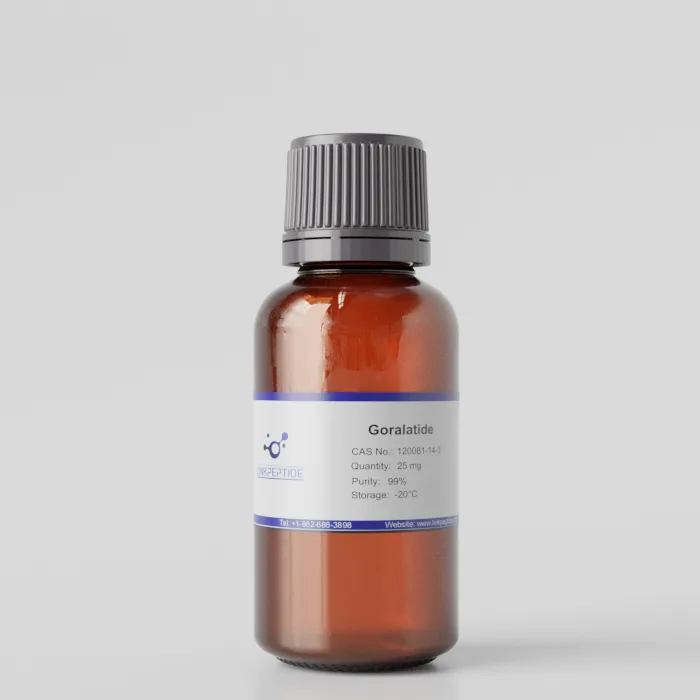
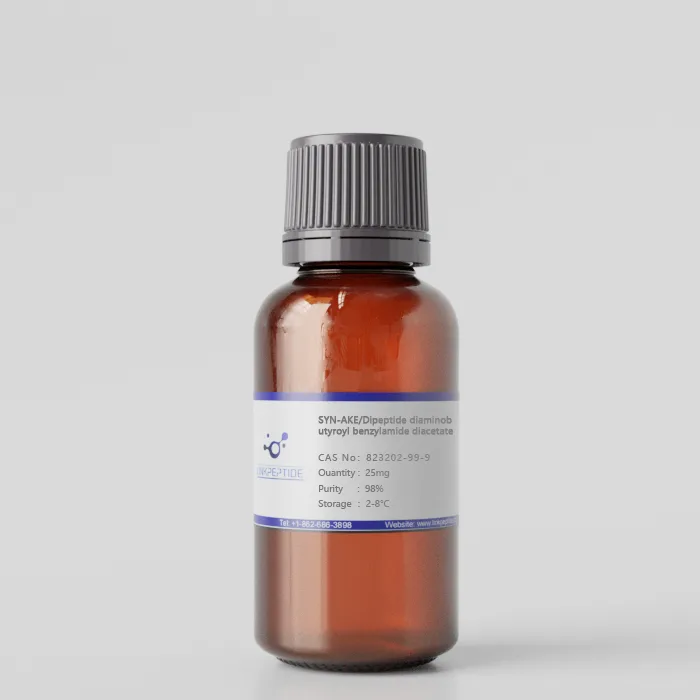
Product Name: Goralatide
Cas No: 120081-14-3
Purity: 99%
Form: Acetate Salt
Chemical Formula: C20H33N5O9
Molar Mass: 487.51
Synonyms: Ac-Ser-Asp-Lys-Pro; AcSDKP
IUPAC Name: (2S)-1-[(2S)-2-[[(2S)-2-[[(2S)-2-acetamido-3-hydroxypropanoyl]amino]-3-carboxypropanoyl]amino]-6-aminohexanoyl]pyrrolidine-2-carboxylic acid
SMILES: CC(=O)NC@@HC(=O)NC@@HC(=O)NC@@HC(=O)N1CCC[C@H]1C(=O)O
InChIKey: HJDRXEQUFWLOGJ-AJNGGQMLSA-N
InChI: InChI=1S/C20H33N5O9/c1-11(27)22-14(10-26)18(31)24-13(9-16(28)29)17(30)23-12(5-2-3-7-21)19(32)25-8-4-6-15(25)20(33)34/h12-15,26H,2-10,21H2,1H3,(H,22,27)(H,23,30)(H,24,31)(H,28,29)(H,33,34)/t12-,13-,14-,15-/m0/s1
Storage: -20 degree Celsius
Sequence: SDKP
Application:
Acetyl Tetrapeptide-1 (Ac-SDKP) is a biomimetic tetrapeptide known for its powerful soothing, barrier-supporting, and restorative skin benefits. Its sequence—Ser-Asp-Lys-Pro—helps reinforce the skin’s natural defense system while reducing visible redness and environmental stress. Ac-SDKP is widely used in calming, anti-pollution, and barrier-repair formulas, making it ideal for sensitive, reactive, or compromised skin. It also supports balanced extracellular matrix activity, contributing to smoother, healthier-looking skin over time. With excellent compatibility in serums, essences, and lightweight emulsions, Acetyl Tetrapeptide-1 provides formulators with a reliable, high-performance peptide for modern “skin resilience” and “skin immunity” concepts.
Current Research:
Goralatide (Ac-SDKP / N-Acetyl-Ser-Asp-Lys-Pro) – Current Research Overview
Goralatide is the pharmacological name for the endogenous tetrapeptide N-Acetyl-Ser-Asp-Lys-Pro (Ac-SDKP), a short peptide released from its precursor thymosin β4. It has been studied for decades as a physiological regulator of hematopoiesis, inflammation, and fibrosis. In basic and preclinical research, Goralatide is recognized for its ability to modulate hematopoietic stem cell cycling, protect tissues from excessive fibrotic remodeling, and fine-tune inflammatory responses. These properties make it a versatile research tool and an attractive candidate scaffold for therapeutic and dermato-cosmetic applications.
In vivo, Goralatide is generated by the sequential processing of thymosin β4. Proline oligopeptidase cleaves thymosin β4 to release the N-terminal tetrapeptide Ac-SDKP. This peptide is widely distributed at low nanomolar concentrations in blood and tissues. Its main route of degradation is through angiotensin-converting enzyme (ACE), which hydrolyzes Ac-SDKP into inactive fragments. As a result, ACE inhibition (for example, in cardiovascular therapy) leads to elevated Goralatide levels, which is thought to contribute to some of the anti-fibrotic effects observed in organs such as the heart and kidneys.
Pharmacokinetic studies indicate that, after intravenous administration, Goralatide is cleared rapidly with a plasma half-life on the order of a few minutes, via ACE-mediated degradation and renal filtration. Despite this short half-life, repeated or continuous exposure can produce sustained biological effects on cell populations and tissue remodeling.
One of the earliest characterized functions of Goralatide is its role as a physiological regulator of hematopoietic stem and progenitor cells. In vitro and in vivo studies show that Goralatide inhibits the entry of primitive hematopoietic stem cells into the S-phase of the cell cycle, keeping them in a quiescent G0 state. This selective cell-cycle inhibition is especially pronounced under conditions of stress or hyperthermia.
These properties have been exploited in experimental “hyperthermic purging” protocols, where Goralatide helps protect early hematopoietic progenitors from damage while allowing more differentiated, proliferative cells (including certain leukemic blasts) to be preferentially eliminated. This selective protection has made Goralatide an interesting tool for leukemia research and bone-marrow transplantation strategies.
Beyond the bone marrow, extensive research has focused on the anti-fibrotic activity of Goralatide in organs such as the heart, kidney, and lung. In multiple models of cardiac and renal injury, administration of Goralatide reduces collagen accumulation, limits myofibroblast differentiation, and improves overall organ structure and function. Mechanistically, it downregulates pro-fibrotic signaling pathways, including those driven by TGF-β, and modulates transcription factors and cytoskeletal regulators involved in fibroblast activation.
In lung and other tissues, Goralatide has been shown to interfere with epithelial–mesenchymal transition and myofibroblast formation, again aligning with its role as an anti-fibrotic, tissue-protective peptide. These effects are subtle and regulatory rather than dramatically cytotoxic, reinforcing its profile as a homeostatic modulator rather than a classic drug-like inhibitor.
Goralatide also influences inflammatory responses and microcirculatory health. Studies indicate that it can reduce the production of key pro-inflammatory cytokines, limit leukocyte infiltration, and preserve endothelial integrity under stress conditions. In ischemia–reperfusion and other injury models, treatment with Goralatide improves capillary density, reduces tissue edema, and enhances recovery of function.
These combined anti-inflammatory and microvascular effects complement its anti-fibrotic action: Goralatide not only prevents pathological matrix buildup but also helps maintain healthy perfusion and attenuates the chronic, low-grade inflammation that drives progressive tissue damage.
Although most mechanistic work on Goralatide comes from cardiovascular, renal, and hematopoietic fields, the same core themes—fibrosis, inflammation, microcirculation, and stem/progenitor cell behavior—are highly relevant to skin. In a dermato-cosmetic context, Goralatide (as Ac-SDKP / Acetyl Tetrapeptide-1) is used as a biomimetic soothing and barrier-supporting peptide, leveraging:
Its ability to modulate low-grade inflammation (“inflammaging”).
Its anti-fibrotic bias, which conceptually helps limit micro-scarring and stiffness in the dermis.
Its protective influence on microvasculature, tied to more even tone and healthier-looking skin.
These features support applications in sensitive-skin products, post-procedure recovery care, and long-term anti-aging routines where controlling chronic inflammation and subtle fibrosis is at least as important as directly stimulating collagen.
Goralatide, as an endogenous peptide, is generally regarded as having a favorable safety profile at experimental and cosmetic use levels, with minimal toxicity observed in preclinical systems. Key research directions now include:
Detailed mapping of its signaling pathways in different cell types, including dermal fibroblasts and keratinocytes.
Clarifying its interactions with ACE and other peptidases in skin and local tissues.
Exploring combination strategies with collagen-stimulating peptides, growth factors, or retinoid-like actives to create “protect and rebuild” therapeutic or cosmetic regimens.
Overall, Goralatide stands out as a multifunctional regulatory tetrapeptide with well-documented roles in hematopoiesis, fibrosis control, and inflammation, and growing interest as a science-backed active for next-generation protective and reparative skincare.
Reference:
Get a Quote
 LinkPeptide