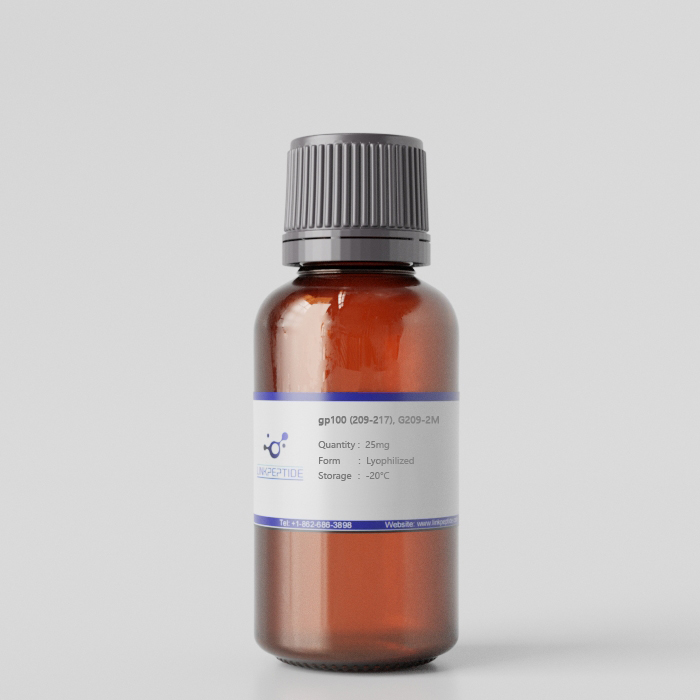
Product Name: gp100 (209-217), G209-2M
Sequence One Letter Code: IMDQVPFSV
Sequence Three Letter Code: H-Ile-Met-Asp-Gln-Val-Pro-Phe-Ser-Val-OH
Chemical Formula:C47H74N10O14S
Molecular Weight: 1035.3
Purity: 95%
Form: Lyophilized
Storage Conditions: - 20 °C
Research Area: Cancer Immunotherapy
Source / Species: human
Conjugation: Unconjugated
Code Nacres: NA.26
Application: gp100 (209–217), G209-2M is a modified HLA-A2.1–restricted melanoma-associated peptide derived from the gp100 tumor antigen. Substitution of threonine with methionine at position 2 enhances binding affinity to HLA-A2.1, resulting in improved peptide–MHC stability and augmented cytotoxic T lymphocyte activation. This optimized epitope can be processed and recognized by antigen-specific T cells and is widely used in tumor immunology research. The peptide supports investigations into antigen presentation, T cell receptor recognition, immune monitoring, and peptide-based cancer vaccine development. It provides a well-characterized model antigen for studying immune responses against melanoma and evaluating immunotherapeutic strategies.
Current Research: gp100 (209–217), G209-2M is a modified melanoma-associated peptide derived from the human gp100 (PMEL17) tumor antigen and restricted by HLA-A*0201 (HLA-A2.1). The native gp100 (209–217) epitope is recognized by cytotoxic CD8⁺ T lymphocytes in melanoma patients; however, its immunogenicity is limited by moderate binding affinity to HLA-A2.1. The G209-2M variant incorporates a substitution of threonine with methionine at position 2, a key anchor residue for HLA-A2 binding. This modification enhances peptide–MHC stability and increases surface presentation efficiency. Position 2 is critical for anchoring peptides within the B pocket of the HLA-A2.1 binding groove. Methionine, as a preferred anchor residue, improves binding affinity compared to threonine. The result is a more stable peptide–MHC complex with prolonged half-life on the cell surface, thereby enhancing T cell receptor (TCR) engagement and downstream activation. Importantly, T cells primed with the modified G209-2M peptide can cross-recognize the native gp100 epitope presented on melanoma cells, making it an effective immunogenic analog for therapeutic research. Functionally, gp100 (209–217), G209-2M induces robust CD8⁺ T cell responses characterized by proliferation, interferon-γ production, and cytolytic activity. It is commonly used in peptide stimulation assays, ELISPOT analysis, intracellular cytokine staining, and HLA-A2 tetramer-based immune monitoring. Because of its enhanced immunogenicity, it serves as a benchmark epitope in studies evaluating antigen-specific T cell expansion and effector function. In tumor immunology, G209-2M has been incorporated into peptide-based cancer vaccine strategies designed to overcome tolerance to self-antigens. The optimized anchor residue promotes stronger initial priming of naïve T cells while maintaining recognition of tumor-expressed native gp100. Clinical and preclinical studies have employed this peptide in combination with adjuvants, cytokines (e.g., IL-2), dendritic cell vaccines, and immune checkpoint blockade to evaluate synergistic antitumor responses. The peptide is also widely used in adoptive T cell therapy research. T cells engineered with TCRs specific for gp100 epitopes are tested for recognition of HLA-A2⁺ melanoma targets, and the G209-2M variant facilitates in vitro expansion and functional characterization of these antigen-specific T cell populations. Detailed analyses of TCR affinity, avidity, and cross-reactivity are often performed using this optimized epitope. Additionally, gp100 (209–217), G209-2M supports mechanistic studies of antigen processing and presentation. Researchers examine how proteasomal cleavage, TAP transport, and peptide editing influence presentation of native versus modified sequences. Structural studies of peptide–HLA complexes further clarify how anchor modifications enhance binding stability without disrupting TCR recognition. Overall, gp100 (209–217), G209-2M is a well-characterized, HLA-A2.1–restricted melanoma epitope optimized for improved MHC binding and T cell activation. Its defined immunological properties make it a valuable model antigen for studying tumor antigen presentation, cytotoxic T lymphocyte responses, immune monitoring methodologies, and peptide-based immunotherapeutic strategies targeting melanoma.
Get a Quote
 LinkPeptide