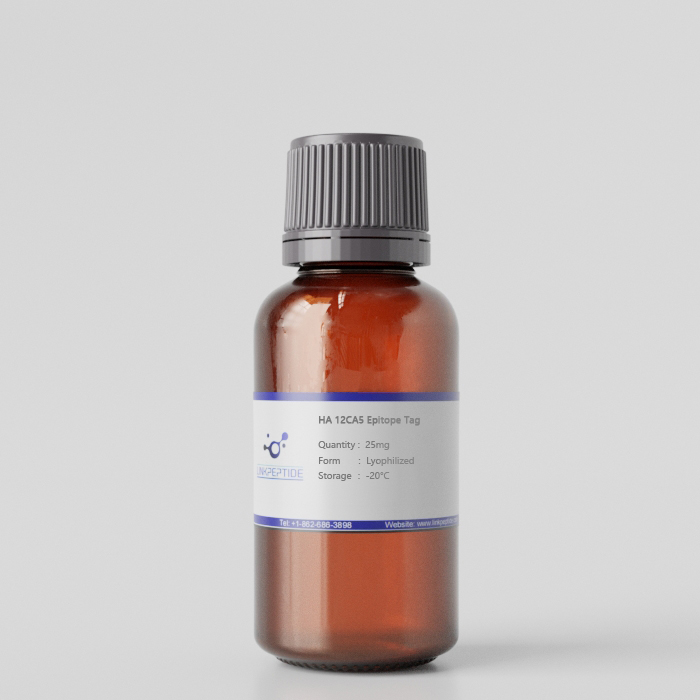
Product Name: HA 12CA5 Epitope Tag
Sequence One Letter Code: CYPYDVPDYA
Sequence Three Letter Code: H-Cys-Tyr-Pro-Tyr-Asp-Val-Pro-Asp-Tyr-Ala-OH
Chemical Formula:C56H72N10O18S1
Molecular Weight: 1205.4
Purity: 95%
Form: Lyophilized
Storage Conditions: - 20 °C
Research Area: Infection Disease Research
Source / Species: Influenza
Conjugation: Unconjugated
Code Nacres: NA.26
Application: HA 12CA5 Epitope Tag is a 10-amino acid peptide derived from the hemagglutinin protein and specifically recognized by the monoclonal antibody 12CA5. Due to its small size and strong antibody affinity, this epitope tag is frequently fused to recombinant proteins for detection and purification. The tag enables immunoblotting, immunoprecipitation, immunofluorescence, and protein localization studies. It is widely used in molecular biology, protein expression systems, and cell biology research to facilitate reliable monitoring of tagged proteins. The HA 12CA5 epitope provides a robust and well-characterized tool for studying protein expression, trafficking, and interaction networks.
Current Research: Epitope tagging is a foundational strategy in molecular and cell biology, enabling sensitive detection and purification of recombinant proteins without the need for protein-specific antibodies. The HA 12CA5 epitope tag is a 10-amino acid peptide derived from the influenza hemagglutinin (HA) protein and is specifically recognized by the monoclonal antibody 12CA5. Owing to its minimal size, strong antibody affinity, and extensive validation across experimental systems, the HA 12CA5 tag remains one of the most widely used peptide tags in recombinant protein research. The canonical HA epitope sequence (YPYDVPDYA) forms the basis for recognition by monoclonal antibody 12CA5. The small size of this tag minimizes the risk of disrupting the structure, folding, or biological activity of the fused protein. It can be introduced at the N-terminus, C-terminus, or within permissive internal regions of a target protein, depending on structural considerations and functional constraints. This flexibility allows researchers to tailor construct design while preserving protein function. One of the principal advantages of the HA 12CA5 epitope is the availability of high-quality monoclonal antibodies with strong specificity and low background. The 12CA5 antibody recognizes the HA sequence with high affinity, enabling sensitive detection in immunoblotting applications. In Western blot assays, HA-tagged proteins can be reliably identified even at low expression levels, supporting quantitative and comparative analyses of recombinant protein expression across experimental conditions. Beyond immunoblotting, the HA 12CA5 tag is extensively employed in immunoprecipitation (IP) and co-immunoprecipitation (co-IP) experiments. Antibody-mediated pull-down of HA-tagged proteins enables isolation of protein complexes from cell lysates, facilitating the study of protein–protein interactions and signaling assemblies. The small size of the tag reduces steric hindrance that might otherwise interfere with complex formation. When coupled with mass spectrometry, HA-based immunoprecipitation serves as a powerful method for mapping interaction networks and identifying novel binding partners. In cell biology applications, the HA 12CA5 epitope supports immunofluorescence and subcellular localization studies. HA-tagged proteins can be visualized using fluorescently labeled secondary antibodies following fixation and permeabilization. This approach allows precise determination of protein localization within cellular compartments, including the nucleus, cytoplasm, plasma membrane, or organelles. Because the tag is well characterized and antibodies are widely standardized, reproducibility across laboratories is high. The HA tag is also compatible with diverse expression systems, including bacterial, yeast, insect, and mammalian cells. Its short sequence is unlikely to interfere with secretion signals, membrane targeting domains, or enzymatic activity when properly positioned. In addition, tandem repeats of the HA epitope can be incorporated to enhance detection sensitivity in cases where expression levels are low or antibody accessibility is limited. In protein trafficking studies, HA tagging enables monitoring of dynamic processes such as membrane insertion, endocytosis, and intracellular transport. Surface-exposed HA tags can be selectively labeled under non-permeabilizing conditions, allowing discrimination between surface-localized and intracellular protein pools. This feature is particularly useful in receptor biology and membrane protein research. The HA 12CA5 epitope also provides advantages in comparative studies where multiple proteins are expressed in parallel. By applying the same antibody detection system, researchers can standardize detection conditions and reduce variability associated with protein-specific antibodies. This consistency improves data interpretation in signaling pathway analyses and expression profiling experiments. In summary, the HA 12CA5 epitope tag is a compact, high-affinity peptide sequence derived from hemagglutinin and specifically recognized by monoclonal antibody 12CA5. Its small size, robust antibody recognition, and compatibility with multiple assay formats make it a versatile tool for protein detection, purification, localization, and interaction studies. As a well-established component of recombinant protein methodology, the HA 12CA5 epitope continues to support precise and reliable investigation of protein expression, trafficking, and cellular function.
Get a Quote
 LinkPeptide