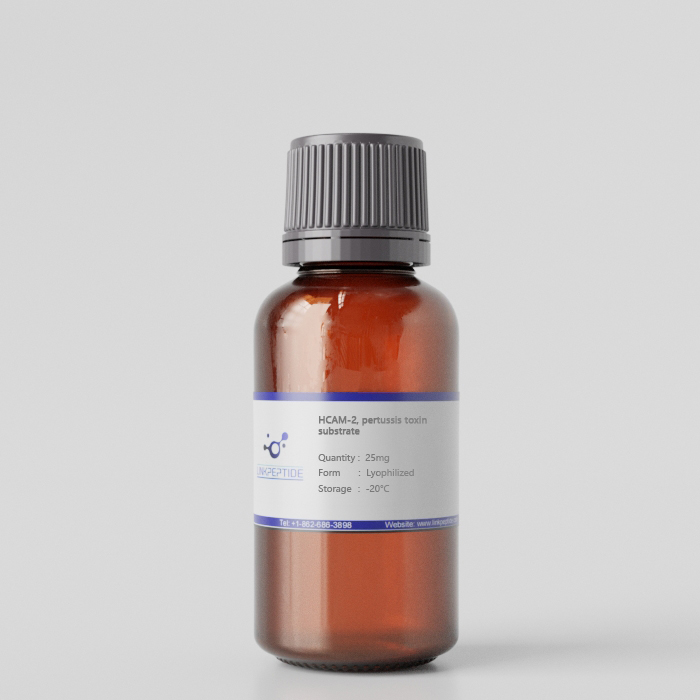
Product Name: HCAM-2, pertussis toxin substrate
Sequence One Letter Code: 6-FAM-VFDAVTDVIIKNNLKECGLY
Sequence Three Letter Code: 6-FAM-Val-Phe-Asp-Ala-Val-Thr-Asp-Val-Ile-Ile-Lys-Asn-Asn-Leu-Lys-Glu-Cys-Gly-Leu-Tyr-OH
Molecular Weight: 2613.1
Purity: 95%
Form: Lyophilized
Storage Conditions: - 20 °C
Research Area: peptide substrate
Source / Species: bacteria (bordetella)
Conjugation: Unconjugated
Code Nacres: NA.26
Application: HCAM-2 Fluorogenic Peptide Substrate is designed for sensitive detection of pertussis toxin (PTx) enzymatic activity in biochemical assays. The peptide is labeled with 6-carboxyfluorescein (6-FAM), allowing fluorescence-based monitoring with excitation/emission maxima of 494/521 nm. Pertussis toxin, produced by Bordetella pertussis, catalyzes ADP-ribosylation of host G-protein substrates, a critical mechanism underlying its pathogenic effects. HCAM-2 provides a convenient and reliable fluorescent readout for studying pertussis toxin activity, enzymatic mechanisms, and inhibitor screening. This substrate is particularly useful in research on bacterial toxins, host–pathogen interactions, toxin neutralization strategies, and vaccine development.
Current Research: Pertussis toxin (PTx), produced by the bacterium Bordetella pertussis, is a major virulence factor responsible for many of the pathological effects associated with whooping cough (pertussis). This toxin disrupts host cell signaling through enzymatic modification of G-protein substrates, altering immune responses and cellular communication. To investigate the biochemical activity of this toxin and evaluate potential inhibitors, researchers rely on sensitive assay systems. The HCAM-2 fluorogenic peptide substrate provides a convenient fluorescence-based tool for detecting pertussis toxin enzymatic activity in biochemical and cellular studies. Pertussis Toxin and Its Biological Function Pertussis toxin belongs to the AB-type bacterial toxin family, composed of a catalytic A subunit and a multimeric B subunit responsible for binding and entry into host cells. Once inside the cell, the catalytic component functions as an ADP-ribosyltransferase, targeting specific heterotrimeric G proteins (Gi/o family) involved in signal transduction. Through ADP-ribosylation of these G proteins, pertussis toxin disrupts normal signaling pathways that regulate processes such as: Immune cell activation Inflammatory signaling Hormone-mediated cellular responses Cellular communication through G protein–coupled receptors (GPCRs) This enzymatic modification prevents proper G-protein interaction with receptors and effector molecules, ultimately altering host immune responses and contributing to disease symptoms. Design of the HCAM-2 Fluorogenic Substrate The HCAM-2 peptide substrate is engineered to enable sensitive detection of pertussis toxin enzymatic activity. The peptide contains a sequence that can serve as a target in assays designed to monitor toxin-mediated biochemical reactions. To facilitate fluorescence-based detection, the peptide is labeled with 6-carboxyfluorescein (6-FAM), a widely used fluorophore with strong emission properties. This fluorescent label allows researchers to monitor substrate processing using standard fluorescence detection systems. The fluorophore exhibits excitation and emission maxima near 494 nm and 521 nm, making it compatible with common fluorescence microscopes, plate readers, and spectrophotometers used in biochemical assays. Fluorescence-Based Detection of Enzymatic Activity In assays using the HCAM-2 substrate, the fluorescent signal serves as a quantitative indicator of pertussis toxin activity. Changes in fluorescence occur as the toxin catalyzes reactions involving the peptide substrate, enabling real-time monitoring of enzymatic processes. This fluorescence-based readout provides several advantages: High sensitivity for detecting low levels of enzymatic activity Quantitative measurement of reaction kinetics Compatibility with microplate-based assays for high-throughput experiments These features make the substrate particularly useful for experiments requiring precise measurement of toxin activity. Applications in Pertussis Toxin Research The HCAM-2 fluorogenic peptide substrate is widely used in laboratory studies aimed at understanding the biochemical properties of pertussis toxin. By providing a straightforward fluorescence readout, the substrate allows researchers to analyze how the toxin interacts with substrates and modifies host proteins. Typical research applications include: Investigating pertussis toxin enzymatic mechanisms Measuring ADP-ribosyltransferase activity in biochemical assays Evaluating mutant toxin variants or structural modifications Studying toxin activity in cellular extracts or purified systems These studies help clarify how the toxin contributes to the pathogenesis of Bordetella pertussis infections. Use in Inhibitor Screening and Therapeutic Research Fluorescent peptide substrates are also valuable for screening compounds that inhibit toxin activity. In these experiments, potential inhibitors are added to reactions containing the toxin and the HCAM-2 substrate. If a compound reduces toxin activity, the fluorescence signal changes accordingly. Such assays support the identification of molecules that may interfere with toxin function, providing insights relevant to therapeutic development and toxin neutralization strategies. Applications in Host–Pathogen Interaction Studies Understanding how bacterial toxins manipulate host signaling pathways is essential for advancing research on infectious diseases. Pertussis toxin plays a major role in altering immune responses during infection, and tools that allow measurement of its enzymatic activity help researchers explore these interactions. Using the HCAM-2 substrate, scientists can examine how toxin activity varies under different experimental conditions, such as changes in cellular environment, presence of immune factors, or exposure to candidate therapeutics. Supporting Vaccine and Infectious Disease Research Research on pertussis toxin also contributes to the development and evaluation of vaccines against Bordetella pertussis. Assays that measure toxin activity are important for studying toxin variants, validating detoxified vaccine components, and analyzing immune responses to pertussis antigens. The HCAM-2 fluorogenic peptide substrate provides a practical and sensitive method for detecting pertussis toxin enzymatic activity. By enabling fluorescence-based monitoring of toxin function, this reagent supports studies of bacterial toxin biology, host–pathogen interactions, inhibitor discovery, and vaccine development.
Get a Quote
 LinkPeptide