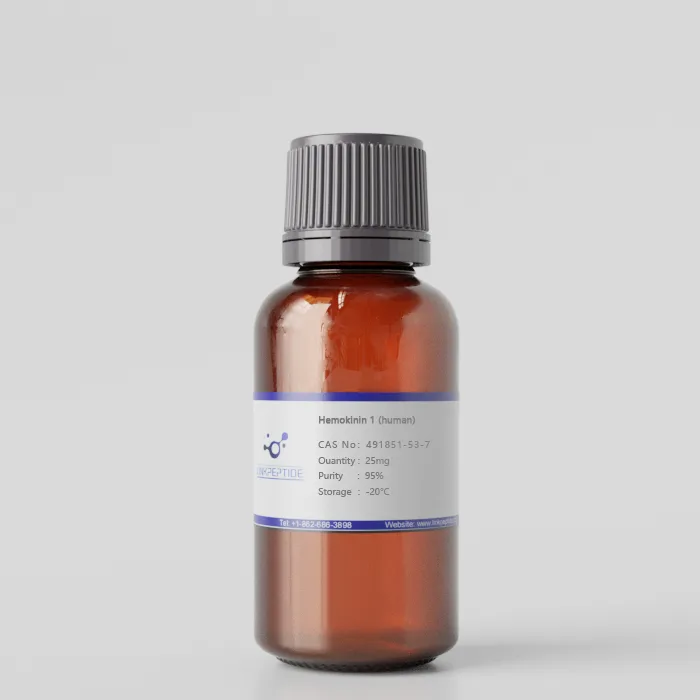
Product Name:Hemokinin 1 (human)
CAS No:491851-53-7
Purity:95%
Molar Mass:1185.4
Chemical Formula:C54H84N14O14S
Storage:Store at -20 degrees Celsius
Sequence:TGKASQFFGLM
Target:NK1
Application:
Hemokinin 1 (human) is a peptide belonging to the tachykinin family, similar to substance P, and plays a significant role in immune regulation and inflammatory responses. It is primarily expressed in hematopoietic cells and is involved in modulating various immune functions, such as cytokine release and immune cell trafficking. Hemokinin 1 interacts with the neurokinin-1 receptor (NK1R), influencing processes like pain perception, stress response, and inflammation. This peptide is valuable in research focused on immune system disorders, inflammatory diseases, and neuroimmune interactions, as it provides insights into therapeutic targets for conditions like asthma, autoimmune diseases, and cancer.
Current Research:
Hemokinin-1 (HK-1) is a member of the tachykinin peptide family, encoded by the TAC4 gene. It shares structural similarities with substance P (SP) and exhibits high affinity for the neurokinin-1 receptor (NK1R), mediating various physiological and pathological processes. Expression and Distribution HK-1 is expressed in multiple human tissues, including the immune system, central nervous system, and respiratory tract. Notably, it is produced by human bronchial cells and lung macrophages, indicating a role in respiratory physiology. Physiological Functions HK-1 is involved in modulating immune responses, inflammation, and nociception. It contributes to pain transmission and stress reactions, similar to SP. Recent studies have shown that HK-1 can induce transcriptomic alterations in pain-related signaling processes in rat primary sensory neurons, independent of NK1R activation. Role in Respiratory System In the respiratory system, HK-1 has been shown to cause contraction of human bronchi, primarily through the activation of NK2 receptors. This suggests its involvement in airway tone regulation and potential implications in respiratory conditions. Involvement in Stress-Induced Pain HK-1 plays a significant role in stress-induced pain mechanisms. Studies using Tac4 gene-deleted mice have demonstrated that HK-1 is a mediator of chronic restraint stress-induced pain, highlighting its importance in stress-related nociceptive processes. Receptor Interactions While HK-1 primarily binds to NK1R, it can also interact with NK2 and NK3 receptors, albeit with lower affinity. Additionally, HK-1 has been shown to activate the Mas-related G protein-coupled receptor X2 (MRGPRX2) on human mast cells, leading to degranulation and contributing to inflammatory responses. Therapeutic Potential Given its involvement in pain modulation, immune response, and inflammation, HK-1 is a potential target for therapeutic interventions in conditions such as chronic pain, stress-related disorders, and respiratory diseases. Further research is needed to fully elucidate its mechanisms and develop targeted treatments.
Reference:
Get a Quote
 LinkPeptide

![[Ala17]-MCH](https://www.linkpeptide.com/wp-content/uploads/2024/08/Ala17-MCH-jpg.webp "[Ala17]-MCH")