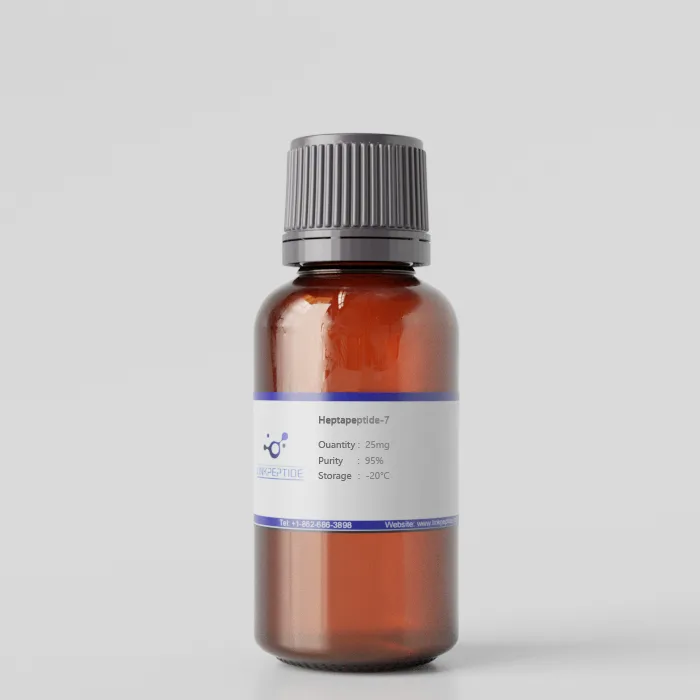
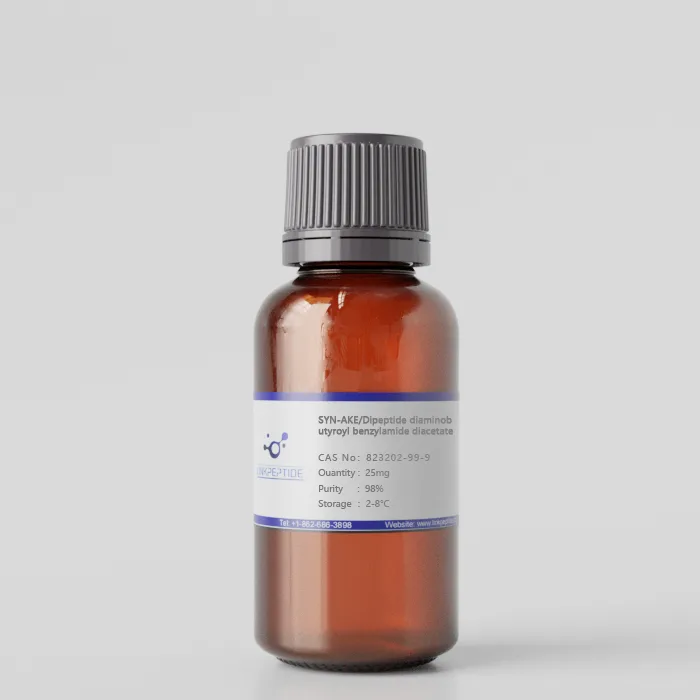
Product Name: Heptapeptide-7
Purity: 95%
Storage: Keep in dark and cool dry place -5~8 degree Celsius
Sequence: Met-Gly-Arg-Asn-Ile-Arg-Asn
Application:
Heptapeptide-7 is a biomimetic seven–amino acid peptide designed to support visible skin regeneration, firmness, and youthful radiance. Known for its ability to promote healthy cellular communication, it helps enhance collagen synthesis, improve elasticity, and refine overall skin texture. In cosmetic research, Heptapeptide-7 is widely used to explore reduced appearance of fine lines, improved resilience, and strengthened skin barrier function. Its excellent stability and compatibility with serums, creams, and advanced anti-aging formulations make it an ideal ingredient for treatments aimed at revitalizing dull, stressed, or aging skin and restoring a smoother, more rejuvenated complexion.
Current Research:
Heptapeptide-7: Current Research Overview
Heptapeptide-7 is a synthetic bioactive peptide positioned as a regeneration-boosting, firming, and DEJ-strengthening ingredient for anti-aging skincare. Chemically, it’s a seven–amino acid sequence (Met–Gly–Arg–Asn–Ile–Arg–Asn) originally derived from a fragment of the well-studied peptide HB-107, which itself is based on the antimicrobial peptide Cecropin B.
HB-107 was developed as a wound-healing peptide: it lacks direct antimicrobial activity but accelerates cutaneous repair by promoting keratinocyte hyperplasia, leukocyte infiltration, and interleukin-8 (IL-8) production in endothelial cells. Heptapeptide-7 captures the regenerative and pro-healing aspects of this parent sequence in a shorter, cosmetically optimized form that is easier to formulate and control.
Heptapeptide-7 appears in ingredient inventories as a synthetic heptapeptide composed of arginine, asparagine, glycine, isoleucine, and methionine, classified functionally as a skin-conditioning active.
Mechanism of Action: DEJ Support + Regeneration
Current in vitro, ex vivo, and supplier data point to two major mechanistic pillars:
Ex vivo and cell-based studies show that Heptapeptide-7:
Promotes keratinocyte proliferation and migration, which supports faster epidermal renewal and repair.
Enhances collagen production by fibroblasts, contributing to improved dermal density and elasticity.
Displays EGF-like activity at the gene expression level, with microarray analyses indicating up-regulation of growth-factor-related genes and extracellular matrix components.
Taken together, these findings position Heptapeptide-7 as a regenerative signal peptide that boosts both epidermal turnover and dermal matrix synthesis. This makes it especially relevant for anti-aging, post-stress, and post-procedure concepts.
More recent positioning emphasizes Heptapeptide-7 as a “DEJ rebuilding peptide”. The dermal–epidermal junction is the anchoring interface between epidermis and dermis; its degradation with age leads to laxity, dullness, and increased wrinkle depth.
Supplier dossiers describe Heptapeptide-7 as:
Targeting the DEJ “bio-rivet” system, reinforcing the connection between the two skin layers.
Stimulating key junction proteins, notably collagen IV, VII, and XVII, which are critical components of the DEJ and anchoring fibrils.
Improving cell adhesion and skin cohesion, helping the epidermis sit more tightly on the dermal foundation.
This DEJ focus supports claims around anti-sagging, firmness, and improved facial contour, particularly for the jawline, neck, and eye area.
Place in Modern Cosmetic Peptide Science
Within the typical peptide classification, Heptapeptide-7 is best described as a regenerative signal peptide with DEJ-structuring properties. It sits at the intersection of:
Wound-healing/repair peptides (via its HB-107 heritage and keratinocyte/fibroblast stimulation),
Matrix-modulating peptides (through increased collagen production), and
Structural/DEJ peptides (via collagen IV/VII/XVII support and improved cohesion).
This gives you a strong, multi-layered scientific story: not just “more collagen”, but better epidermal renewal, stronger dermal anchoring, and improved tissue organization.
Heptapeptide-7 is often framed as a regeneration booster and firming peptide for mature or stressed skin, and complements other actives like classic collagen-signal peptides, hyaluronic-acid boosters, and barrier-support ingredients.
In Vitro, Ex Vivo, and Clinical Data
Available data (primarily from technical dossiers and ingredient guides) highlight:
Ex vivo / in vitro
Increased keratinocyte proliferation and migration, indicating enhanced re-epithelialization and skin renewal.
Elevated collagen synthesis in fibroblasts, supporting anti-wrinkle and firming claims.
Gene expression profiles consistent with EGF-like, pro-growth signaling and up-regulation of extracellular matrix components.
Clinical observations
A reported study on ~30+ women around their mid-50s using a Heptapeptide-7 formulation showed:
Reduction in forehead wrinkle depth,
Improved skin texture and overall skin condition,
Better perceived elasticity and smoothness after several weeks of use.
Formulation performance
Frequently delivered in liposomal or similar encapsulated systems to enhance stability and penetration.
Marketed as effective at relatively low usage levels in serums, creams, and targeted firming products.
As with many cosmetic peptides, most data are small-scale and manufacturer-generated rather than large, independent trials, so claims should be framed appropriately within cosmetic (non-medical) boundaries.
Safety and Regulatory Status
Heptapeptide-7 appears in multiple cosmetic ingredient lists (including recent Japanese and Chinese catalogs) as a permitted skin-conditioning agent. It is a synthetic, non-biological peptide with high purity, used at low concentrations in leave-on formulations. Standard toxicological and irritation/sensitization screenings indicate good tolerability at recommended levels.
Get a Quote
 LinkPeptide