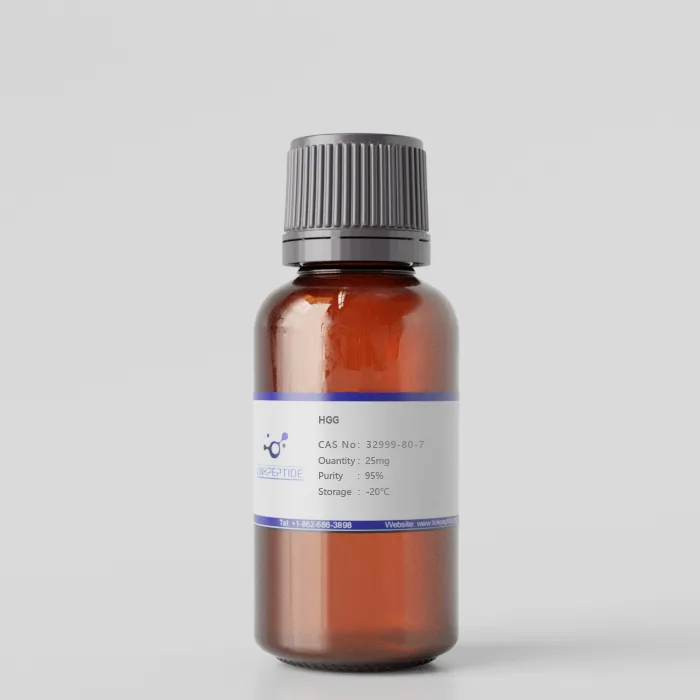
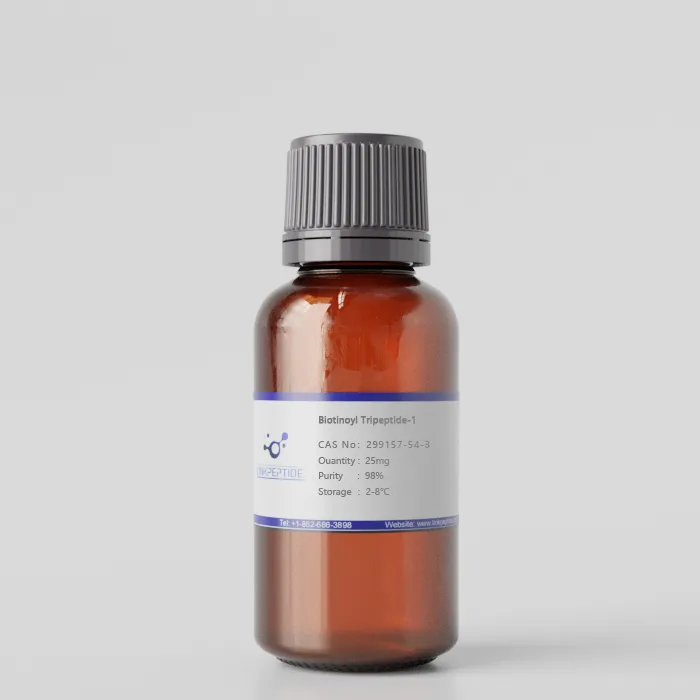
Product Name: HGG
Cas No: 32999-80-7
Purity: 95%
Storage: Keep in dark and cool dry place -5~8 degree Celsius
Sequence: His-Gly-Gly
Molar Mass: 269.26
Chemical Formula: C10H15N5O4
IUPAC Name: 2-[[2-[[(2S)-2-amino-3-(1H-imidazol-5-yl)propanoyl]amino]acetyl]amino]acetic acid
SMILES: C1=C(NC=N1)C[C@@H](C(=O)NCC(=O)NCC(=O)O)N
InChIKey: FDQYIRHBVVUTJF-ZETCQYMHSA-N
InChI: InChI=1S/C10H15N5O4/c11-7(1-6-2-12-5-15-6)10(19)14-3-8(16)13-4-9(17)18/h2,5,7H,1,3-4,11H2,(H,12,15)(H,13,16)(H,14,19)(H,17,18)/t7-/m0/s1
Application:
His-Gly-Gly is a tripeptide composed of histidine and two glycine residues, valued in cosmetic research for its antioxidant and skin-soothing potential. With strong metal-chelating and free radical–scavenging properties, this peptide supports studies exploring protection against environmental stress and oxidative damage. His-Gly-Gly also plays a role in promoting balanced skin tone and maintaining a healthier-looking complexion. Its excellent stability and compatibility with water-based formulations make it suitable for serums, moisturizers, and restorative skincare designed to enhance radiance, reinforce the skin barrier, and improve overall resilience.
Current Research:
His-Gly-Gly: Research Overview
His-Gly-Gly is a naturally occurring tripeptide composed of histidine, glycine, and glycine. It belongs to the family of histidine-containing dipeptides and tripeptides found in biological systems, structurally related to imidazole-based peptides involved in buffering, metal-chelating, and antioxidant processes. Although less widely studied than carnosine (β-Ala-His) or anserine, His-Gly-Gly has specific biochemical properties linked to its imidazole ring, low molecular weight, and flexible glycine-rich backbone.
His-Gly-Gly consists of a histidine residue at the N-terminus followed by two glycine residues. This arrangement results in:
A single imidazole ring capable of proton exchange and metal binding
High conformational flexibility due to the two glycine residues
A molecular weight well below typical diffusion thresholds for topical bioactives
Histidine-containing small peptides serve as intermediates in protein metabolism and participate in cellular antioxidant systems. His-Gly-Gly shows reactivity patterns characteristic of imidazole peptides, enabling interactions with reactive oxygen species (ROS), carbonyl groups, and transition metal ions.
The histidine residue imparts strong radical-scavenging activity, due to:
Proton donation via the imidazole ring
Quenching of singlet oxygen
Scavenging of hydroxyl and peroxyl radicals
Interaction with lipid peroxidation intermediates
In cell-free and cell-based oxidative stress models, histidine-based peptides reduce ROS levels and limit oxidative damage to proteins and lipids. His-Gly-Gly is of interest in studies examining non-enzymatic antioxidant defenses because the imidazole ring can undergo reversible oxidation, acting as a stabilizing redox buffer.
His-Gly-Gly can bind transition metal ions, including copper and iron, which catalyze Fenton-type reactions. Metal chelation reduces formation of highly reactive hydroxyl radicals and moderates oxidative chain reactions in membranes and extracellular matrix structures.
Additionally, histidine-containing peptides interact with reactive carbonyl species (RCS) generated during glycation and lipid peroxidation. This activity is relevant to research on:
Reduction of protein glycation
Modulation of advanced glycation end product (AGE) formation
Protection of long-lived proteins such as collagen from carbonyl-mediated crosslinking
These behaviors position His-Gly-Gly within the broader category of anti-carbonyl stress micro-peptides.
Histidine-containing peptides exhibit a high buffering capacity near physiological pH due to the imidazole group’s pKa (~6.0). His-Gly-Gly contributes to:
Local buffering in microenvironments undergoing shifts in acidity
Stabilization of enzyme activity in pH-sensitive systems
Protection of structural proteins under acidic or oxidative stress
This buffering ability is relevant in cutaneous biology where extracellular acidification occurs during inflammation, barrier impairment, or oxidative stress.
Experimental work on histidine-rich peptides suggests several cytoprotective mechanisms:
Limitation of protein carbonylation under oxidative load
Preservation of mitochondrial membrane potential
Stabilization of proteins against thermal or chemical denaturation
Reduction of oxidative fragmentation of collagen and elastin
His-Gly-Gly’s small size facilitates diffusion into cellular and extracellular compartments where it can interact with reactive species, supporting cellular resilience under stress.
In cosmetic science, interest in His-Gly-Gly aligns with themes including:
Anti-glycation: protecting dermal collagen from AGE-mediated stiffening
Antioxidant defense: supporting intracellular and extracellular redox balance
Environmental-stress protection: mitigating damage from UV-induced oxidative species
Matrix preservation: reducing oxidative and carbonyl stress that accelerate dermal degradation
Although His-Gly-Gly is not as extensively documented as longer peptides like carnosine, its structural features place it within the same biochemical framework relevant to managing oxidative and carbonyl stress in skin models.
His-Gly-Gly is:
Highly water-soluble due to its peptide backbone and charged groups
Extremely low in molecular weight, supporting effective diffusion
Chemically reactive, requiring antioxidant-stabilized environments to prevent autoxidation
Its small size enables use in aqueous serums, gel systems, and encapsulation formats designed to enhance stability and deliver the peptide to deeper layers of the epidermis.
Summary
His-Gly-Gly is a histidine-based tripeptide with activity centered on antioxidant defense, carbonyl-stress reduction, metal chelation, and biochemical buffering. Through these mechanisms, it contributes to protection of cellular components and extracellular matrix proteins in oxidative or glycation-prone environments. Its low molecular weight, imidazole chemistry, and flexible structure make it a relevant micro-peptide for research focused on maintaining protein integrity and resilience in cutaneous systems.
Get a Quote
 LinkPeptide