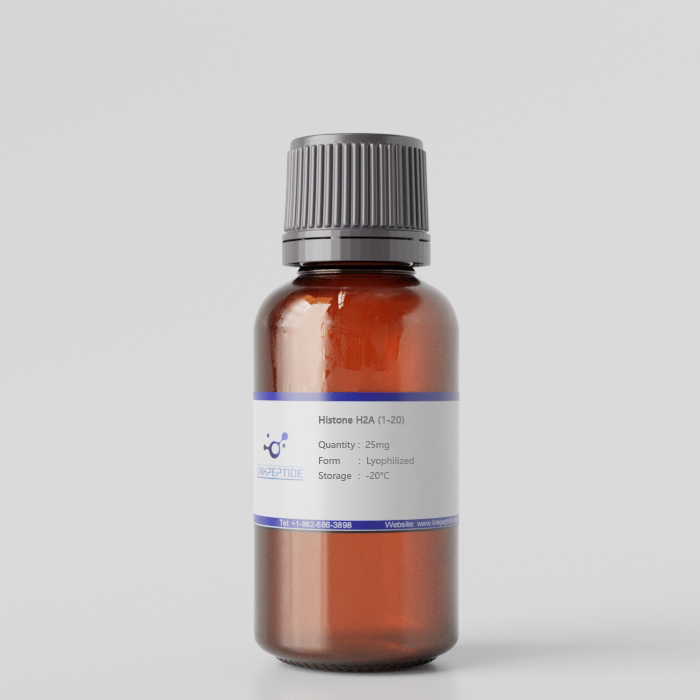
Product Name: Histone H2A (1-20)
Sequence One Letter Code: SGRGKQGGKARAKAKTRSSR
Sequence Three Letter Code: H-Ser-Gly-Arg-Gly-Lys-Gln-Gly-Gly-Lys-Ala-Arg-Ala-Lys-Ala-Lys-Thr-Arg-Ser-Ser-Arg-OH
Chemical Formula:C83H155N37O26
Molecular Weight: 2087.5
Purity: 95%
Form: Lyophilized
Storage Conditions: - 20 °C
Research Area: epigenetics
Source / Species: human
Conjugation: Unconjugated
Code Nacres: NA.26
Application: Histone H2A (1–20) is a synthetic peptide corresponding to the N-terminal region of histone H2A, one of the four core histones that assemble into the nucleosome. The N-terminal tail is accessible for covalent modification and protein interaction, contributing to nucleosome stability and chromatin architecture. Post-translational modifications within this region influence transcriptional regulation and chromatin dynamics. This peptide is suitable for biochemical studies of histone-modifying enzymes, chromatin-binding proteins, and nucleosome-associated regulatory mechanisms. It provides a defined substrate for investigations into epigenetic regulation and histone–protein interaction networks.
Current Research: Chromatin structure and gene expression are governed by complex interactions between DNA and histone proteins. At the core of chromatin organization lies the nucleosome, a structural unit composed of DNA wrapped around an octamer of histone proteins. These histones—H2A, H2B, H3, and H4—contain flexible N-terminal tails that extend outward from the nucleosome and serve as key regulatory platforms for protein interactions and chemical modifications. The Histone H2A (1–20) peptide, representing the first 20 amino acids of the histone H2A N-terminal region, provides a defined model system for studying these regulatory mechanisms in biochemical and epigenetic research. Histone H2A and the Structure of the Nucleosome Histone H2A is one of the four core histones that assemble into the nucleosome, which packages genomic DNA into chromatin. Each nucleosome consists of approximately 147 base pairs of DNA wrapped around a histone octamer containing two copies each of H2A, H2B, H3, and H4. The histone core forms a stable structural scaffold, while the N-terminal tails of histones extend outward from the nucleosome surface. These flexible tails are accessible to numerous regulatory proteins and enzymes. As a result, they play a central role in controlling chromatin structure, nucleosome positioning, and transcriptional accessibility. The N-terminal region of histone H2A participates in interactions that contribute to nucleosome stability and higher-order chromatin organization. Regulatory Role of Histone N-Terminal Tails Histone N-terminal tails are important targets for post-translational modifications (PTMs) such as acetylation, methylation, phosphorylation, and ubiquitination. These modifications act as molecular signals that influence chromatin structure and regulate gene expression. The N-terminal tail of H2A contains residues that can undergo such modifications or participate in interactions with chromatin-associated proteins. Through these mechanisms, the H2A tail contributes to processes including transcriptional regulation, DNA repair, and chromatin remodeling. Because histone modifications can alter the accessibility of DNA to transcription factors and other regulatory proteins, studying histone tail sequences provides insight into the molecular mechanisms that govern epigenetic regulation. The H2A (1–20) Region in Chromatin Dynamics The first 20 amino acids of histone H2A encompass a segment of the N-terminal tail that interacts with both DNA and neighboring nucleosomes. This region contributes to maintaining nucleosome integrity and influences how chromatin fibers are organized within the nucleus. Changes in this region—whether through chemical modification or interaction with regulatory proteins—can affect how tightly DNA is packaged. Such changes influence the balance between condensed chromatin states that repress transcription and relaxed chromatin states that permit gene activation. The H2A (1–20) peptide reproduces this important region in a simplified form, allowing researchers to study these processes without the complexity of the full nucleosome. Applications in Studying Histone-Modifying Enzymes Synthetic histone peptides are frequently used as substrates in biochemical assays that examine histone-modifying enzymes. Enzymes that catalyze modifications of histone tails recognize specific amino acid sequences within these regions. By using a defined peptide representing the H2A N-terminal sequence, researchers can evaluate enzyme activity, determine substrate specificity, and investigate how particular residues influence modification patterns. These experiments contribute to understanding how histone-modifying enzymes regulate chromatin structure and transcriptional activity. Investigating Chromatin-Binding Proteins Histone peptides also provide valuable tools for studying protein–histone interactions. Many chromatin-associated proteins recognize specific histone sequences or modification states, allowing them to bind to particular regions of chromatin. Using the H2A (1–20) peptide, researchers can analyze how proteins interact with the H2A tail and how these interactions influence chromatin regulation. Pull-down assays, binding studies, and structural analyses often rely on such peptides to identify proteins that associate with histone tails. These studies help map histone–protein interaction networks that control chromatin dynamics. Exploring Nucleosome-Associated Regulatory Mechanisms Because histone tails act as hubs for regulatory signaling, peptides derived from these regions are widely used in studies of nucleosome-associated regulatory mechanisms. By isolating a specific histone sequence, researchers can investigate how interactions at that site influence broader chromatin processes. The H2A (1–20) peptide allows scientists to examine how modifications or protein binding events at the H2A tail affect chromatin accessibility and transcriptional control. Such investigations contribute to a deeper understanding of the epigenetic mechanisms that regulate genome function. Conclusion The Histone H2A (1–20) peptide represents a key segment of the H2A N-terminal tail involved in chromatin organization and regulatory signaling. By reproducing this region in a defined synthetic format, the peptide enables controlled studies of histone-modifying enzymes, chromatin-binding proteins, and nucleosome-associated regulatory pathways. Through applications in biochemical assays, interaction studies, and epigenetic research, this peptide provides a valuable tool for exploring how histone tails contribute to chromatin structure and gene regulation.
Get a Quote
 LinkPeptide