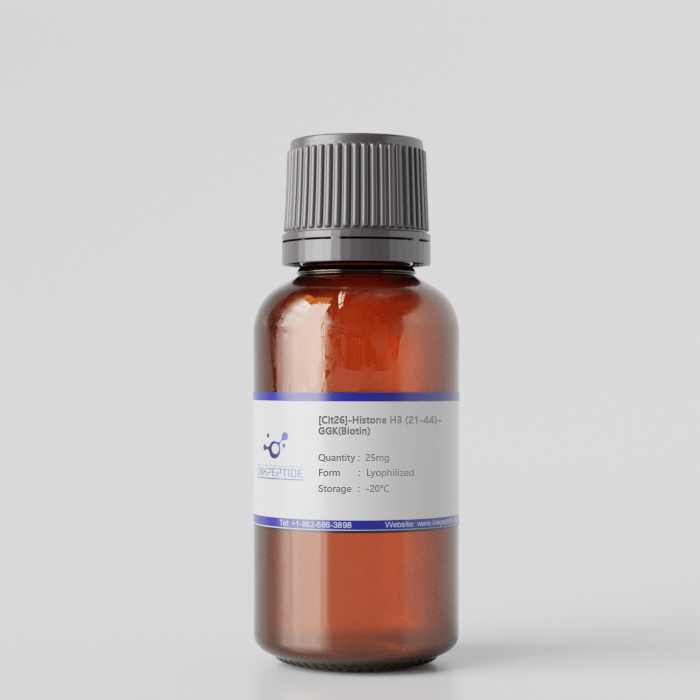
Product Name: Histone H3 (21-44)-GK(Biotin)
Sequence One Letter Code: ATKAARKSAPATGGVKKPHRYRPG-GK(Biotin)
Sequence Three Letter Code: H-Ala-Thr-Lys-Ala-Ala-Arg-Lys-Ser-Ala-Pro-Ala-Thr-Gly-Gly-Val-Lys-Lys-Pro-His-Arg-Tyr-Arg-Pro-Gly-Gly-Lys(Biotin)-OH
Chemical Formula:C127H214N44O33S1
Molecular Weight: 2917.6
Purity: 95%
Form: Lyophilized
Storage Conditions: - 20 °C
Research Area: epigenetics
Source / Species: human
Conjugation: Conjugated
Conjugation Type: Biotins
Code Nacres: NA.26
Application: Histone H3 (21–44)-GK(Biotin) is a synthetic peptide corresponding to residues 21–44 of histone H3, extended with a C-terminal glycine–lysine sequence bearing a biotin modification. This region includes key regulatory sites such as lysine 27 and lysine 36, which are frequently subject to post-translational modifications. The peptide serves as a defined substrate for histone methyltransferase and demethylase assays, enabling precise investigation of epigenetic enzyme activity. The biotin tag facilitates affinity-based capture, detection, and protein interaction studies using streptavidin systems. It is widely used in epigenetics research to study chromatin modification, enzyme specificity, and histone–protein interactions.
Current Research: Histone H3 (21–44)-GK(Biotin) is a synthetic histone-derived peptide encompassing amino acid residues 21–44 of histone H3, extended with a C-terminal glycine–lysine sequence conjugated to biotin. This region of histone H3 contains key regulatory lysine residues, notably K27 and K36, which are central to epigenetic control of gene expression. The combination of biologically relevant sequence elements and an affinity tag makes this peptide a powerful tool for studying chromatin modification and histone–protein interactions. Functional Importance of the H3 (21–44) Region The H3 (21–44) segment includes two critical lysine residues: Lysine 27 (H3K27) – associated with transcriptional repression when methylated (e.g., H3K27me3 via PRC2) Lysine 36 (H3K36) – linked to transcriptional elongation and active chromatin when methylated These residues undergo various post-translational modifications (PTMs), including methylation and acetylation, which regulate: Chromatin accessibility Transcriptional activity Recruitment of chromatin-associated proteins Because this peptide spans both sites, it provides a useful model for studying cross-talk between histone modifications. Biotin Tag and Experimental Utility The addition of a C-terminal GK(Biotin) motif enables strong and specific interaction with streptavidin or avidin, facilitating a wide range of affinity-based applications. Advantages of the biotin modification include: Efficient immobilization on solid supports Selective enrichment of binding partners High-sensitivity detection in biochemical assays Compatibility with pull-down and proteomics workflows Importantly, the biotin tag is positioned to minimize interference with enzymatic modification sites within the peptide. Applications in Enzyme Activity Assays Histone H3 (21–44)-GK(Biotin) serves as a well-defined substrate for studying epigenetic enzyme function, particularly: Histone methyltransferases (HMTs) targeting K27 or K36 Histone demethylases (KDMs) that remove methyl groups Histone acetyltransferases (HATs) and deacetylases (HDACs)** These assays allow researchers to: Measure enzyme activity and substrate specificity Analyze modification patterns at specific lysine residues Investigate regulatory mechanisms of chromatin-modifying enzymes Protein Interaction and Pull-Down Studies The biotinylated peptide is widely used in protein–histone interaction studies. By immobilizing the peptide on streptavidin-coated surfaces or beads, researchers can identify proteins that recognize specific histone regions. Applications include: Pull-down assays to isolate histone-binding proteins Identification of chromatin reader domains (e.g., bromodomains, chromodomains) Mapping interaction networks involved in chromatin regulation Proteomic analysis of histone-associated complexes These studies are essential for understanding how histone modifications are interpreted by cellular machinery. Role in Epigenetics and Chromatin Research Histone modifications at K27 and K36 are key regulators of gene expression programs, development, and disease. This peptide enables controlled investigation of: Polycomb-mediated repression (H3K27-related pathways) Transcription elongation and chromatin organization (H3K36-related pathways) Dynamic regulation of chromatin states Interplay between different histone modifications Such research is critical for elucidating the molecular basis of epigenetic regulation. Applications in Disease and Therapeutic Research Dysregulation of histone modifications is implicated in various diseases, including: Cancer (e.g., altered PRC2 activity, K36 methylation defects) Developmental disorders Epigenetic dysregulation syndromes Histone H3 (21–44)-GK(Biotin) is therefore used in studies aimed at: Characterizing disease-associated epigenetic enzymes Screening inhibitors of histone-modifying enzymes Understanding mechanisms of epigenetic therapy A Powerful Tool for Chromatin Biology Studies Histone H3 (21–44)-GK(Biotin) combines a biologically relevant histone sequence with a versatile affinity tag, making it an indispensable reagent for investigating epigenetic enzyme activity, chromatin interactions, and transcriptional regulation. By enabling precise and controlled analysis of key histone modification sites, this peptide continues to support advances in understanding chromatin dynamics, gene regulation, and epigenetic mechanisms in health and disease.
Get a Quote
 LinkPeptide