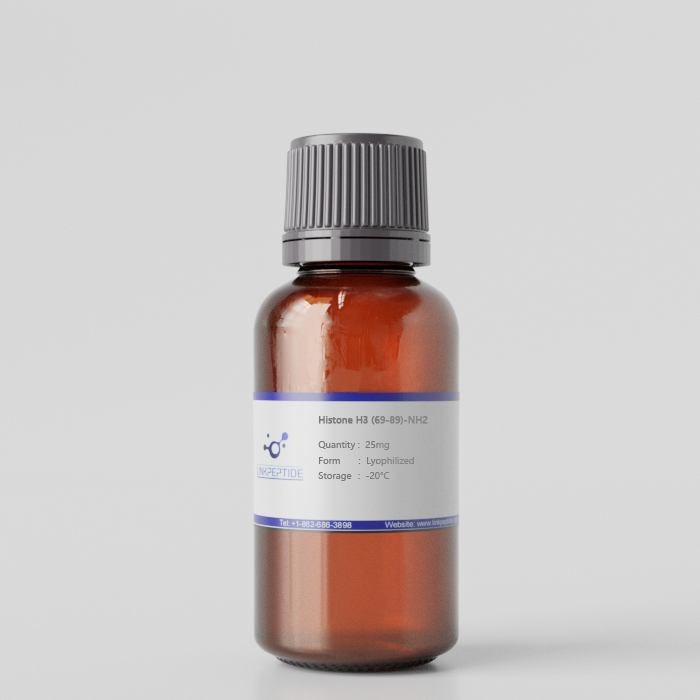
Product Name: Histone H3 (69-89)-NH2
Sequence One Letter Code: RLVREIAQDFKTDLRFQSSAV-NH2
Sequence Three Letter Code: H-Arg-Leu-Val-Arg-Glu-Ile-Ala-Gln-Asp-Phe-Lys-Thr-Asp-Leu-Arg-Phe-Gln-Ser-Ser-Ala-Val-NH2
Chemical Formula:C109H180N34O32
Molecular Weight: 2479
Purity: 95%
Form: Lyophilized
Storage Conditions: - 20 °C
Research Area: Cancer Disease Research
Source / Species: human
Conjugation: Unconjugated
Code Nacres: NA.26
Application: Histone H3 (69–89)-NH₂ is a synthetic peptide spanning residues 69 to 89 of histone H3 and encompasses the region surrounding lysine 79. Methylation of H3K79, catalyzed by DOT1L within nucleosomes, is generally associated with active transcription and has been implicated in leukemogenesis when aberrantly regulated. This peptide is commonly used to evaluate antibody specificity against different H3K79 methylation states and to study modification-dependent protein recognition. It serves as a valuable reagent in chromatin biology, epigenetic profiling, and leukemia-related research, supporting biochemical assays, enzyme characterization, and histone modification analysis.
Current Research: Histone H3 (69–89)-NH₂ is a synthetic peptide corresponding to residues 69–89 of histone H3 and includes lysine 79 (H3K79), a residue located within the globular core domain of the nucleosome rather than the flexible N-terminal tail. The C-terminal amidation (–NH₂) enhances peptide stability and more closely mimics the native backbone environment. This region is of particular interest because methylation of H3K79 represents a distinctive epigenetic modification associated with transcriptional regulation and oncogenic transformation. Unlike many lysine methylation events that occur on histone tails, H3K79 is positioned within the nucleosome core and becomes accessible to enzymatic modification only in the context of assembled chromatin. Methylation at this site is catalyzed exclusively by DOT1L (disruptor of telomeric silencing 1-like), a non-SET domain histone methyltransferase. DOT1L-mediated mono-, di-, and trimethylation of H3K79 is generally enriched in actively transcribed gene bodies and correlates with RNA polymerase II elongation. Current research highlights the importance of H3K79 methylation in hematologic malignancies, particularly mixed-lineage leukemia (MLL)-rearranged leukemias. In these cancers, MLL fusion proteins aberrantly recruit DOT1L to inappropriate genomic loci, resulting in ectopic H3K79 methylation and sustained activation of oncogenic transcriptional programs. This mechanistic insight has led to the development of DOT1L inhibitors as targeted therapeutic agents. The Histone H3 (69–89)-NH₂ peptide supports biochemical studies aimed at characterizing DOT1L activity and inhibitor specificity. Although full enzymatic methylation of H3K79 requires nucleosomal context, synthetic peptides containing the K79 region are widely used in downstream analytical applications. A primary use is validation of antibodies specific for H3K79 methylation states (me1, me2, me3). Because antibody cross-reactivity can compromise chromatin immunoprecipitation (ChIP) and epigenomic profiling data, defined peptides representing unmodified and methylated variants are essential controls in dot blot, ELISA, and competitive binding assays. In protein interaction studies, the H3 (69–89) region serves as a probe for modification-dependent recognition. Although H3K79 methylation does not recruit classical methyl-lysine reader domains in the same manner as H3K4 or H3K27 methylation, emerging evidence suggests that chromatin-associated complexes can respond indirectly to K79 methylation status. The peptide enables in vitro binding assays to assess potential reader interactions or to evaluate how methylation influences local protein association. The unique positioning of H3K79 within the nucleosome core has prompted structural investigations into how methylation alters nucleosome architecture. While isolated peptides do not fully replicate nucleosomal conformation, they are used in comparative binding and competition assays to complement structural studies. Coupled with mass spectrometry, the peptide also assists in calibrating detection methods for K79 methylation states in histone extracts. In leukemia research, the H3 (69–89)-NH₂ peptide supports preclinical evaluation of DOT1L-targeted therapies. Enzyme assays assessing methyltransferase inhibition often employ peptide-based systems for initial screening, even though confirmatory studies require nucleosomal substrates. These assays contribute to understanding catalytic mechanisms and inhibitor binding kinetics. Overall, Histone H3 (69–89)-NH₂ represents a defined segment of the histone core domain encompassing the transcription-associated H3K79 site. It serves as a valuable reagent for antibody validation, modification-state analysis, and biochemical characterization of DOT1L-related epigenetic regulation. Its applications span chromatin biology, transcriptional regulation studies, and mechanistic investigations into leukemogenesis driven by aberrant H3K79 methylation.
Get a Quote
 LinkPeptide