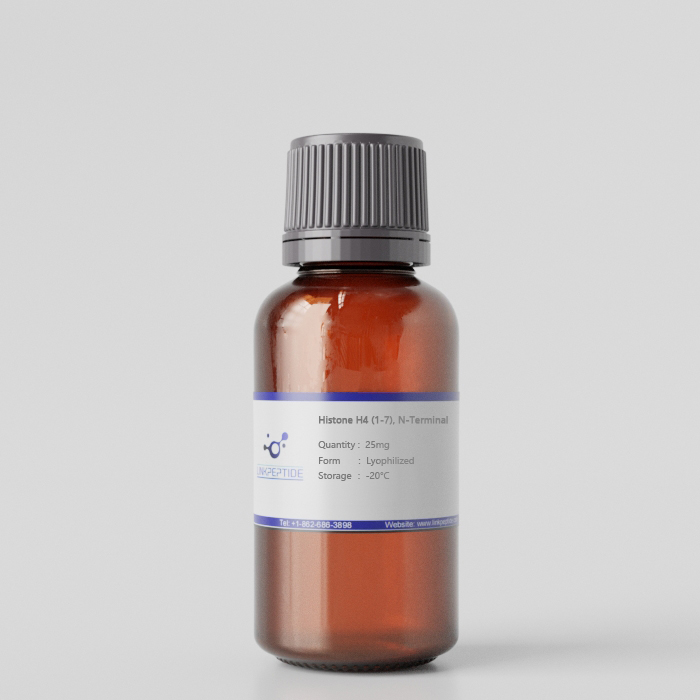
Product Name: Histone H4 (1-7), N-Terminal
Sequence One Letter Code: SGRGKGG
Sequence Three Letter Code: H-Ser-Gly-Arg-Gly-Lys-Gly-Gly-OH
Chemical Formula:C23H43N11O9
Molecular Weight: 617.7
Purity: 95%
Form: Lyophilized
Storage Conditions: - 20 °C
Research Area: epigenetics
Source / Species: human
Conjugation: Unconjugated
Code Nacres: NA.26
Application: Histone H4 (1–7) is a short peptide corresponding to the extreme N-terminal tail of histone H4, a region enriched in regulatory post-translational modification sites. This segment includes lysine residues, such as Lys5, that are frequently targeted by acetyltransferases and other chromatin-modifying enzymes. Modifications within this region influence transcriptional regulation, DNA damage repair, and nucleosome dynamics. The H4 N-terminus contributes to histone–histone interactions and higher-order chromatin structure. This peptide is useful for studying enzyme specificity, chromatin-binding protein interactions, and epigenetic signaling events that act on the earliest residues of histone H4 in biochemical and structural assays.
Current Research: Histone proteins play a central role in organizing genomic DNA into chromatin and regulating gene expression through a variety of post-translational modifications (PTMs). Among the four core histones, histone H4 is particularly important for chromatin structure and regulatory signaling due to its highly conserved N-terminal tail. The extreme N-terminus of H4 contains several lysine residues that are frequently modified by chromatin-modifying enzymes, influencing transcriptional activity and genome stability. The Histone H4 (1–7) peptide, representing the first seven amino acids of the H4 protein, provides a simplified biochemical model for studying these early regulatory events. The Histone H4 N-Terminal Tail in Chromatin Regulation In nucleosomes, DNA wraps around a histone octamer composed of two copies each of histones H2A, H2B, H3, and H4. While the histone core maintains structural integrity, the flexible N-terminal tails extend outward from the nucleosome surface and serve as accessible platforms for regulatory modifications. The N-terminal region of histone H4 is one of the most extensively modified histone tails. Lysine residues within this region can undergo acetylation, methylation, and other chemical modifications that influence chromatin organization and gene expression. These modifications help determine whether chromatin adopts a condensed state that restricts transcription or a more open configuration that allows transcriptional machinery to access DNA. The peptide corresponding to residues 1–7 of histone H4 represents the very beginning of this regulatory tail and includes lysine residues that play critical roles in chromatin signaling. Lysine 5 and Early Histone Modification Events Within the H4 (1–7) segment lies lysine 5 (K5), one of the most well-studied acetylation sites on histone H4. Acetylation of lysine residues is catalyzed by histone acetyltransferases (HATs), enzymes that transfer acetyl groups from acetyl-CoA to histone tails. Acetylation neutralizes the positive charge of lysine side chains, reducing electrostatic interactions between histones and DNA. This process promotes a more relaxed chromatin structure that facilitates transcriptional activation. In addition to altering chromatin structure directly, acetylated lysines can be recognized by bromodomain-containing proteins, which recruit transcriptional regulators and chromatin remodeling complexes. Because K5 acetylation is one of the earliest modifications introduced during histone processing and chromatin assembly, the H4 N-terminus is often used to study enzyme specificity and modification dynamics. Role in Chromatin Structure and Histone Interactions Beyond serving as a substrate for enzymatic modification, the N-terminal tail of histone H4 also contributes to histone–histone interactions that stabilize nucleosome architecture. The tail participates in contacts between neighboring nucleosomes, helping organize higher-order chromatin structures. These interactions influence chromatin compaction and accessibility, which in turn affect transcription, DNA replication, and repair processes. Even short segments of the H4 tail can provide insight into how histone tails contribute to chromatin organization. By isolating the first seven residues of histone H4, researchers can examine how modifications or protein binding events affect these structural interactions. Applications in Enzyme Specificity Studies The H4 (1–7) peptide serves as a useful substrate in biochemical assays designed to investigate the activity of chromatin-modifying enzymes. Because the peptide contains lysine residues targeted by acetyltransferases and other modifying enzymes, it can be used to evaluate enzyme substrate specificity and catalytic activity. Short peptides offer several advantages in such studies. They provide a simplified system that eliminates complications arising from the full nucleosome structure while preserving the key sequence elements recognized by enzymes. Researchers can therefore focus on how individual residues influence enzyme recognition and modification patterns. Studying Chromatin-Binding Protein Interactions In addition to enzymatic assays, histone peptides are frequently used to analyze interactions between histone tails and chromatin-binding proteins. Many regulatory proteins recognize specific sequences or modification states within histone tails. Using a defined H4 (1–7) peptide allows researchers to examine how proteins interact with the earliest residues of histone H4 and how these interactions influence downstream chromatin signaling pathways. These studies contribute to understanding how chromatin readers interpret histone tail sequences and recruit regulatory complexes that control gene expression. Structural and Biophysical Investigations Short histone peptides are also valuable in structural biology and biophysical research. Techniques such as nuclear magnetic resonance (NMR) spectroscopy and circular dichroism often employ synthetic peptides to examine conformational properties and binding interactions at high resolution. Because the H4 (1–7) peptide represents the extreme N-terminus of the histone tail, it provides a minimal yet biologically relevant model for exploring how histone sequences interact with proteins and contribute to chromatin organization. Relevance to DNA Damage Response and Epigenetic Signaling Histone modifications in the H4 N-terminal region are involved not only in transcriptional regulation but also in DNA damage repair and genome maintenance. Specific acetylation patterns can influence recruitment of repair factors and help coordinate chromatin remodeling at sites of DNA damage. Studying short peptides derived from the H4 N-terminus therefore helps researchers investigate the early molecular events that connect chromatin signaling to cellular stress responses. Conclusion The Histone H4 (1–7) peptide represents a minimal segment of the histone H4 N-terminal tail that retains important regulatory residues involved in chromatin modification and structural interactions. By providing a simplified model of this highly conserved region, the peptide enables detailed investigation of enzyme specificity, histone–protein interactions, and epigenetic signaling mechanisms. Through applications in biochemical assays, structural studies, and chromatin interaction experiments, this peptide supports research into the molecular processes that govern transcriptional regulation, DNA repair, and chromatin organization. As scientists continue to explore the complexity of histone modification networks, short histone peptides remain valuable tools for dissecting the fundamental principles of epigenetic regulation.
Get a Quote
 LinkPeptide