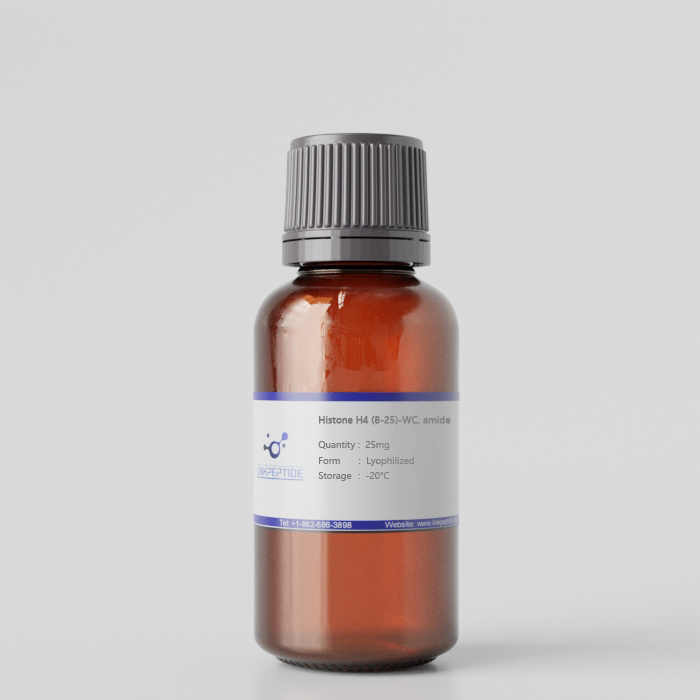
Product Name: Histone H4 (8-25)-WC, amide
Sequence One Letter Code: KGLGKGGAKRHRKVLRDNWC-NH2
Sequence Three Letter Code: H-Lys-Gly-Leu-Gly-Lys-Gly-Gly-Ala-Lys-Arg-His-Arg-Lys-Val-Leu-Arg-Asp-Asn-Trp-Cys-NH2
Chemical Formula:C98H168N38O23S1
Molecular Weight: 2278.8
Purity: 95%
Form: Lyophilized
Storage Conditions: - 20 °C
Research Area: epigenetics
Source / Species: human
Conjugation: Unconjugated
Code Nacres: NA.26
Application: This peptide is an amidated fragment of histone H4 corresponding to residues 8–25, extended with two additional C-terminal residues (WC). The N-terminal region of histone H4 contains several lysine residues that play essential roles in epigenetic regulation and chromatin organization. These lysines are key sites for post-translational modifications such as acetylation and methylation, which modulate chromatin structure, regulate gene expression, and influence DNA accessibility. By preserving these biologically important residues, this peptide serves as a valuable tool for studying the activity and specificity of histone-modifying enzymes, including histone acetyltransferases, histone deacetylases, and histone methyltransferases. The added tryptophan–cysteine (WC) residues at the C-terminus provide convenient functional groups that can facilitate peptide conjugation, labeling, or immobilization in biochemical and biophysical assays. As a result, this peptide is widely used in research focused on histone–protein interactions, chromatin remodeling, and mechanistic studies of epigenetic modification processes.
Current Research: Epigenetic regulation has emerged as one of the most important mechanisms controlling gene expression, cellular identity, and disease development. Among the many molecular players involved in epigenetic regulation, histone proteins—and particularly their N-terminal tails—play a central role. These flexible regions are rich in lysine residues that undergo diverse post-translational modifications (PTMs), which influence chromatin structure and gene activity. To better understand these processes, researchers frequently rely on synthetic histone peptides that replicate key regions of histone proteins. The Histone H4 (8–25)-WC amide peptide is a synthetic peptide derived from residues 8–25 of histone H4, extended with a C-terminal tryptophan–cysteine (WC) sequence and capped with an amide group. This design preserves the biologically important lysine-rich region of histone H4 while adding functional elements that enhance its utility in biochemical assays. As a result, the peptide has become a valuable research reagent for studies of epigenetic regulation, chromatin remodeling, and histone-modifying enzymes. The Biological Significance of the Histone H4 N-Terminal Tail Histone H4 is one of the core histone proteins that form nucleosomes, the fundamental structural units of chromatin. Each nucleosome consists of DNA wrapped around a histone octamer, which includes two copies each of H2A, H2B, H3, and H4. The N-terminal tail of histone H4 extends outward from the nucleosome core and is highly accessible to regulatory enzymes. Within this region, several lysine residues—including K8, K12, K16, and K20—serve as critical regulatory hotspots. These residues can undergo various post-translational modifications, such as: Acetylation, typically associated with transcriptional activation and chromatin relaxation Methylation, which can either activate or repress gene expression depending on the modification state Ubiquitination and other modifications, contributing to chromatin dynamics and DNA repair mechanisms Because these modifications influence DNA accessibility, transcriptional regulation, and chromatin compaction, the histone H4 tail has become a major focus in modern epigenetics research. Studying Histone-Modifying Enzymes The Histone H4 (8–25)-WC peptide contains the core sequence that includes several lysine residues targeted by histone-modifying enzymes. This makes it an ideal substrate model for studying the activity and specificity of key epigenetic enzymes, including: Histone acetyltransferases (HATs) – enzymes that add acetyl groups to lysine residues, promoting transcriptionally active chromatin Histone deacetylases (HDACs) – enzymes that remove acetyl groups and often contribute to gene repression Histone methyltransferases (HMTs) – enzymes responsible for methylating lysine residues, which can influence transcriptional activation, repression, or chromatin organization Using a defined synthetic peptide allows researchers to isolate specific biochemical events without the complexity of full nucleosomes or chromatin structures. This controlled environment helps scientists analyze enzyme kinetics, substrate specificity, and the effects of chemical inhibitors. Advantages of the WC Extension One distinguishing feature of this peptide is the addition of tryptophan (W) and cysteine (C) residues at the C-terminus. These residues introduce functional benefits that expand the peptide’s experimental applications. Tryptophan is a naturally fluorescent amino acid that can facilitate spectroscopic monitoring in biochemical assays. Its presence allows researchers to track peptide interactions or conformational changes using fluorescence-based techniques. Cysteine, on the other hand, contains a reactive thiol group. This functional group enables convenient site-specific conjugation with a wide variety of molecules, including fluorescent probes, affinity tags, nanoparticles, or solid supports. As a result, the peptide can be easily immobilized or labeled for applications such as binding assays, pull-down experiments, or biosensor development. The combination of these two residues makes the peptide particularly versatile for biophysical and analytical studies. Applications in Chromatin and Epigenetics Research The Histone H4 (8–25)-WC amide peptide is widely used across multiple research fields related to chromatin biology. Common applications include: Enzyme activity assays for histone acetyltransferases, deacetylases, and methyltransferases Screening of epigenetic inhibitors in drug discovery programs Protein–peptide interaction studies involving chromatin-associated proteins Biophysical studies of histone recognition domains, such as bromodomains or chromodomains Chromatin remodeling investigations exploring how histone modifications influence nucleosome dynamics Synthetic histone peptides like this one also serve as valuable tools in epigenetic drug discovery, where researchers evaluate candidate molecules targeting chromatin-modifying enzymes. Many therapies currently under investigation—particularly in oncology—focus on modulating these enzymes to restore normal gene regulation. Supporting Advances in Epigenetic Research As the field of epigenetics continues to expand, the demand for reliable model substrates remains high. Synthetic histone peptides provide a simplified yet biologically relevant platform for exploring the molecular mechanisms that govern chromatin regulation. By preserving the lysine-rich regulatory region of histone H4 while incorporating a functional WC extension, the Histone H4 (8–25)-WC amide peptide offers both biological relevance and experimental flexibility. Its design supports a wide range of biochemical, structural, and mechanistic studies aimed at understanding how histone modifications control gene expression. Through these applications, this peptide contributes to ongoing efforts to unravel the complex epigenetic networks that influence cellular function, development, and disease.
Get a Quote
 LinkPeptide