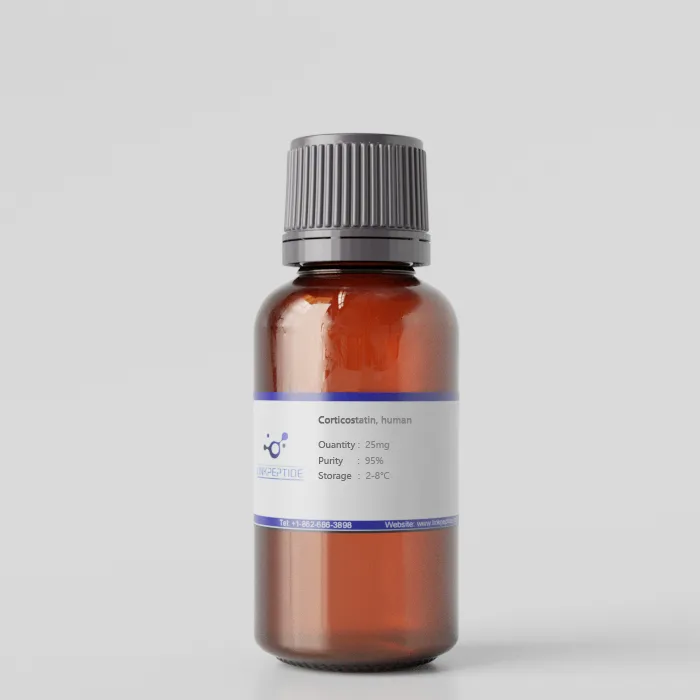
Product Name: Human Platelet Factor IV, C18G
Sequence One Letter Code: ALYKKLLKKLLKSAKKLG
Sequence Three Letter Code: H-Ala-Leu-Tyr-Lys-Lys-Leu-Leu-Lys-Lys-Leu-Leu-Lys-Ser-Ala-Lys-Lys-Leu-Gly-OH
Chemical Formula:C98H179N25O21
Molecular Weight: 2043.8
Purity: 95%
Form: Lyophilized
Storage Conditions: - 20 °C
Research Area: Inflammation and Immunology Research
Source / Species: human
Conjugation: Unconjugated
Code Nacres: NA.26
Application: C18G is a synthetic α-helical peptide derived from human platelet factor IV (PF4), a chemokine involved in host defense and inflammatory regulation. This peptide retains strong antimicrobial activity, particularly against Gram-negative bacteria such as Salmonella species. C18G interacts with bacterial membranes through electrostatic attraction to negatively charged phospholipids and hydrophobic insertion into lipid bilayers, leading to membrane destabilization, permeabilization, and rapid bacterial killing. Its well-defined structure and mechanism make it a widely used model for studying antimicrobial peptide–membrane interactions and the biophysical basis of membrane disruption. C18G is valuable for investigating innate immune defense mechanisms, structure–activity relationships, and resistance development. It also supports the rational design of peptide-based antibacterial agents and novel anti-infective therapeutics. This peptide is suitable for microbiology research, membrane biophysics studies, and antimicrobial drug discovery programs focused on alternative strategies to combat antibiotic-resistant pathogens.
Current Research: C18G is a synthetic antimicrobial peptide derived from human platelet factor IV (PF4, CXCL4), a CXC chemokine involved in host defense, inflammation, and platelet biology. Engineered as an 18-residue fragment optimized for antimicrobial activity, C18G adopts a well-defined amphipathic α-helical structure in membrane-mimetic environments. It retains potent activity against Gram-negative bacteria, including Salmonella species, and has become a widely used model system for investigating peptide–membrane interactions and the mechanistic basis of membrane-targeted antimicrobial action. The antimicrobial activity of C18G arises from its cationic and amphipathic character. The peptide contains positively charged residues that promote electrostatic attraction to negatively charged bacterial membranes enriched in phosphatidylglycerol and lipopolysaccharide (LPS). Upon binding, hydrophobic residues align along one face of the α-helix, enabling insertion into the lipid bilayer. This amphipathic organization facilitates membrane destabilization, increased permeability, and ultimately rapid bacterial killing. The sequence and length of C18G provide a structurally tractable framework for studying how charge distribution and hydrophobic moment influence antimicrobial potency. Biophysical studies have extensively characterized C18G’s membrane interactions. Circular dichroism spectroscopy demonstrates that the peptide adopts a predominantly helical conformation in the presence of lipid vesicles or detergent micelles, while remaining less structured in aqueous solution. Fluorescence spectroscopy and dye-leakage assays reveal concentration-dependent permeabilization of model membranes, confirming its capacity to disrupt bilayer integrity. These features make C18G a benchmark system for correlating structural parameters with membrane activity. The peptide is particularly valuable in Gram-negative bacterial models, where the outer membrane barrier and LPS layer present significant challenges to conventional antibiotics. C18G can bind LPS and penetrate the outer membrane, providing insight into strategies for overcoming permeability barriers. Studies using mutant bacterial strains and lipid vesicle systems allow systematic evaluation of how membrane composition influences susceptibility. Such analyses clarify determinants of selectivity between bacterial and mammalian membranes, a critical consideration in therapeutic development. C18G also supports research into innate immune defense mechanisms. PF4 and related chemokines contribute to antimicrobial responses at sites of infection, and C18G serves as a simplified derivative for dissecting chemokine-derived antimicrobial functions independent of chemotactic signaling. By isolating the membrane-active domain, researchers can examine direct bactericidal effects without confounding receptor-mediated pathways. Structure–activity relationship (SAR) studies frequently employ C18G as a template for peptide engineering. Systematic substitution of charged or hydrophobic residues enables analysis of how amphipathic balance, helix stability, and side-chain composition influence antimicrobial efficacy and cytotoxicity. These modifications inform rational design of next-generation peptide-based antibiotics with optimized potency and reduced host toxicity. Resistance development is another area where C18G provides experimental value. Because membrane-targeting peptides exert physical disruption rather than enzyme inhibition, resistance mechanisms differ from those affecting traditional antibiotics. Investigations into bacterial adaptation—such as alterations in membrane charge, lipid composition, or efflux systems—use C18G as a defined probe to understand how pathogens respond to membrane-active agents. In antimicrobial drug discovery, C18G supports screening platforms aimed at identifying synergistic combinations with conventional antibiotics or novel membrane-disrupting compounds. Its reproducible activity profile and well-characterized mechanism make it suitable for high-throughput and mechanistic assays. In summary, C18G is a synthetic α-helical peptide derived from human PF4 that exhibits potent membrane-disruptive antimicrobial activity, particularly against Gram-negative bacteria. Its defined structure, clear mechanism of action, and suitability for biophysical analysis make it an essential model for studying peptide–membrane interactions, innate host defense strategies, and rational design of alternative anti-infective therapeutics targeting antibiotic-resistant pathogens.
Get a Quote
 LinkPeptide