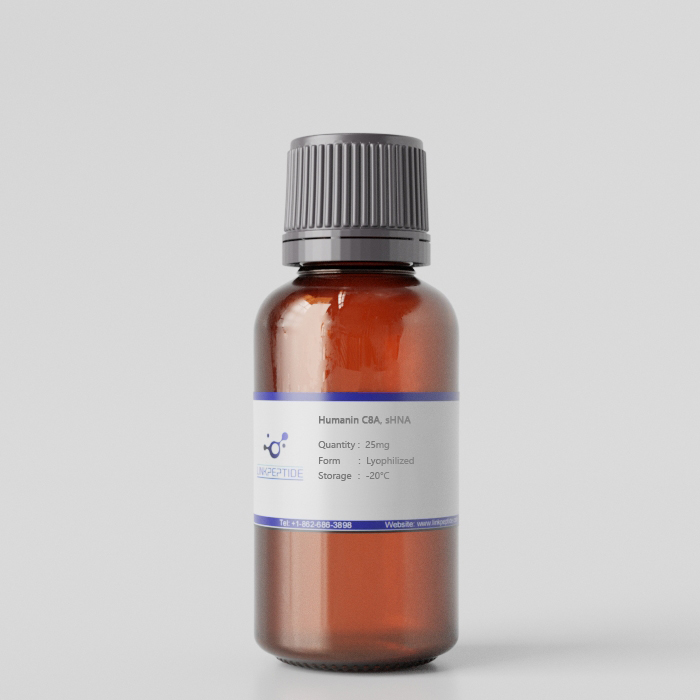
Product Name: Humanin C8A, sHNA
Sequence One Letter Code: MAPRGFSALLLLTSEIDLPVKRRA
Sequence Three Letter Code: H-Met-Ala-Pro-Arg-Gly-Phe-Ser-Ala-Leu-Leu- Leu-Leu-Thr-Ser-Glu-Ile-Asp-Leu-Pro-Val-Lys- Arg-Arg-Ala-OH
Chemical Formula:C119H204N34O32S
Molecular Weight: 2655.4
Purity: 95%
Form: Lyophilized
Storage Conditions: - 20 °C
Research Area: Neurological Disease Research
Source / Species: human
Conjugation: Unconjugated
Code Nacres: NA.26
Application: Humanin C8A is a modified variant of the mitochondrial-derived peptide humanin in which cysteine at position 8 is substituted with alanine. Native humanin peptides have been extensively studied for their cytoprotective and neuroprotective properties, particularly in relation to mitochondrial signaling and neurodegenerative disease mechanisms. The C8A substitution eliminates the neuroprotective activity associated with wild-type humanin, making this peptide an important negative control in functional studies. Humanin C8A is widely used to investigate the structure–function relationships of humanin peptides and to clarify the signaling pathways involved in cellular survival, apoptosis regulation, and neuronal protection. By enabling direct comparison with active humanin analogs, this peptide provides a useful experimental tool for research on mitochondrial peptides and neurodegenerative disease biology.
Current Research: Humanin is a small mitochondrial-derived peptide that has attracted considerable attention for its cytoprotective and neuroprotective properties. Originally identified during studies of Alzheimer’s disease–related neuronal death, humanin peptides have since been implicated in a variety of biological processes including mitochondrial signaling, apoptosis regulation, metabolic control, and cellular stress responses. Among the experimental variants developed to study this peptide family, Humanin C8A is a modified analog in which the cysteine residue at position 8 is replaced with alanine. This single amino acid substitution significantly alters the peptide’s biological function by eliminating the neuroprotective activity observed in the wild-type humanin sequence. Because of this loss of function, Humanin C8A is widely used as a negative control peptide in research designed to investigate the mechanisms underlying humanin-mediated cytoprotection. Humanin and Mitochondrial-Derived Peptides Humanin belongs to a growing class of mitochondrial-derived peptides (MDPs) encoded within the mitochondrial genome. These peptides represent an emerging signaling network that links mitochondrial function with cellular stress responses and systemic metabolic regulation. Humanin has been shown to influence multiple cellular processes, including: Protection against oxidative stress Regulation of apoptosis pathways Modulation of mitochondrial signaling Support of neuronal survival under stress conditions Because mitochondria play a central role in cellular energy production and apoptosis regulation, peptides derived from mitochondrial DNA have become increasingly important in studies of aging, neurodegeneration, and metabolic disease. Structural Modification in Humanin C8A Humanin C8A differs from the native peptide by a single amino acid substitution, where cysteine at position 8 is replaced by alanine. While this change may appear minor, it has a significant impact on the peptide’s functional activity. Cysteine residues often contribute to peptide structure and receptor interactions due to their ability to form disulfide bonds or participate in critical binding interactions. Replacing cysteine with alanine removes these chemical properties, resulting in a peptide that lacks the biological activity associated with native humanin. As a result, Humanin C8A does not display the same protective effects in cellular models, making it an effective experimental comparator. Role as a Negative Control in Functional Studies One of the most important uses of Humanin C8A is as a negative control in experimental systems. In peptide signaling research, negative controls are essential for confirming that observed biological effects are specifically caused by the active molecule under investigation. By comparing experimental outcomes between: Wild-type humanin or active humanin analogs, and Humanin C8A, which lacks functional activity, researchers can determine whether the observed biological responses truly depend on the structural features of the active peptide. This approach helps validate experimental results and strengthens conclusions about humanin-mediated signaling pathways. Studying Structure–Function Relationships Humanin C8A also plays an important role in structure–function studies of mitochondrial-derived peptides. Understanding how specific amino acids contribute to peptide activity allows scientists to identify structural elements that are essential for receptor binding and signaling. Experiments using Humanin C8A allow researchers to investigate: The importance of cysteine residues in peptide activity Structural requirements for cytoprotective signaling Molecular determinants of neuroprotective function Interactions between humanin peptides and their cellular targets These studies provide valuable insights into how small peptides derived from mitochondria influence complex biological processes. Relevance to Neurodegenerative Disease Research Humanin peptides have been widely investigated in the context of neurodegenerative diseases, particularly conditions characterized by neuronal stress and mitochondrial dysfunction. Research has explored the role of humanin in cellular pathways associated with: Neuronal survival under toxic stress Regulation of apoptosis in neuronal cells Protection against amyloid-associated toxicity Mitochondrial signaling in aging and neurodegeneration Humanin C8A contributes to these studies by providing a non-active comparison peptide that allows scientists to distinguish between specific protective mechanisms and non-specific experimental effects. Applications in Cellular Survival and Apoptosis Studies In addition to neurobiology research, Humanin C8A is commonly used in experiments examining cellular survival and apoptosis regulation. Humanin peptides interact with several intracellular signaling pathways that influence cell fate decisions, particularly under conditions of metabolic or oxidative stress. By including Humanin C8A in experimental designs, researchers can better analyze how active humanin peptides affect: Apoptosis-related signaling networks Stress response pathways Mitochondrial communication with the nucleus Cellular protection mechanisms This makes the peptide an important tool for clarifying the molecular mechanisms underlying mitochondrial peptide signaling. Conclusion Humanin C8A is a modified humanin peptide analog in which cysteine at position 8 is replaced with alanine, resulting in the loss of the neuroprotective activity observed in native humanin peptides. This functional difference makes Humanin C8A a valuable negative control for experimental studies investigating mitochondrial-derived peptide signaling. By enabling direct comparison with active humanin variants, the peptide helps researchers examine structure–function relationships, cytoprotective signaling mechanisms, and pathways involved in neuronal survival and apoptosis regulation. As interest in mitochondrial-derived peptides continues to grow, Humanin C8A remains an important reagent for advancing research in neurodegeneration, mitochondrial biology, and cellular stress responses.
Get a Quote
 LinkPeptide

![[Leu31,Pro34]-Neuropeptide Y (human, rat)](https://www.linkpeptide.com/wp-content/uploads/2024/10/Leu31Pro34-Neuropeptide-Y-human-rat-jpg-3.webp "[Leu31,Pro34]-Neuropeptide Y (human, rat)")