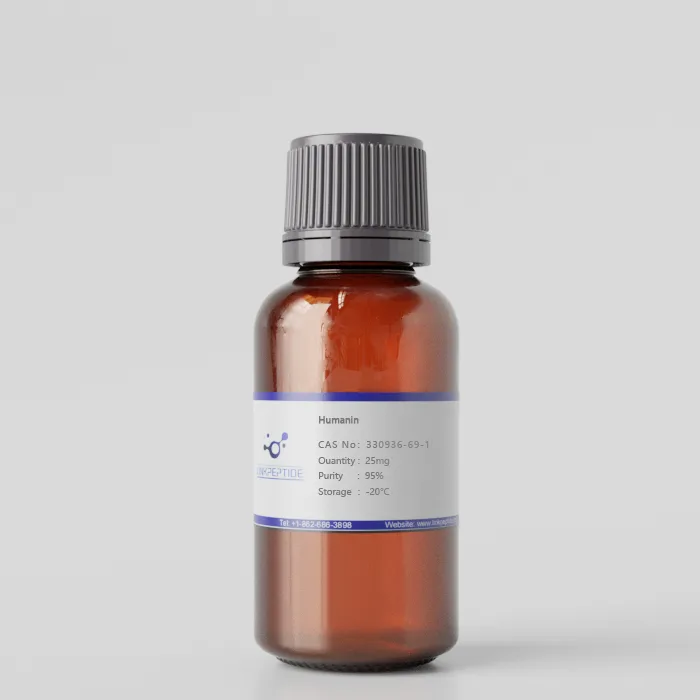
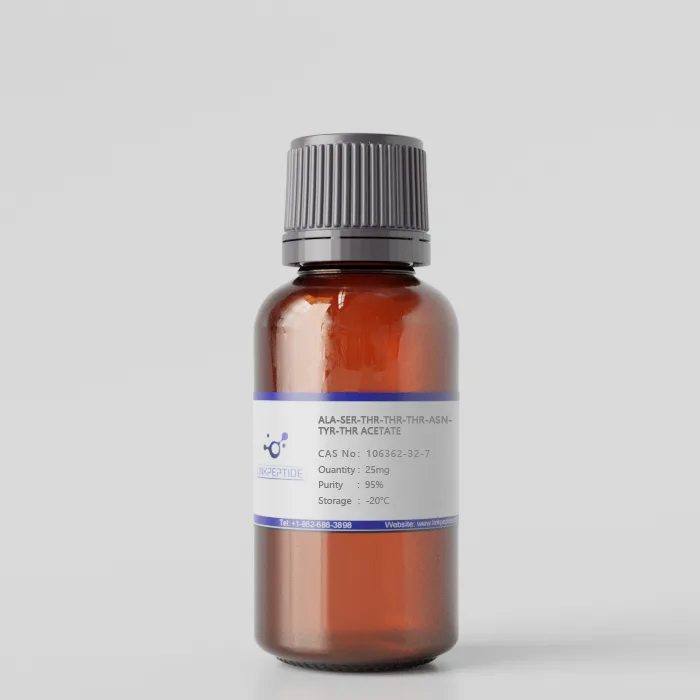
Product Name:Humanin
Cas No:330936-69-1
Purity:95%
Chemical Formula:C119H204N34O32S2
Molar Mass:2687.2
Synonyms:formyl humanin; Protein Humanin (human)
IUPAC Name:(4S)-5-[[(2S,3S)-1-[[(2S)-1-[[(2S)-1-[(2S)-2-[[(2S)-1-[[(2S)-6-amino-1-[[(2S)-5-carbamimidamido-1-[[(2S)-5-carbamimidamido-1-[[(1S)-1-carboxyethyl]amino]-1-oxopentan-2-yl]amino]-1-oxopentan-2-yl]amino]-1-oxohexan-2-yl]amino]-3-methyl-1-oxobutan-2-yl]carbamoyl]pyrrolidin-1-yl]-4-methyl-1-oxopentan-2-yl]amino]-3-carboxy-1-oxopropan-2-yl]amino]-3-methyl-1-oxopentan-2-yl]amino]-4-[[(2S)-2-[[(2S,3R)-2-[[(2S)-2-[[(2S)-2-[[(2S)-2-[[(2S)-2-[[(2R)-2-[[(2S)-2-[[(2S)-2-[[2-[[(2S)-2-[[(2S)-1-[(2S)-2-[[(2S)-2-amino-4-methylsulfanylbutanoyl]amino]propanoyl]pyrrolidine-2-carbonyl]amino]-5-carbamimidamidopentanoyl]amino]acetyl]amino]-3-phenylpropanoyl]amino]-3-hydroxypropanoyl]amino]-3-sulfanylpropanoyl]amino]-4-methylpentanoyl]amino]-4-methylpentanoyl]amino]-4-methylpentanoyl]amino]-4-methylpentanoyl]amino]-3-hydroxybutanoyl]amino]-3-hydroxypropanoyl]amino]-5-oxopentanoic acid
SMILES:CC[C@H](C)[C@@H](C(=O)N[C@@H](CC(=O)O)C(=O)N[C@@H](CC(C)C)C(=O)N1CCC[C@H]1C(=O)N[C@@H](C(C)C)C(=O)N[C@@H](CCCCN)C(=O)N[C@@H](CCCNC(=N)N)C(=O)N[C@@H](CCCNC(=N)N)C(=O)N[C@@H](C)C(=O)O)NC(=O)[C@H](CCC(=O)O)NC(=O)[C@H](CO)NC(=O)[C@H]([C@@H](C)O)NC(=O)[C@H](CC(C)C)NC(=O)[C@H](CC(C)C)NC(=O)[C@H](CC(C)C)NC(=O)[C@H](CC(C)C)NC(=O)[C@H](CS)NC(=O)[C@H](CO)NC(=O)[C@H](CC2=CC=CC=C2)NC(=O)CNC(=O)[C@H](CCCNC(=N)N)NC(=O)[C@@H]3CCCN3C(=O)[C@H](C)NC(=O)[C@H](CCSC)N
InChIKey:DPEUWKZJZIPZKE-OFANTOPUSA-N
InChI:InChI=1S/C119H204N34O32S2/c1-19-65(14)92(112(180)144-81(54-90(160)161)104(172)145-82(52-63(10)11)115(183)153-46-29-37-87(153)110(178)149-91(64(12)13)111(179)139-72(32-23-24-41-120)97(165)136-74(35-27-44-130-119(126)127)98(166)135-73(34-26-43-129-118(124)125)96(164)133-67(16)116(184)185)150-99(167)75(38-39-89(158)159)137-106(174)84(57-155)147-113(181)93(68(17)156)151-105(173)79(51-62(8)9)142-101(169)77(49-60(4)5)140-100(168)76(48-59(2)3)141-102(170)78(50-61(6)7)143-108(176)85(58-186)148-107(175)83(56-154)146-103(171)80(53-69-30-21-20-22-31-69)134-88(157)55-131-95(163)71(33-25-42-128-117(122)123)138-109(177)86-36-28-45-152(86)114(182)66(15)132-94(162)70(121)40-47-187-18/h20-22,30-31,59-68,70-87,91-93,154-156,186H,19,23-29,32-58,120-121H2,1-18H3,(H,131,163)(H,132,162)(H,133,164)(H,134,157)(H,135,166)(H,136,165)(H,137,174)(H,138,177)(H,139,179)(H,140,168)(H,141,170)(H,142,169)(H,143,176)(H,144,180)(H,145,172)(H,146,171)(H,147,181)(H,148,175)(H,149,178)(H,150,167)(H,151,173)(H,158,159)(H,160,161)(H,184,185)(H4,122,123,128)(H4,124,125,129)(H4,126,127,130)/t65-,66-,67-,68+,70-,71-,72-,73-,74-,75-,76-,77-,78-,79-,80-,81-,82-,83-,84-,85-,86-,87-,91-,92-,93-/m0/s1
Storage:-20 degree Celsius
Application:Humanin is a 24-amino acid peptide originally discovered in the human hypothalamus and encoded within the mitochondrial 16S rRNA region. It exhibits remarkable cytoprotective properties, especially in models of neurodegeneration, apoptosis, and metabolic stress. Humanin interferes with pro-apoptotic signaling pathways and promotes cell survival by binding to receptors such as FPRL1 and interacting with BAX-related proteins. It has been studied in contexts ranging from Alzheimer’s disease and stroke to insulin resistance and cardiovascular aging. Humanin is a promising tool for research into age-related diseases, mitochondrial biology, and systemic longevity signaling.
Current Research:Introduction: A Mitochondrial-Derived Peptide with Broad Protective Effects Humanin is part of a growing class of peptides known as mitochondrial-derived peptides (MDPs), which are encoded within the mitochondrial genome and exert powerful effects on cellular health and aging. Identified in 2001 from a cDNA library of an Alzheimer’s patient’s brain, Humanin quickly gained attention for its ability to protect neurons from death triggered by toxic insults, such as amyloid-beta accumulation. Encoded in the mitochondrial 16S rRNA region, Humanin challenges the long-held belief that the mitochondrial genome encodes only 13 proteins. It represents a new paradigm in peptide-based longevity signaling. Mechanism of Action: Anti-Apoptotic and Cytoprotective Humanin’s core function is cell survival promotion, achieved through several overlapping mechanisms: Inhibition of pro-apoptotic proteins such as BAX, BID, and tBid Modulation of inflammatory cytokine production Activation of protective receptor complexes, including FPRL1 and the trimeric CNTFR/gp130/WSX-1 receptor complex Reduction of oxidative stress and mitochondrial dysfunction These actions help Humanin block apoptosis, improve mitochondrial efficiency, and limit the cellular damage associated with aging and metabolic overload. Neurodegeneration and Alzheimer’s Disease One of the earliest and most robust areas of Humanin research is its effect on neurodegenerative diseases—particularly Alzheimer’s. Humanin: Protects neurons from amyloid-beta toxicity Reduces tau phosphorylation Improves cognitive performance in Alzheimer’s mouse models Decreases neuroinflammation and glial activation Humanin analogs, such as HNG (S14G-Humanin), have shown even greater potency in restoring memory function and reducing plaque load, highlighting the therapeutic potential of this peptide family in neuroprotective research. Insulin Resistance and Metabolic Regulation Humanin also plays a key role in metabolic homeostasis. It improves insulin sensitivity, reduces systemic inflammation, and enhances mitochondrial function in liver and muscle tissues. Key findings include: Improved glucose uptake and reduced hepatic gluconeogenesis Protection against beta-cell apoptosis in the pancreas Attenuation of high-fat diet-induced insulin resistance It is postulated that Humanin functions as part of an adaptive mitochondrial response to metabolic stress, particularly relevant in type 2 diabetes and metabolic syndrome models. Cardiovascular Protection and Vascular Aging Humanin exerts cardioprotective effects by reducing oxidative stress in endothelial and cardiac cells, enhancing nitric oxide bioavailability, and preventing apoptosis in response to ischemic injury. In rodent models, Humanin treatment: Reduces infarct size after myocardial ischemia Improves endothelial function Lowers markers of vascular inflammation These actions suggest Humanin may help counter age-related endothelial dysfunction, a key driver of hypertension and atherosclerosis. Longevity and Aging Circulating Humanin levels decline with age in both humans and rodents, and higher levels have been correlated with exceptional longevity in human centenarians. In experimental models: Overexpression of Humanin extends lifespan in mice Enhances stress resistance, including resistance to UV, oxidative, and ER stress Delays onset of age-associated decline in physical and cognitive functions These data support its emerging role as a hormonal-like mitochondrial signal that promotes systemic resilience and healthy aging. Synergy with Other Mitochondrial Peptides Humanin is functionally and structurally related to other mitochondrial-derived peptides like MOTS-c and SHLPs (Small Humanin-Like Peptides). These peptides may work in concert to maintain metabolic flexibility, immune balance, and cellular protection, forming a mitokine network involved in inter-organ communication. In research, Humanin is increasingly being used alongside other MDPs, NAD+ precursors (e.g., NMN, NR), and senolytics to dissect multi-pathway approaches to longevity. Conclusion Humanin is a multifaceted peptide with broad utility in studies of aging, neurodegeneration, metabolism, and mitochondrial biology. Its unique origin within the mitochondrial genome, potent anti-apoptotic actions, and systemic benefits make it a compelling focus for therapeutic discovery. Whether as a neuroprotective agent, metabolic modulator, or longevity enhancer, Humanin continues to illuminate the untapped potential of mitochondrial peptides in regenerative and anti-aging research.
Reference:
Get a Quote
 LinkPeptide