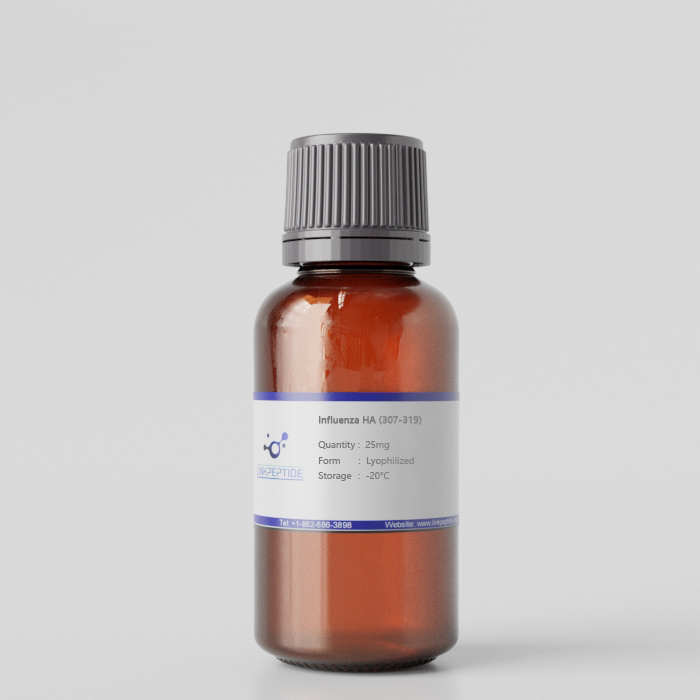
Product Name: Influenza HA (307-319)
Sequence One Letter Code: PKYVKQNTLKLAT
Sequence Three Letter Code: H-Pro-Lys-Tyr-Val-Lys-Gln-Asn-Thr-Leu-Lys-Leu-Ala-Thr-OH
Chemical Formula:C69H118N18O19
Molecular Weight: 1503.9
Purity: 95%
Form: Lyophilized
Storage Conditions: - 20 °C
Research Area: Infection Disease Research
Source / Species: Influenza
Conjugation: Unconjugated
Code Nacres: NA.26
Application: Influenza HA (307–319) is a synthetic peptide corresponding to residues 307–319 of the hemagglutinin (HA) protein from the influenza virus. This sequence represents a well-characterized CD4⁺ T-cell epitope restricted by the HLA-DRB1*0101 major histocompatibility complex class II molecule. Because of its defined immunological properties, the peptide is widely used in immunology research to study antigen presentation, T-cell activation, and adaptive immune responses to influenza infection. Influenza HA (307–319) is commonly employed in experiments investigating MHC class II–restricted immune recognition, vaccine-related immune mechanisms, and host–pathogen interactions. The peptide therefore serves as a useful experimental reagent for studying influenza-specific T-cell responses and immune system dynamics.
Current Research: Influenza HA (307–319) is a synthetic peptide corresponding to amino acid residues 307–319 of the hemagglutinin (HA) protein from the influenza virus. Hemagglutinin is one of the major surface glycoproteins of influenza viruses and plays a central role in viral attachment and entry into host cells. In addition to its role in viral infection, HA contains multiple immunogenic epitopes that are recognized by the adaptive immune system. The HA (307–319) peptide represents a well-characterized CD4⁺ T-cell epitope that is presented by the HLA-DRB1*0101 major histocompatibility complex (MHC) class II molecule. Because of its defined immunological properties and reproducible immune recognition, this peptide has become a widely used experimental tool in immunology research. It is frequently applied in studies examining antigen presentation, T-cell activation, vaccine immunology, and host–pathogen interactions. Hemagglutinin and Influenza Immune Recognition Hemagglutinin is a viral surface protein responsible for binding to sialic acid receptors on host cells, enabling influenza virus entry. It is also one of the most immunogenic viral proteins, making it a major target for immune responses during influenza infection. Fragments of the HA protein are processed by antigen-presenting cells and displayed on the cell surface in association with MHC molecules. These peptide–MHC complexes are recognized by T-cell receptors on CD4⁺ or CD8⁺ T cells, initiating adaptive immune responses. The HA (307–319) sequence is particularly useful because it forms a stable peptide–MHC complex with HLA-DRB1*0101, allowing consistent activation of antigen-specific CD4⁺ T cells in experimental systems. MHC Class II–Restricted T-Cell Epitope The immune response to viral infections involves both MHC class I and MHC class II pathways. MHC class II molecules present peptide antigens to CD4⁺ helper T cells, which play a central role in coordinating adaptive immune responses. The Influenza HA (307–319) peptide is specifically recognized in the context of HLA-DRB1*0101, a human MHC class II allele. When antigen-presenting cells process influenza HA and present this peptide on MHC class II molecules, CD4⁺ T cells recognizing the epitope become activated. Activated helper T cells can then contribute to immune responses by: Supporting B-cell activation and antibody production Enhancing cytotoxic T-cell responses Promoting cytokine-mediated immune signaling Coordinating broader adaptive immune defenses Because this peptide epitope has been extensively characterized, it provides a reliable system for studying MHC class II–restricted immune recognition. Applications in Antigen Presentation Studies Influenza HA (307–319) is frequently used in experiments designed to analyze antigen presentation mechanisms. Researchers often use the peptide in controlled systems where antigen-presenting cells such as dendritic cells or B cells present the peptide to T cells. These experiments allow scientists to investigate: Peptide binding to MHC class II molecules Stability of peptide–MHC complexes Recognition of antigen by T-cell receptors (TCRs) Activation thresholds for CD4⁺ T cells By using a well-defined peptide epitope, researchers can precisely evaluate how immune cells process and respond to viral antigens. Role in Vaccine and Immunological Research Because hemagglutinin is a major target of immune responses against influenza, peptides derived from HA are widely used in vaccine and immunology research. The HA (307–319) peptide provides a useful model system for studying how helper T cells recognize influenza antigens and contribute to immune protection. Research applications include studies of: Vaccine-induced T-cell responses Mechanisms of immune memory formation Cross-reactivity between influenza strains Host immune recognition of viral proteins These investigations help improve understanding of how the immune system responds to influenza infection and vaccination. Investigating Host–Pathogen Interactions The Influenza HA (307–319) peptide also supports research focused on host–pathogen interactions. Viral infections trigger complex interactions between viral proteins and the host immune system, and understanding these interactions is essential for studying immune defense mechanisms. Using this peptide, researchers can analyze: T-cell recognition of viral epitopes Immune signaling triggered by viral antigens Regulation of helper T-cell responses during infection Cellular communication between antigen-presenting cells and lymphocytes Such studies provide insight into how the immune system detects and responds to viral pathogens. Conclusion Influenza HA (307–319) is a synthetic peptide corresponding to residues 307–319 of the influenza virus hemagglutinin protein and represents a well-characterized CD4⁺ T-cell epitope presented by the HLA-DRB1*0101 MHC class II molecule. Because of its defined immunological properties, it is widely used as a model antigen in immunology research. The peptide plays an important role in studies examining antigen presentation, T-cell activation, adaptive immune responses, and vaccine-related immune mechanisms. By providing a reliable experimental system for investigating influenza-specific T-cell recognition, Influenza HA (307–319) continues to support research into viral immunology and host–pathogen interactions.
Get a Quote
 LinkPeptide