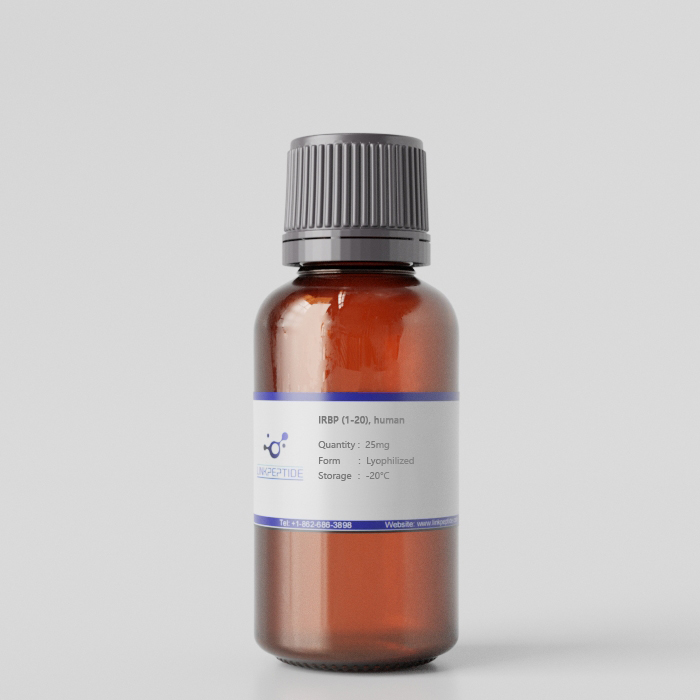
Product Name: IRBP (1-20), human
Sequence One Letter Code: GPTHLFQPSLVLDMAKVLLD
Sequence Three Letter Code: H-Gly-Pro-Thr-His-Leu-Phe-Gln-Pro-Ser-Leu-Val-Leu-Asp-Met-Ala-Lys-Val-Leu-Leu-Asp-OH
Chemical Formula:C101H164N24O28S1
Molecular Weight: 2194.8
Purity: 95%
Form: Lyophilized
Storage Conditions: - 20 °C
Research Area: Inflammation and Immunology Research
Source / Species: human
Conjugation: Unconjugated
Code Nacres: NA.26
Application: IRBP (1–20), human is a synthetic peptide corresponding to residues 1–20 of interphotoreceptor retinoid-binding protein, a glycolipoprotein localized in the interphotoreceptor matrix of the retina. This fragment contains a dominant T cell epitope associated with the H-2b haplotype and exhibits strong immunogenicity. Immunization with IRBP (1–20) induces T cell–mediated experimental autoimmune uveoretinitis (EAU), closely recapitulating pathology triggered by the full-length protein. The peptide is widely used in murine models to study retinal autoimmunity, antigen-specific T cell responses, and inflammatory mechanisms underlying autoimmune uveitis. It supports investigations into immune tolerance, cytokine regulation, and therapeutic strategies targeting ocular inflammatory disease.
Current Research: Interphotoreceptor retinoid-binding protein (IRBP) is a large glycolipoprotein localized within the interphotoreceptor matrix of the retina, where it plays a central role in the visual cycle by facilitating the transport of retinoids between photoreceptors and the retinal pigment epithelium. Beyond its physiological importance, IRBP is a well-characterized autoantigen in autoimmune uveitis. Among its immunogenic regions, the N-terminal fragment encompassing residues 1–20—designated IRBP (1–20), human—has emerged as a highly defined peptide epitope for dissecting antigen-specific T cell responses and modeling retinal autoimmunity. IRBP (1–20) corresponds to a dominant T cell epitope associated with the H-2^b haplotype in mice. This short synthetic peptide retains strong immunogenic properties and is sufficient to induce experimental autoimmune uveoretinitis (EAU) following immunization in susceptible strains. EAU is a T cell–mediated inflammatory disease of the posterior segment of the eye and is widely accepted as a robust model for human autoimmune uveitis. Importantly, disease induced by IRBP (1–20) closely recapitulates the histopathological and immunological features observed with full-length IRBP, including retinal infiltration by autoreactive T lymphocytes, photoreceptor damage, vasculitis, and breakdown of the blood–retina barrier. The use of IRBP (1–20) offers several methodological advantages. As a defined minimal epitope, it enables precise interrogation of antigen-specific CD4⁺ T cell activation, clonal expansion, and differentiation. In H-2^b mice, IRBP (1–20)-specific T cells predominantly differentiate into Th1 and Th17 subsets, both of which are implicated in EAU pathogenesis. IFN-γ–producing Th1 cells and IL-17–secreting Th17 cells contribute to retinal inflammation through recruitment of monocytes and neutrophils, amplification of local cytokine networks, and disruption of retinal architecture. This peptide-driven model therefore provides a controlled system to dissect lineage commitment, transcription factor regulation (e.g., T-bet and RORγt), and effector cytokine dynamics during ocular autoimmunity. Recent research has leveraged IRBP (1–20)–induced EAU to explore the balance between pathogenic effector T cells and regulatory T cells (Tregs). Induction of peripheral tolerance through antigen-specific mechanisms—such as mucosal administration of peptide, tolerogenic dendritic cells, or low-dose antigen exposure—has been evaluated using this defined epitope. Because the inciting antigen is precisely known, investigators can monitor IRBP (1–20)-specific T cell frequencies using peptide restimulation assays, MHC class II tetramers, and cytokine profiling. This has facilitated mechanistic studies of immune deviation, anergy, clonal deletion, and Treg-mediated suppression in the context of retinal inflammation. In addition, IRBP (1–20) serves as a valuable tool for examining cytokine regulation and intracellular signaling pathways involved in autoimmune tissue damage. Studies employing gene-deficient mice or pharmacological inhibitors have used IRBP (1–20) immunization to evaluate the roles of IL-6, IL-23, GM-CSF, and co-stimulatory molecules such as CD28 and ICOS in disease progression. The model has also been instrumental in elucidating the contribution of innate immune activation, including Toll-like receptor signaling and inflammasome components, which modulate antigen-presenting cell function and shape downstream T cell responses. From a translational perspective, IRBP (1–20)-driven EAU remains a cornerstone for preclinical evaluation of therapeutic strategies targeting autoimmune uveitis. Small-molecule inhibitors, biologics directed against proinflammatory cytokines, and cell-based therapies are frequently assessed using this peptide-induced model. Because disease onset and severity are reproducible and quantifiable via clinical scoring and histological analysis, IRBP (1–20) enables rigorous evaluation of immunomodulatory efficacy. Moreover, antigen-specific approaches—such as peptide-coupled nanoparticles or tolerogenic vaccination platforms—can be systematically tested for their ability to attenuate IRBP-reactive T cell responses without broad immunosuppression. In summary, IRBP (1–20), human is a synthetic peptide representing a dominant retinal autoantigenic epitope with strong immunogenic capacity in H-2^b mice. Its ability to reproducibly induce T cell–mediated EAU makes it an indispensable reagent for studying antigen-specific immunity, cytokine networks, immune tolerance mechanisms, and therapeutic interventions in ocular inflammatory disease. By providing a reductionist yet pathophysiologically relevant model, IRBP (1–20) continues to advance mechanistic understanding of autoimmune uveitis and supports the development of targeted strategies aimed at preserving retinal integrity and visual function.
Get a Quote
 LinkPeptide