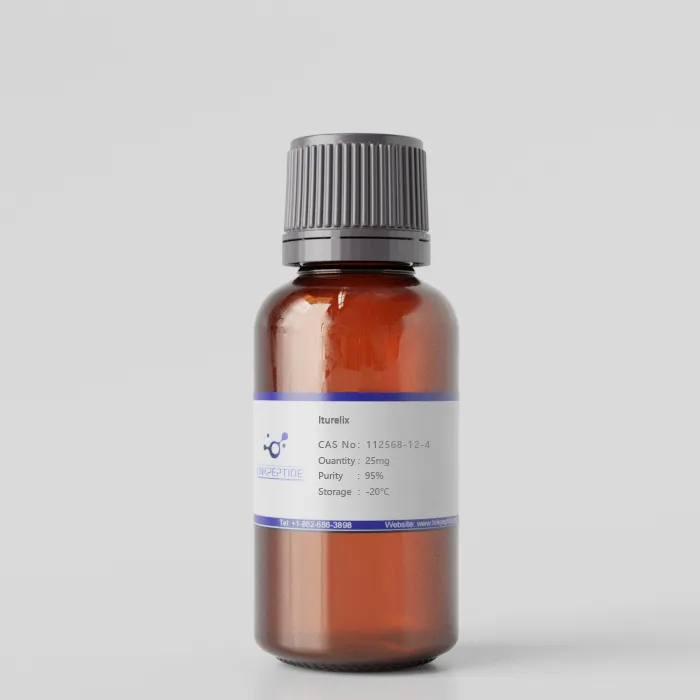
Product Name:Iturelix
Form:Acetate salt
Purity:95%
Storage:-20oC
Cas No:112568-12-4
Molar Mass:1591.3
Chemical Formula:C82H108ClN17O14
Synonyms:Antide
IUPAC Name:N-[(5R)-5-[[(2S)-2-[[(2S)-2-[[(2R)-2-[[(2R)-2-[[(2R)-2-acetamido-3-naphthalen-2-ylpropanoyl]amino]-3-(4-chlorophenyl)propanoyl]amino]-3-pyridin-3-ylpropanoyl]amino]-3-hydroxypropanoyl]amino]-6-(pyridine-3-carbonylamino)hexanoyl]amino]-6-[[(2S)-1-[[(2S)-1-[(2S)-2-[[(2R)-1-amino-1-oxopropan-2-yl]carbamoyl]pyrrolidin-1-yl]-1-oxo-6-(propan-2-ylamino)hexan-2-yl]amino]-4-methyl-1-oxopentan-2-yl]amino]-6-oxohexyl]pyridine-3-carboxamide
SMILES:C[C@H](C(=O)N)NC(=O)[C@@H]1CCCN1C(=O)[C@H](CCCCNC(C)C)NC(=O)[C@H](CC(C)C)NC(=O)[C@@H](CCCCNC(=O)C2=CN=CC=C2)NC(=O)[C@H](CCCCNC(=O)C3=CN=CC=C3)NC(=O)[C@H](CO)NC(=O)[C@@H](CC4=CN=CC=C4)NC(=O)[C@@H](CC5=CC=C(C=C5)Cl)NC(=O)[C@@H](CC6=CC7=CC=CC=C7C=C6)NC(=O)C
InChIKey:QRYFGTULTGLGHU-NBERXCRTSA-N
InChI:InChI=1S/C82H108ClN17O14/c1-50(2)41-65(76(108)95-64(26-11-12-37-88-51(3)4)82(114)100-40-18-27-70(100)81(113)91-52(5)71(84)103)96-75(107)63(25-10-14-39-90-73(105)60-23-17-36-87-48-60)93-74(106)62(24-9-13-38-89-72(104)59-22-16-35-86-47-59)94-80(112)69(49-101)99-79(111)68(45-56-19-15-34-85-46-56)98-78(110)67(43-54-29-32-61(83)33-30-54)97-77(109)66(92-53(6)102)44-55-28-31-57-20-7-8-21-58(57)42-55/h7-8,15-17,19-23,28-36,42,46-48,50-52,62-70,88,101H,9-14,18,24-27,37-41,43-45,49H2,1-6H3,(H2,84,103)(H,89,104)(H,90,105)(H,91,113)(H,92,102)(H,93,106)(H,94,112)(H,95,108)(H,96,107)(H,97,109)(H,98,110)(H,99,111)/t52-,62+,63-,64+,65+,66-,67-,68-,69+,70+/m1/s1
Sequence:XXXSXXLXPA
Application:Antide is a synthetic gonadotropin-releasing hormone (GnRH) antagonist that blocks the GnRH receptor in the anterior pituitary gland, preventing the release of luteinizing hormone (LH) and follicle-stimulating hormone (FSH). By suppressing gonadotropin secretion, it effectively reduces testosterone and estrogen levels, making it a potential treatment for hormone-dependent conditions such as prostate cancer, endometriosis, and precocious puberty. Though initially developed for fertility control and endocrine disorders, its clinical development was discontinued. Current research explores its role in reproductive health, cancer therapy, and neuroendocrine disorders, positioning it as a key tool in hormonal regulation studies.
Current Research:Antide is a decapeptide GnRH antagonist that functions by competitively binding to the GnRH receptor, effectively suppressing the secretion of LH and FSH. Unlike GnRH agonists, which initially cause a hormone surge before suppression, Antide directly inhibits gonadotropin release, leading to an immediate reduction in testosterone and estrogen levels. While its clinical development was discontinued, research continues to explore its applications in endocrinology, oncology, and reproductive medicine. Endocrine and Reproductive Health Applications Antide has been studied for its effects on reproductive hormone regulation, particularly in: Prostate cancer treatment: By lowering testosterone levels, it may help slow androgen-dependent tumor growth. Endometriosis and uterine fibroids: Suppressing estrogen production may help reduce the growth of endometrial and fibroid tissue. Polycystic ovary syndrome (PCOS): Research suggests that GnRH antagonists may rebalance LH/FSH levels, improving ovulatory function. Contraceptive research: Investigations have explored its potential in reversible fertility control by temporarily inhibiting ovulation or spermatogenesis. Oncology and Cancer Research Hormone-sensitive cancers: Antide??s ability to suppress gonadal steroidogenesis makes it a potential therapeutic agent for hormone-driven cancers such as breast cancer and ovarian cancer. Alternative to androgen deprivation therapy (ADT): Research is comparing GnRH antagonists like Antide to existing GnRH agonists (e.g., Leuprolide, Goserelin) to determine efficacy in long-term cancer management. Neuroendocrine and Metabolic Research Hypothalamic-pituitary-gonadal (HPG) axis regulation: Antide is used in research to study the impact of GnRH suppression on metabolic and neuroendocrine disorders. Cognitive and neurodegenerative diseases: Some studies suggest that GnRH signaling may play a role in neuroprotection, prompting investigations into its effects on cognitive health. Emerging Research Areas Transgender hormone therapy: Some research suggests that GnRH antagonists like Antide may provide a reversible alternative to puberty blockers. Combination therapies: Studies are evaluating Antide in conjunction with selective estrogen receptor modulators (SERMs) or anti-androgens for optimized hormone suppression. Anti-aging research: Since the GnRH axis is linked to aging-related hormonal decline, Antide is being explored for its role in hormonal modulation and longevity studies. Although Antide's clinical development was halted, ongoing research continues to uncover its potential in hormonal regulation, cancer therapy, and reproductive medicine.
Get a Quote
 LinkPeptide