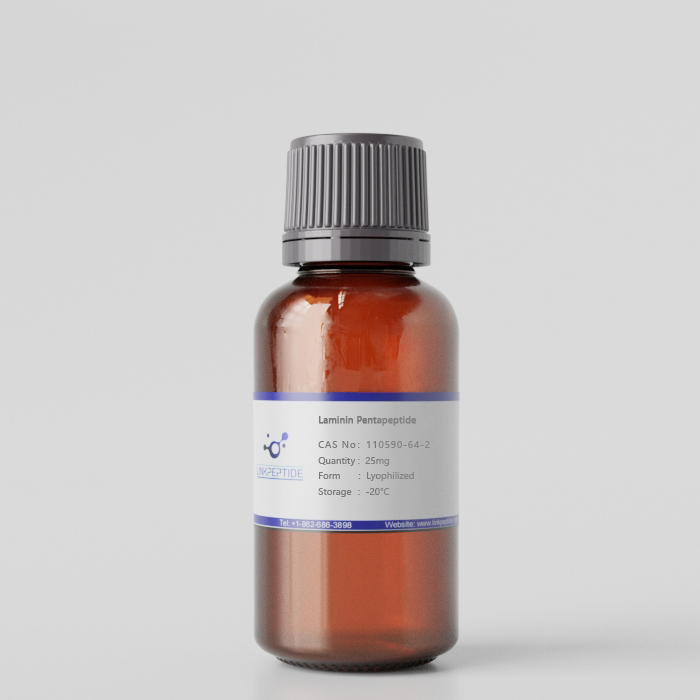
Product Name: Laminin Pentapeptide
Sequence One Letter Code: YIGSR
Sequence Three Letter Code: H-Tyr-Ile-Gly-Ser-Arg-OH
Cas No: 110590-64-2
Chemical Formula:C26H42N8O8
Molecular Weight: 594.7
Purity: 95%
Form: Lyophilized
Storage Conditions: - 20 °C
Research Area: Cell Penetrating Peptides
SMILES: CC[C@H](C)[C@@H](C(=O)NCC(=O)N[C@@H](CO)C(=O)N[C@@H](CCCN=C(N)N)C(=O)O)NC(=O)[C@H](CC1=CC=C(C=C1)O)N
IUPAC: (2S)-2-[[(2S)-2-[[2-[[(2S,3S)-2-[[(2S)-2-amino-3-(4-hydroxyphenyl)propanoyl]amino]-3-methylpentanoyl]amino]acetyl]amino]-3-hydroxypropanoyl]amino]-5-(diaminomethylideneamino)pentanoic acid
INCHIKEY: MWOGMBZGFFZBMK-LJZWMIMPSA-N
INCHI:
InChI=1S/C26H42N8O8/c1-3-14(2)21(34-22(38)17(27)11-15-6-8-16(36)9-7-15)24(40)31-12-20(37)32-19(13-35)23(39)33-18(25(41)42)5-4-10-30-26(28)29/h6-9,14,17-19,21,35-36H,3-5,10-13,27H2,1-2H3,(H,31,40)(H,32,37)(H,33,39)(H,34,38)(H,41,42)(H4,28,29,30)/t14-,17-,18-,19-,21-/m0/s1
Source / Species: mouse
Conjugation: Unconjugated
Code Nacres: NA.26
Application: Laminin Pentapeptide is a short bioactive fragment derived from laminin, a key extracellular matrix glycoprotein involved in tissue architecture and cell adhesion. Laminin-derived motifs interact with cell surface receptors to regulate attachment, migration, and differentiation during development and tissue repair. This pentapeptide serves as a functional motif for studying cell–matrix interactions and adhesion signaling pathways. It is commonly incorporated into biomaterials and culture systems to modulate cellular behavior in vitro. The peptide is widely used in cell biology, developmental biology, and regenerative medicine research to examine extracellular matrix–mediated regulation of tissue organization and morphogenesis.
Current Research: Laminin Pentapeptide is a short bioactive fragment derived from laminin, a major extracellular matrix (ECM) glycoprotein that plays a central role in basement membrane structure and cell–matrix interactions. Laminins are heterotrimeric proteins composed of α, β, and γ chains that assemble into networks supporting tissue architecture. Specific short peptide motifs within laminin mediate binding to cell surface receptors and regulate adhesion, migration, differentiation, and survival. The Laminin Pentapeptide represents one such functional motif and provides a defined tool for studying ECM-dependent signaling mechanisms. Laminin and Cell–Matrix Interactions Laminin is a key structural component of basement membranes in epithelial, endothelial, neural, and muscle tissues. It interacts with integrins, dystroglycan, syndecans, and other adhesion receptors to coordinate cytoskeletal organization and intracellular signaling. These interactions are essential for embryonic development, tissue maintenance, and wound repair. Short laminin-derived sequences have been identified as minimal receptor-binding domains that retain biological activity independent of the full-length protein. The Laminin Pentapeptide reproduces critical aspects of these interactions, enabling focused investigation of ECM-mediated cellular responses. Mechanisms of Cellular Regulation Engagement of laminin receptors activates intracellular signaling pathways involving focal adhesion kinase (FAK), Src family kinases, PI3K/Akt, and MAPK cascades. These pathways regulate: Cell attachment and spreading Cytoskeletal rearrangement Directed cell migration Survival and anti-apoptotic signaling Lineage-specific differentiation Because the pentapeptide represents a defined receptor-interacting motif, it allows researchers to isolate the contribution of laminin-specific signaling from other ECM components. Applications in Cell Biology and Development Laminin-derived peptides are widely used in cell culture systems to enhance cell adhesion and modulate behavior. The Laminin Pentapeptide can be applied in: Adhesion assays Migration and invasion studies Neurite outgrowth experiments Stem cell differentiation models Tissue morphogenesis investigations In developmental biology research, laminin signaling is critical for organogenesis and basement membrane assembly. The pentapeptide supports mechanistic studies of receptor-mediated processes guiding tissue patterning. Biomaterials and Regenerative Medicine The incorporation of laminin motifs into biomaterials and scaffold systems is a common strategy in regenerative medicine. By presenting bioactive peptide sequences on synthetic or natural substrates, researchers can mimic ECM cues and influence cellular organization. The Laminin Pentapeptide is frequently used to functionalize surfaces, hydrogels, or three-dimensional scaffolds to promote controlled cell attachment and tissue integration. Such applications are relevant in neural regeneration, vascular graft engineering, and epithelial tissue reconstruction. Experimental Advantages Minimal bioactive ECM motif Defined and reproducible receptor interaction Suitable for coating, conjugation, and scaffold integration Supports controlled study of adhesion signaling pathways Compatible with in vitro and biomaterial-based systems Because of its short length and defined structure, the peptide offers greater experimental consistency compared to full-length laminin proteins, which may vary in composition and purity. Research Significance Laminin Pentapeptide provides a streamlined platform for investigating extracellular matrix–mediated regulation of cellular behavior. By reproducing essential receptor-binding functions of laminin, it supports detailed analysis of adhesion signaling, tissue organization, and morphogenetic processes. Its versatility in cell culture and biomaterial applications makes it a valuable reagent in cell biology, developmental biology, and regenerative medicine research.
Get a Quote
 LinkPeptide

![[Glu3]-RGES, Control for RGD Peptides](https://www.linkpeptide.com/wp-content/uploads/2026/06/Glu3-RGES-Control-for-RGD-Peptides.jpg "[Glu3]-RGES, Control for RGD Peptides")