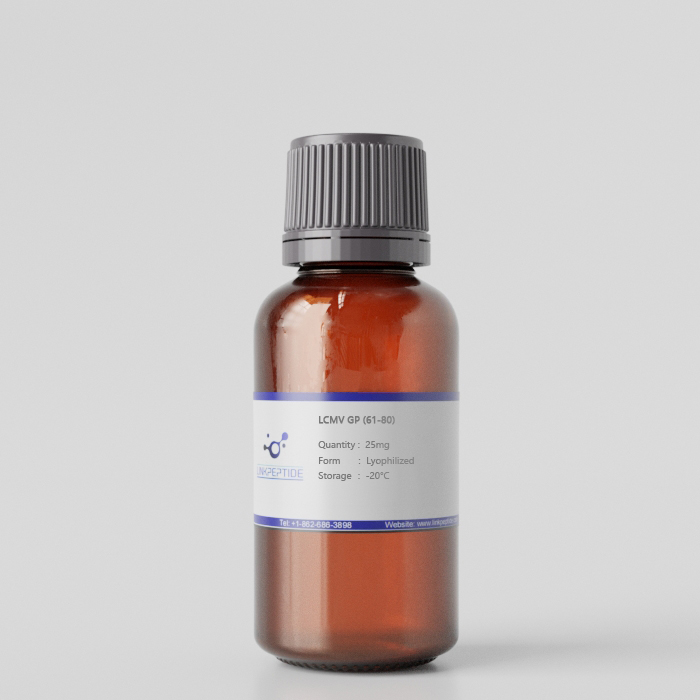
Product Name: LCMV GP (61-80)
Sequence One Letter Code: GLKGPDIYKGVYQFKSVEFD
Sequence Three Letter Code: H-Gly-Leu-Lys-Gly-Pro-Asp-Ile-Tyr-Lys-Gly-Val-Tyr-Gln-Phe-Lys-Ser-Val-Glu-Phe-Asp-OH
Chemical Formula:C108H160N24O31
Molecular Weight: 2290.7
Purity: 95%
Form: Lyophilized
Storage Conditions: - 20 °C
Research Area: Inflammation and Immunology Research
Source / Species: LCMV
Conjugation: Unconjugated
Code Nacres: NA.26
Application: LCMV GP (61–80) is a synthetic peptide corresponding to residues 61–80 of the lymphocytic choriomeningitis virus glycoprotein. This epitope is recognized by CD4⁺ T cells and is extensively used to study antigen presentation and helper T-cell activation. The peptide serves as a defined model antigen in assays evaluating adaptive immune responses, including proliferation, cytokine production, and T-cell differentiation. It is broadly applied in investigations of host–virus interactions, viral pathogenesis, and immune memory formation. Additionally, LCMV GP (61–80) supports epitope mapping and vaccine research aimed at characterizing virus-specific T-cell responses in experimental infection models.
Current Research: Understanding how the immune system recognizes viral antigens is essential for deciphering mechanisms of infection control, immune memory formation, and vaccine-induced protection. Experimental models that provide well-defined antigenic epitopes have played a crucial role in advancing this field. Among the most widely used systems is the lymphocytic choriomeningitis virus (LCMV) model, which has become a cornerstone of modern immunology. Within this system, the LCMV GP (61–80) peptide, corresponding to amino acid residues 61–80 of the viral glycoprotein, serves as a classical epitope used to investigate CD4⁺ T-cell responses and antigen presentation mechanisms. LCMV as a Model for Studying Antiviral Immunity LCMV is a rodent-borne arenavirus that has been extensively studied in laboratory mice. Because the immune responses to LCMV infection are well characterized and reproducible, the virus has become a powerful experimental model for examining host–virus interactions. Research using LCMV has contributed significantly to fundamental discoveries in immunology, including the mechanisms of T-cell activation, immune exhaustion, and immunological memory. The viral glycoprotein (GP) is a major antigenic component of LCMV and is processed by antigen-presenting cells into multiple peptide fragments that can be displayed on major histocompatibility complex (MHC) molecules. These peptide–MHC complexes are recognized by T-cell receptors, triggering adaptive immune responses. Among these fragments, the GP (61–80) region is a prominent epitope recognized by CD4⁺ helper T cells. Role of the GP (61–80) Epitope in CD4⁺ T-Cell Recognition The LCMV GP (61–80) peptide is presented by MHC class II molecules, enabling recognition by CD4⁺ T lymphocytes. These helper T cells are essential coordinators of adaptive immunity, supporting both cellular and humoral immune responses. Upon recognition of the GP (61–80) epitope on antigen-presenting cells such as dendritic cells or macrophages, CD4⁺ T cells become activated and undergo proliferation and differentiation. Activated CD4⁺ T cells produce cytokines that regulate immune responses and help orchestrate the activity of other immune cells. For example, helper T cells promote B-cell antibody production, assist CD8⁺ cytotoxic T-cell responses, and contribute to the formation of long-term immune memory. Because GP (61–80) triggers well-defined CD4⁺ T-cell responses, it has become a valuable antigenic peptide for studying the mechanisms underlying helper T-cell activation and function. Applications in Antigen Presentation Studies The GP (61–80) peptide is widely used as a defined model antigen in assays designed to investigate antigen presentation pathways. In experimental systems, the synthetic peptide can be directly loaded onto MHC class II molecules of antigen-presenting cells, bypassing the need for complex antigen processing. This approach allows researchers to examine specific aspects of immune recognition with greater precision. Using GP (61–80), scientists can evaluate how antigen-presenting cells stimulate CD4⁺ T cells and how co-stimulatory signals influence T-cell activation. The peptide is commonly used in assays measuring T-cell proliferation, where activated lymphocytes expand in response to antigen stimulation. It is also used in experiments assessing cytokine production, including key immune mediators such as interferon-γ, interleukin-2, and other regulatory cytokines associated with T-cell differentiation. Investigating T-Cell Differentiation and Immune Memory Another major application of the LCMV GP (61–80) peptide is the study of T-cell differentiation pathways. CD4⁺ T cells can develop into multiple specialized subsets—including Th1, Th2, Th17, and regulatory T cells—depending on the cytokine environment and antigenic stimulation. Experiments using GP (61–80) enable researchers to analyze how viral epitopes influence these differentiation processes. In the context of viral infection models, the peptide is also used to study immune memory formation. Memory T cells provide long-term protection by responding rapidly upon re-exposure to the same antigen. By tracking GP (61–80)-specific T cells over time, investigators can examine how memory populations develop, persist, and respond to secondary infections. Insights into Viral Pathogenesis and Host–Virus Interactions Research using the LCMV model has revealed important insights into viral pathogenesis and immune regulation. For instance, studies of GP (61–80)-specific CD4⁺ T cells have helped clarify how helper T cells support effective antiviral immunity and how dysregulated responses can contribute to immunopathology. The peptide is also valuable in exploring mechanisms of chronic viral infection and T-cell dysfunction, particularly in models where persistent viral exposure leads to altered immune responses. These investigations have helped illuminate the balance between protective immunity and immune-mediated tissue damage during viral infection. Applications in Epitope Mapping and Vaccine Research Beyond basic immunology, the GP (61–80) peptide is frequently used in epitope mapping studies, where researchers identify and characterize antigenic regions of viral proteins that are recognized by T cells. Mapping these epitopes provides important information about immune recognition patterns and antigen immunodominance. In vaccine research, well-defined epitopes like GP (61–80) help scientists evaluate how candidate vaccines stimulate virus-specific T-cell responses. By measuring proliferation, cytokine production, and memory formation in response to the peptide, researchers can assess the effectiveness of experimental immunization strategies. Conclusion The LCMV GP (61–80) peptide has become an essential experimental tool in immunological research. Derived from the glycoprotein of lymphocytic choriomeningitis virus, this peptide represents a well-characterized epitope recognized by CD4⁺ T cells and serves as a model antigen for studying antigen presentation and helper T-cell activation. Through its application in proliferation assays, cytokine analysis, immune memory studies, and epitope mapping, GP (61–80) continues to support investigations into antiviral immunity and host–virus interactions. As a defined and reproducible antigenic peptide, it remains a valuable resource for researchers exploring the molecular and cellular mechanisms that shape adaptive immune responses.
Get a Quote
 LinkPeptide