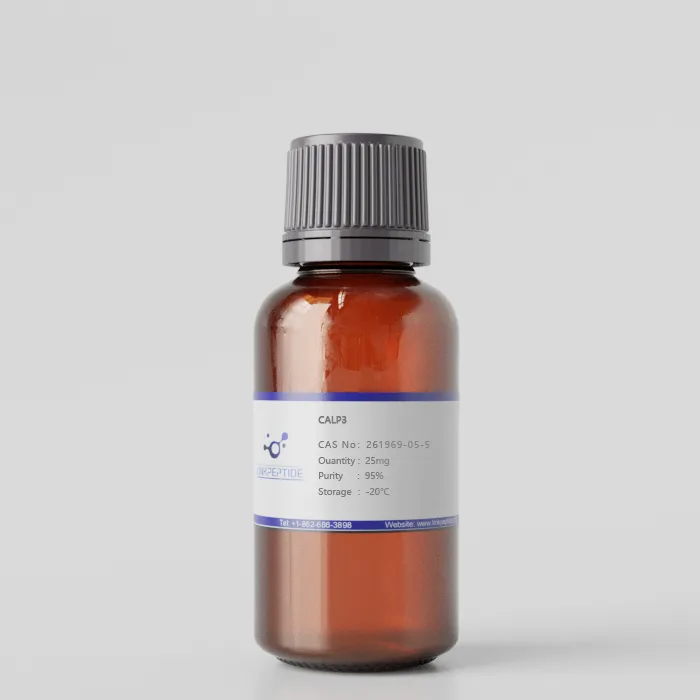
Product Name: [Lys(Ac)382]-p53 (372-389), human
Sequence One Letter Code: KKGQSTSRHK-K(Ac)-LMFKTEG
Sequence Three Letter Code: H-Lys-Lys-Gly-Gln-Ser-Thr-Ser-Arg-His-Lys-Lys(Ac)-Leu-Met-Phe-Lys-Thr-Glu-Gly-OH
Molecular Weight: 2133.6
Purity: 95%
Form: Lyophilized
Storage Conditions: - 20 °C
Research Area: Cancer Disease Research
Source / Species: human
Conjugation: Unconjugated
Code Nacres: NA.26
Application: [Lys(Ac)382]-p53 (372–389) is a synthetic peptide derived from the C-terminal regulatory region of human p53 and acetylated at lysine 382. Acetylation at this site enhances p53 transcriptional activity and influences DNA binding, cell cycle arrest, and apoptotic signaling. This peptide is commonly used to study post-translational regulation of p53, modification-dependent protein interactions, and epigenetic control of tumor suppressor function. It supports biochemical assays examining acetylation-specific binding partners and regulatory mechanisms relevant to cancer biology.
Current Research: The tumor suppressor p53 is a central regulator of genomic integrity, orchestrating transcriptional programs that govern cell cycle arrest, DNA repair, senescence, and apoptosis. Its activity is tightly controlled by a network of post-translational modifications (PTMs), including phosphorylation, ubiquitination, methylation, and acetylation. Among these, acetylation of lysine 382 (K382) within the C-terminal regulatory domain is a critical modification associated with enhanced transcriptional activation and stabilization of p53. [Lys(Ac)382]-p53 (372–389) is a synthetic peptide corresponding to residues 372–389 of human p53, incorporating a site-specific acetylation at K382. This reagent provides a focused platform for investigating acetylation-dependent regulation of p53 function. The C-terminal region of p53 (residues ~360–393) is intrinsically disordered and serves as a regulatory hub that modulates DNA binding affinity and protein–protein interactions. Lysine residues within this domain are targets of histone acetyltransferases (HATs) such as p300/CBP and PCAF. Acetylation at K382 has been shown to enhance sequence-specific DNA binding by reducing electrostatic interactions that otherwise constrain p53’s core DNA-binding domain. This modification also antagonizes ubiquitination at overlapping lysine residues, thereby stabilizing p53 and promoting transcriptional activation of downstream target genes such as CDKN1A (p21), BAX, and PUMA. The [Lys(Ac)382]-p53 (372–389) peptide is widely used in biochemical assays to dissect modification-dependent binding events. For example, peptide pull-down experiments employing acetylated and non-acetylated counterparts enable identification of acetylation-sensitive interactors. Bromodomain-containing proteins, which recognize acetyl-lysine motifs, can be evaluated for selective binding to the K382-acetylated sequence. Such studies clarify how acetylation recruits transcriptional coactivators or chromatin-modifying complexes to p53-responsive promoters. In addition to bromodomain recognition, acetylation at K382 influences interactions with regulatory proteins such as MDM2, the principal E3 ubiquitin ligase that targets p53 for proteasomal degradation. By using the acetylated peptide in competitive binding assays, researchers can examine how K382 modification alters MDM2 affinity or affects recruitment of deacetylases such as SIRT1 and HDACs. These experiments provide insight into the dynamic interplay between acetylation and deacetylation in controlling p53 stability and transcriptional potency. The peptide is also suitable for structural and biophysical analyses. Techniques such as isothermal titration calorimetry (ITC), surface plasmon resonance (SPR), and fluorescence polarization allow quantitative measurement of binding affinities between the acetylated motif and candidate regulatory domains. Comparisons with unmodified p53 (372–389) peptides delineate the energetic contribution of acetylation to complex formation. Such quantitative data are valuable in understanding how specific PTMs fine-tune transcription factor activity. In cancer biology, dysregulation of p53 acetylation contributes to impaired tumor suppressor function. Reduced acetylation at K382 is observed in certain malignancies, often due to overexpression of deacetylases or defective HAT activity. The [Lys(Ac)382]-p53 peptide supports mechanistic studies aimed at restoring p53 activity through modulation of acetylation pathways. It can be used to evaluate small-molecule inhibitors of deacetylases or compounds that enhance p300/CBP-mediated acetylation, thereby informing therapeutic strategies designed to reactivate p53 signaling in tumors retaining wild-type p53. Furthermore, the peptide facilitates investigation of epigenetic cross-talk between histone modifications and transcription factor acetylation. Because p53 acetylation status influences chromatin accessibility at target genes, examining K382-specific interactions helps clarify how PTMs integrate stress signaling with transcriptional output. In summary, [Lys(Ac)382]-p53 (372–389) is a site-specifically acetylated peptide derived from the C-terminal regulatory region of p53. By modeling a key post-translational modification that enhances transcriptional activity and stability, it serves as a precise tool for studying acetylation-dependent protein interactions, regulatory mechanisms, and epigenetic control of tumor suppressor function. Its application advances understanding of p53 regulation and supports cancer research focused on modulating PTM-driven signaling pathways.
Get a Quote
 LinkPeptide
![[Lys(Ac)382]-p53 (372-389), human](https://www.linkpeptide.com/wp-content/uploads/2026/06/LysAc382-p53-372-389-human.jpg)