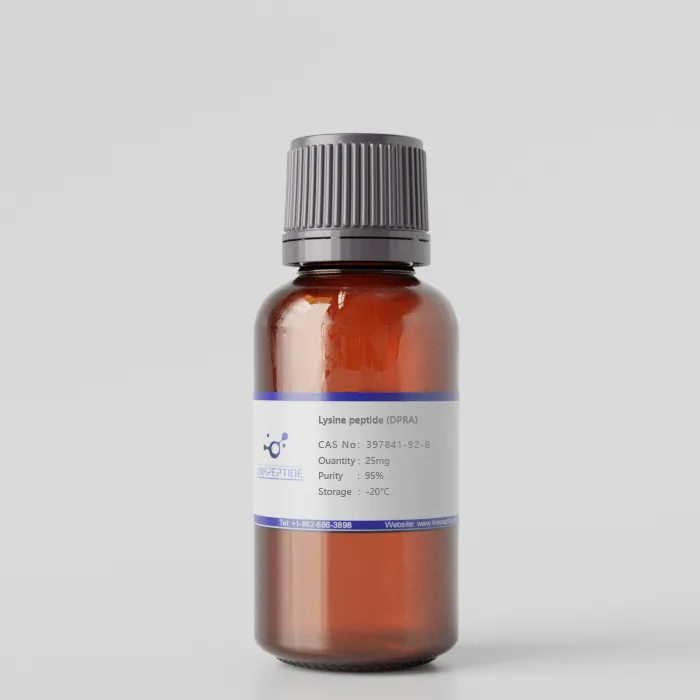
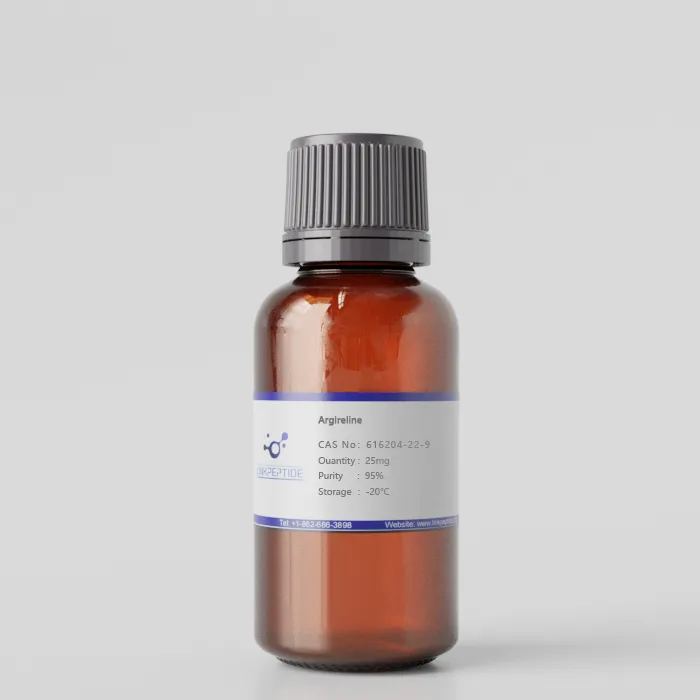
Product Name: Lysine peptide (DPRA)
Cas No: 397841-92-8
Purity: 95%
Storage: Keep in dark and cool dry place -5~8 degree Celsius
Sequence: Ac-RFAAKAA-COOH
Synonyms: α-N-(2-(1-naphthyl)acetyl)-L-Lysine
Application:
Lysine Peptide (DPRA) is a synthetic heptapeptide engineered for the Direct Peptide Reactivity Assay, an established in vitro method for evaluating skin sensitization. Containing a primary amine–bearing lysine residue, this peptide functions as an electrophile-reactive probe to measure peptide depletion following exposure to test compounds. Its defined sequence, high stability, and batch-to-batch consistency support precise quantification and robust DPRA performance. Widely used in cosmetic safety assessment, chemical screening, and toxicology research, this peptide enables reliable characterization of nucleophile–electrophile interactions within regulatory-aligned, animal-alternative testing workflows.
Current Research:
Current Research on Lysine Peptide (DPRA) in Cosmetic Safety Assessment
Lysine peptide, used in the Direct Peptide Reactivity Assay (DPRA), is a key component of modern non-animal approaches to evaluating the skin sensitization potential of cosmetic ingredients. While cysteine peptides often receive more attention because of their high reactivity, current research increasingly emphasizes the complementary and sometimes unique role of lysine peptides in capturing a broader spectrum of chemical reactivity.
DPRA is built on the concept that many skin sensitizers are electrophiles that form covalent bonds with nucleophilic amino acid residues in skin proteins. Lysine, with its primary amine side chain, represents one of the major nucleophilic sites in those proteins. In DPRA, a synthetic lysine-containing peptide is incubated with a test substance, and the reduction in free peptide (peptide depletion) is quantified.
Current research underlines how lysine peptide complements cysteine peptide by better capturing slower-reacting or less thiol-selective electrophiles. Some cosmetic ingredients, such as certain fragrance aldehydes, reactive dyes, and acylating agents, can show more pronounced interaction with lysine peptide, improving overall assay sensitivity and chemical domain coverage.
One active research area is chemical “domain mapping” within DPRA: understanding which structural classes of cosmetic ingredients preferentially react with cysteine versus lysine peptides. Studies show that soft electrophiles, like Michael acceptors, often react strongly with cysteine, whereas harder electrophiles, such as some aldehydes and acyl chlorides, exhibit greater or more balanced reactivity toward lysine.
This has several implications for cosmetic safety assessment:
It supports using both peptides together to minimize false negatives.
It encourages re-evaluation of borderline or ambiguous results where cysteine depletion is weak but lysine depletion is more pronounced.
It helps formulators understand structure–reactivity relationships when designing new cosmetic raw materials.
As with cysteine, recent work shows that the performance of the lysine peptide reagent is a major determinant of DPRA reliability. Researchers examine factors such as peptide sequence design, purity profile, solubility in organic–aqueous mixtures, and long-term storage stability.
For lysine peptide, solubility and stability in the presence of organic solvents used in DPRA (for example, acetonitrile) are particularly important. Degradation or aggregation of the peptide can alter peak shape and area in chromatographic analysis, leading to inaccurate depletion values. This drives demand for lysine peptides with:
High chemical and sequence purity
Robust stability data
Minimal lot-to-lot variation
Service laboratories and cosmetic companies increasingly expect detailed certificates of analysis and method support for both cysteine and lysine peptides.
In kinetic DPRA approaches, multiple timepoints are used to track peptide depletion rates. While cysteine often dominates the discussion due to its higher reactivity, current research also explores the kinetic behavior of lysine peptide. For certain cosmetic ingredients, the kinetics of lysine adduct formation can provide additional insights into potency and reaction mechanisms.
Advanced DPRA modifications that use mass spectrometry, miniaturised formats, or automated liquid handling still rely on both peptide types. In these systems, lysine peptide can help:
Identify multiple adduct structures with the same ingredient
Characterize different reaction pathways (for example, Schiff base formation with aldehydes)
Clarify why some ingredients show inconsistent patterns in traditional DPRA readouts
Within integrated testing strategies for cosmetics, DPRA data are evaluated together with keratinocyte activation assays, dendritic cell assays, and sometimes 3D skin models. The lysine peptide contributes critical information to that weight-of-evidence by improving detection of chemicals that might otherwise appear weakly reactive if only cysteine-based data were considered.
For cosmetic developers, this means:
More confidence that strongly sensitizing candidates are identified early.
Better discrimination among analogues when optimizing fragrance mixtures, preservatives, and other actives.
Stronger scientific justification when presenting non-animal data packages to regulators.
In today’s research and regulatory environment, a dedicated lysine peptide optimized for DPRA is more than just a companion to cysteine peptide. It is:
A necessary reagent for full coverage of electrophilic mechanisms relevant to cosmetic ingredients.
A contributor to potency and domain analyses in kinetic and advanced DPRA versions.
A quality-critical component that directly affects the reliability of non-animal safety assessments.
By providing a well-characterized, stable, and DPRA-validated lysine peptide, a cosmetic supplier or testing lab supports robust skin sensitization prediction, aligns with international non-animal testing trends, and strengthens the scientific foundation of cosmetic safety evaluations.
Get a Quote
 LinkPeptide