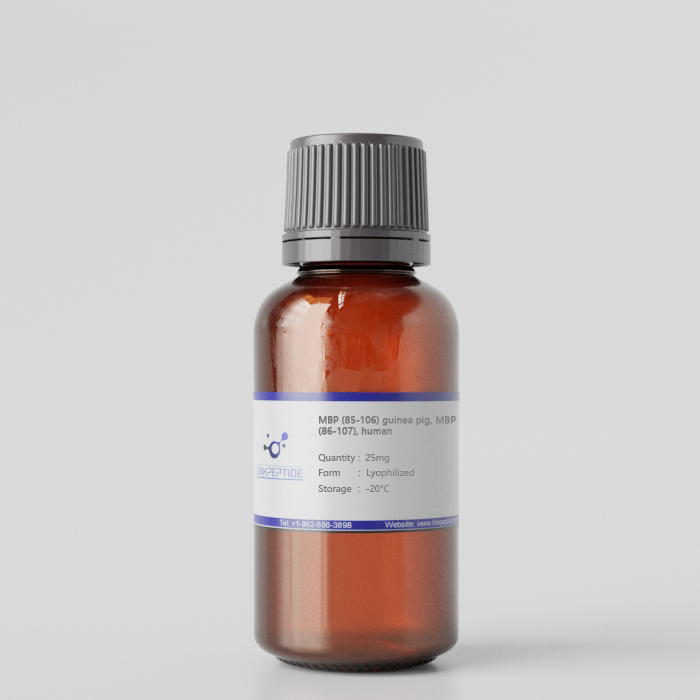
Product Name: MBP (85-106) guinea pig, MBP (86-107), human
Sequence One Letter Code: VVHFFKNIVTPRTPPPSQGKGR
Sequence Three Letter Code: H-Val-Val-His-Phe-Phe-Lys-Asn-Ile-Val-Thr-Pro-Arg-Thr-Pro-Pro-Pro-Ser-Gln-Gly-Lys-Gly-Arg-OH
Chemical Formula:C113H180N34O28
Molecular Weight: 2462.9
Purity: 95%
Form: Lyophilized
Storage Conditions: - 20 °C
Research Area: Inflammation and Immunology Research
Source / Species: guinea pig, human
Conjugation: Unconjugated
Code Nacres: NA.26
Application: This peptide corresponds to residues 85–106 of guinea pig myelin basic protein (MBP) and aligns with residues 86–107 of the human MBP sequence. It represents a well-characterized encephalitogenic epitope that has been widely used in studies of multiple sclerosis and experimental autoimmune encephalomyelitis (EAE). The peptide is recognized by autoreactive T cells that target myelin components in the central nervous system, making it an important model antigen for investigating autoimmune neuroinflammation. Researchers commonly use this peptide to study T-cell activation, antigen presentation, and immune responses against myelin proteins. It is particularly useful for exploring the mechanisms of demyelination and the development of autoimmune responses in the central nervous system. The peptide supports immunological and neurological research focused on disease pathogenesis, immune regulation, and the development of therapeutic strategies targeting autoimmune demyelinating disorders.
Current Research: Autoimmune diseases of the central nervous system (CNS), particularly multiple sclerosis (MS), are characterized by immune-mediated destruction of myelin sheaths that insulate neuronal axons. This demyelination disrupts neural signaling and leads to progressive neurological impairment. To better understand the mechanisms driving these disorders, researchers frequently rely on well-defined model antigens that reproduce aspects of the autoimmune response. One such antigen is the MBP (85–106) peptide, a segment derived from myelin basic protein (MBP) that represents a well-characterized encephalitogenic epitope widely used in immunological and neurological research. Myelin Basic Protein and CNS Autoimmunity Myelin basic protein is a major structural component of the myelin sheath, the multilayered membrane that surrounds axons in the central nervous system. Myelin is essential for efficient nerve impulse transmission because it facilitates saltatory conduction, allowing electrical signals to propagate rapidly along nerve fibers. In diseases such as multiple sclerosis, immune cells mistakenly recognize myelin proteins as foreign antigens and initiate inflammatory responses that damage the myelin sheath. Among the various myelin antigens studied in autoimmune demyelinating disorders, MBP has received particular attention due to its strong immunogenic and encephalitogenic properties. Specific regions of MBP can activate autoreactive T cells, triggering inflammatory cascades that lead to demyelination. Identifying and studying these regions has been critical for developing experimental models that mimic aspects of human autoimmune disease. The MBP (85–106) Encephalitogenic Epitope The MBP (85–106) peptide corresponds to residues 85–106 of guinea pig MBP, which aligns closely with residues 86–107 of the human MBP sequence. This region represents one of the most extensively studied T-cell epitopes associated with autoimmune responses to myelin. Because of its strong ability to activate autoreactive T cells, the peptide has been widely used as a model antigen in research on multiple sclerosis and related disorders. Autoreactive CD4⁺ T lymphocytes can recognize peptides derived from myelin proteins when presented by major histocompatibility complex (MHC) molecules on antigen-presenting cells. The MBP (85–106) peptide effectively stimulates these T cells, making it a powerful tool for studying the processes that initiate autoimmune responses in the CNS. Through this interaction, researchers can investigate how immune cells recognize myelin-derived antigens and how these responses contribute to inflammatory damage in neural tissue. Role in Experimental Autoimmune Encephalomyelitis Models A major application of the MBP (85–106) peptide is in the study of experimental autoimmune encephalomyelitis (EAE), the most widely used animal model for multiple sclerosis. EAE reproduces many pathological features observed in human MS, including immune cell infiltration into the CNS, inflammatory cytokine production, and demyelination. In EAE models, peptides derived from myelin proteins—such as MBP (85–106)—are used to induce antigen-specific immune responses. Once introduced into the immune system, the peptide can stimulate T cells that recognize myelin components. These activated immune cells migrate into the central nervous system, where they initiate inflammatory processes that damage myelin and disrupt neural function. Using defined peptides like MBP (85–106) allows researchers to control the antigenic stimulus that drives disease development. This controlled system provides a powerful platform for studying disease mechanisms, including T-cell differentiation, cytokine signaling, and immune cell trafficking into the CNS. Studying T-Cell Activation and Antigen Presentation The MBP (85–106) peptide is also widely used in studies examining T-cell activation and antigen presentation pathways. When antigen-presenting cells such as dendritic cells or macrophages process and present MBP-derived peptides via MHC class II molecules, they can activate MBP-specific T cells. This process provides a model system for exploring how immune tolerance breaks down and how autoreactive immune responses develop. Researchers frequently use the peptide to investigate T-cell receptor recognition, cytokine secretion patterns, and immune regulation mechanisms. Such studies have provided insights into how different T-cell subsets—including Th1 and Th17 cells—contribute to neuroinflammation and tissue damage in autoimmune diseases. Insights Into Demyelination and Neuroinflammation Beyond its role in immune activation studies, the MBP (85–106) peptide has helped researchers better understand the molecular and cellular mechanisms underlying demyelination. Immune responses triggered by MBP peptides can lead to inflammatory signaling within the CNS, activation of microglia, and recruitment of peripheral immune cells. By studying how MBP-reactive immune cells interact with neural tissue, scientists can examine the complex interplay between immune responses and neuronal health. These investigations have contributed to a deeper understanding of how chronic inflammation drives axon damage, myelin loss, and neurological dysfunction. Supporting Research on Therapeutic Strategies Because the MBP (85–106) peptide serves as a defined antigen for autoimmune responses, it has also been valuable in research aimed at developing therapeutic strategies for autoimmune demyelinating disorders. Investigators use this peptide to evaluate approaches that modulate immune tolerance, suppress pathogenic T-cell activity, or promote regulatory immune responses. Experimental therapies targeting antigen-specific immune pathways can be assessed using MBP-derived epitopes, helping researchers determine whether potential treatments can alter disease progression or prevent immune-mediated damage to myelin. A Valuable Model Antigen for Neuroimmunology The MBP (85–106) peptide remains an important experimental tool for studying the immune mechanisms that drive demyelinating diseases. Its well-defined antigenic properties make it particularly useful for examining T-cell responses, antigen presentation, and neuroinflammatory pathways in both in vitro and in vivo systems. As research into autoimmune neurological disorders continues to expand, model antigens like MBP (85–106) will remain essential for advancing our understanding of disease pathogenesis and for supporting the development of new therapeutic strategies targeting immune-mediated damage in the central nervous system.
Get a Quote
 LinkPeptide