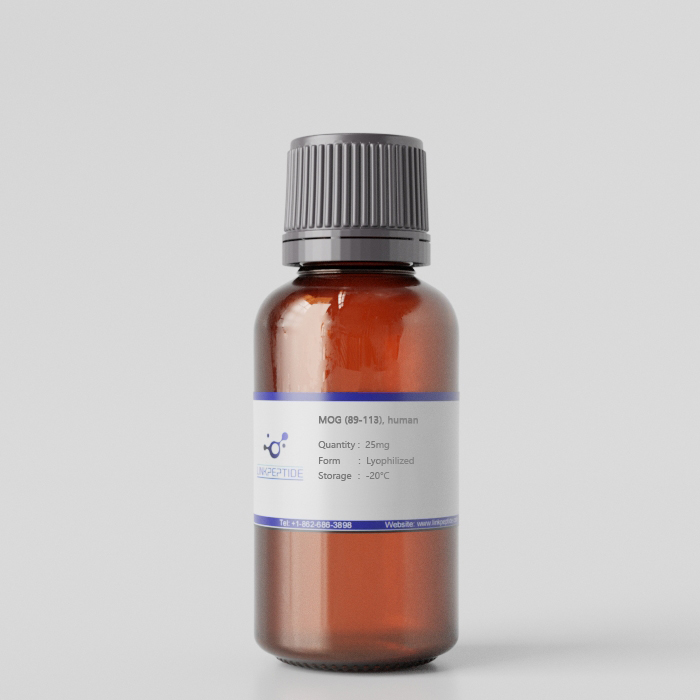
Product Name: MOG (89-113), human
Sequence One Letter Code: RFSDEGGFTCFFRDHSYQEEAAMEL
Sequence Three Letter Code: H-Arg-Phe-Ser-Asp-Glu-Gly-Gly-Phe-Thr-Cys-Phe-Phe-Arg-Asp-His-Ser-Tyr-Gln-Glu-Glu-Ala-Ala-Met-Glu-Leu-OH
Chemical Formula:C130H182N34O43S2
Molecular Weight: 2973.4
Purity: 95%
Form: Lyophilized
Storage Conditions: - 20 °C
Research Area: Inflammation and Immunology Research
Source / Species: human
Conjugation: Unconjugated
Code Nacres: NA.26
Application: This peptide corresponds to residues 89–113 of human myelin oligodendrocyte glycoprotein (MOG) and represents an HLA-DR2–restricted epitope recognized by autoreactive T cells. MOG is a myelin-associated protein expressed on the outer surface of oligodendrocytes and plays a role in central nervous system immune responses. The MOG (89–113) fragment is widely used in immunological studies investigating autoimmune mechanisms associated with multiple sclerosis and related demyelinating disorders. It supports experiments examining antigen presentation, T-cell activation, and immune tolerance to myelin-derived antigens. The peptide is commonly applied in both in vitro and in vivo models to explore neuroinflammation, autoreactive T-cell responses, and mechanisms driving autoimmune demyelination in the central nervous system.
Current Research: Autoimmune diseases of the central nervous system (CNS) often arise when immune cells mistakenly recognize components of neural tissue as foreign. One of the most studied targets in this context is myelin oligodendrocyte glycoprotein (MOG), a protein expressed on the outer surface of oligodendrocytes and within the myelin sheath that insulates neuronal axons. Among the peptide fragments derived from this protein, MOG (89–113) has become a widely used antigen in immunological research. This peptide corresponds to residues 89–113 of human MOG and represents an HLA-DR2–restricted epitope recognized by autoreactive T cells. Because of its strong immunological relevance, it is frequently employed to investigate mechanisms underlying multiple sclerosis (MS) and other autoimmune demyelinating diseases. Biological Role of Myelin Oligodendrocyte Glycoprotein Myelin oligodendrocyte glycoprotein is a minor but functionally important component of the myelin sheath, the multilayered membrane structure that surrounds axons in the central nervous system. Myelin enables rapid electrical signal conduction along neurons and supports overall neural communication. Although MOG accounts for only a small fraction of total myelin proteins, its location on the outermost surface of the myelin sheath makes it highly accessible to immune surveillance. This structural positioning contributes to its recognition as an autoantigen in inflammatory demyelinating conditions. Research suggests that MOG participates in processes related to myelin stability, immune signaling, and cell–cell interactions within the CNS. However, when immune tolerance to this protein is disrupted, MOG-derived epitopes can trigger autoreactive immune responses that damage myelin and impair neuronal function. MOG (89–113) as an Immunodominant T-Cell Epitope The MOG (89–113) peptide represents a specific segment of the MOG protein that can be presented by HLA-DR2 major histocompatibility complex (MHC) class II molecules. In this context, the peptide functions as a T-cell antigen capable of activating CD4⁺ T lymphocytes. Autoreactive T cells recognizing this epitope have been identified in individuals with autoimmune demyelinating diseases. Upon antigen presentation by professional antigen-presenting cells (APCs), these T cells can initiate inflammatory immune responses that contribute to demyelination and neural damage. Because of its ability to stimulate T-cell responses, the MOG (89–113) peptide has become a valuable experimental antigen for examining how immune recognition of myelin components contributes to autoimmune pathology. Applications in Multiple Sclerosis Research Multiple sclerosis is a chronic inflammatory disease characterized by immune-mediated destruction of myelin within the central nervous system. Although the precise causes of MS remain complex and multifactorial, autoreactive T-cell responses against myelin proteins are believed to play a central role in disease progression. The MOG (89–113) peptide is commonly used in research to explore several aspects of MS-related immune activity, including: Antigen presentation mechanisms involving MHC class II molecules Activation and proliferation of autoreactive CD4⁺ T cells Cytokine responses and inflammatory signaling pathways Immune tolerance and regulatory T-cell function By studying immune responses triggered by this defined peptide epitope, researchers can better understand the cellular and molecular mechanisms that drive autoimmune demyelination. Use in Experimental Autoimmune Encephalomyelitis Models In addition to in vitro immunological studies, the MOG (89–113) peptide is frequently used in experimental autoimmune encephalomyelitis (EAE) models. EAE is one of the most widely used animal models for studying multiple sclerosis because it reproduces many of the immunological and pathological features of the disease. Administration of myelin-derived peptides such as MOG fragments can trigger T-cell–mediated inflammation and demyelination in susceptible animal strains. These models allow researchers to investigate: Mechanisms of neuroinflammation Migration of immune cells into the central nervous system The role of cytokines and chemokines in disease progression Potential therapeutic strategies for controlling autoimmune responses Using defined peptides like MOG (89–113) provides experimental consistency and allows researchers to focus on specific antigen-driven immune mechanisms. Investigating Neuroinflammation and Immune Tolerance Beyond its role in disease modeling, the MOG (89–113) peptide is also used to study immune tolerance mechanisms and the regulation of autoreactive T-cell responses. Understanding how immune tolerance fails in autoimmune diseases is critical for developing strategies that restore immune balance without broadly suppressing immunity. Experiments using this peptide help clarify how antigen-presenting cells process myelin antigens, how T cells become activated in inflammatory environments, and how regulatory pathways can limit harmful immune responses. These insights contribute to broader efforts aimed at designing targeted immunotherapies for autoimmune neurological disorders. Advancing Research on Autoimmune Demyelination Defined antigenic peptides are powerful tools for investigating the immune processes involved in neurological disease. The MOG (89–113) peptide provides researchers with a well-characterized epitope that reliably stimulates myelin-specific T-cell responses in experimental systems. Through its application in antigen presentation studies, T-cell activation assays, and neuroinflammatory disease models, this peptide continues to support advances in understanding multiple sclerosis and related demyelinating conditions. By enabling controlled investigation of autoimmune responses to myelin proteins, MOG (89–113) remains an essential reagent in modern immunology and neuroinflammation research.
Get a Quote
 LinkPeptide