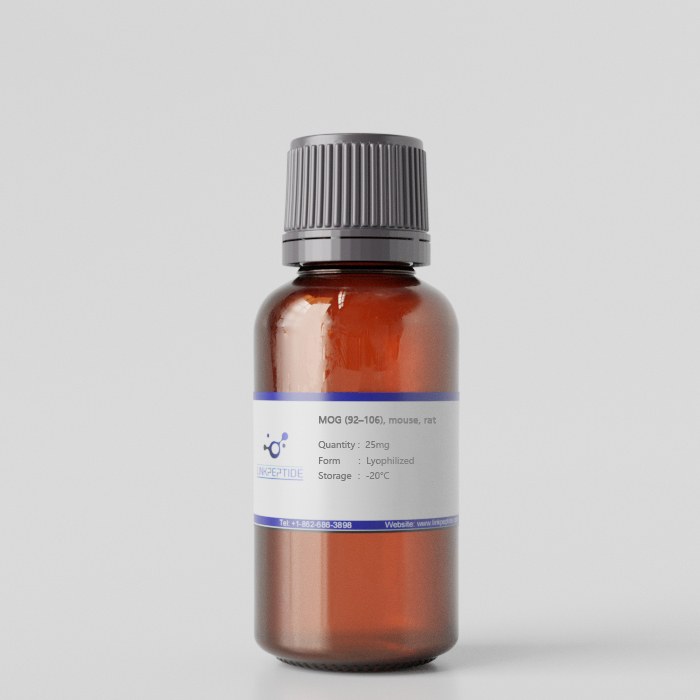
Product Name: MOG (92–106), mouse, rat
Sequence One Letter Code: DEGGYTCFFRDHSYQ
Sequence Three Letter Code: H-Asp-Glu-Gly-Gly-Tyr-Thr-Cys-Phe-Phe-Arg-Asp- His-Ser-Tyr-Gln-OH
Chemical Formula:C80H104N21O27S
Molecular Weight: 1825
Purity: 95%
Form: Lyophilized
Storage Conditions: - 20 °C
Research Area: Inflammation and Immunology Research
Source / Species: mouse, rat
Conjugation: Unconjugated
Code Nacres: NA.26
Application: MOG (92–106) is a synthetic peptide derived from residues 92–106 of myelin oligodendrocyte glycoprotein in mouse and rat. It is a well-established encephalitogenic epitope used in experimental autoimmune encephalomyelitis (EAE) models of multiple sclerosis. Although it induces relatively modest T-cell proliferation, it triggers severe autoimmune pathology characterized by strong B-cell reactivity against myelin antigens. This peptide is extensively used to study autoimmune demyelination, neuroinflammation, and immune mechanisms driving central nervous system autoimmunity. It supports investigations into T cell–B cell interactions and therapeutic strategies targeting multiple sclerosis–like disease.
Current Research: Autoimmune diseases of the central nervous system (CNS), such as multiple sclerosis (MS), arise when the immune system mistakenly targets components of myelin, the insulating sheath that surrounds neuronal axons. One of the most widely used experimental systems for studying these processes is experimental autoimmune encephalomyelitis (EAE), a laboratory model that replicates key features of MS, including immune-mediated demyelination and neuroinflammation. Within this model, defined peptide epitopes derived from myelin proteins are used to trigger disease in animals. The MOG (92–106) peptide, corresponding to residues 92–106 of myelin oligodendrocyte glycoprotein (MOG), is one such epitope that has become an important tool for investigating autoimmune responses in the CNS. Myelin Oligodendrocyte Glycoprotein and CNS Immunity Myelin oligodendrocyte glycoprotein is a minor but immunologically significant component of the myelin sheath produced by oligodendrocytes in the central nervous system. Although it represents a small fraction of total myelin protein, MOG is located on the outermost surface of the myelin membrane, making it accessible to immune recognition. Because of this exposed position, MOG has long been considered a potential target of autoimmune responses in demyelinating diseases. Immune recognition of MOG-derived epitopes can stimulate both T-cell and B-cell responses, leading to inflammation and destruction of myelin in the CNS. Synthetic peptides derived from MOG are therefore commonly used to model autoimmune mechanisms relevant to multiple sclerosis. The MOG (92–106) Encephalitogenic Epitope The MOG (92–106) peptide represents a specific segment of the MOG protein that can trigger autoimmune responses in rodents. When administered in appropriate immunization protocols, this peptide can induce experimental autoimmune encephalomyelitis in mouse and rat models. Unlike some encephalitogenic peptides that primarily stimulate strong T-cell responses, MOG (92–106) is notable for inducing relatively modest T-cell proliferation while still producing severe disease pathology. This distinction has made the peptide particularly valuable for studying complex immune interactions involved in autoimmune demyelination. The pathological responses observed following MOG (92–106) immunization include inflammation within the central nervous system, demyelination, and neurological symptoms that resemble aspects of multiple sclerosis. Role of B Cells in MOG-Induced Autoimmunity A defining characteristic of MOG (92–106)-induced EAE is the strong B-cell response directed against myelin antigens. While T cells are essential for initiating autoimmune inflammation, B cells can contribute significantly to disease progression by producing antibodies that target myelin components. In models using the MOG (92–106) peptide, the immune response often includes the generation of autoantibodies against MOG, which can enhance demyelination and tissue damage. These antibodies may activate complement pathways or promote immune-mediated destruction of myelin structures. Because of this pronounced B-cell involvement, the MOG (92–106) peptide has become a valuable tool for studying T cell–B cell cooperation in autoimmune disease. Investigating Neuroinflammation and Demyelination EAE models induced by MOG-derived peptides provide important insight into the processes that drive neuroinflammation and demyelination. In these models, immune cells infiltrate the central nervous system, where they release cytokines, chemokines, and other inflammatory mediators. These signals can activate resident CNS cells such as microglia and astrocytes, amplifying inflammatory responses and contributing to tissue damage. The resulting demyelination disrupts neuronal signaling and leads to neurological deficits in experimental animals. Using defined peptides such as MOG (92–106), researchers can examine the immune pathways responsible for initiating and sustaining CNS inflammation. Applications in Multiple Sclerosis Research Because EAE shares many immunological features with multiple sclerosis, the MOG (92–106) peptide is widely used in preclinical research on MS pathogenesis. The peptide allows investigators to reproduce key elements of autoimmune demyelination in laboratory models, enabling detailed analysis of disease mechanisms. Researchers use this system to investigate how immune tolerance is lost, how autoreactive lymphocytes become activated, and how immune responses target myelin components. These studies provide insight into the complex interactions between the immune system and the nervous system in autoimmune disease. Studying T Cell–B Cell Interactions The immune responses triggered by MOG (92–106) highlight the importance of cooperation between T cells and B cells in autoimmune pathology. T cells recognizing the peptide can provide help to B cells that produce antibodies against myelin proteins, creating a feedback loop that amplifies immune responses. This interplay is increasingly recognized as an important factor in multiple sclerosis. Modern MS therapies targeting B cells underscore the significance of antibody-mediated mechanisms in disease progression. By using the MOG (92–106) peptide in experimental models, researchers can dissect how T-cell activation leads to B-cell responses and how these interactions contribute to demyelination. Supporting Development of Therapeutic Strategies EAE models based on MOG-derived peptides are widely used to evaluate potential therapies for autoimmune demyelinating diseases. Experimental treatments that target immune cell activation, cytokine signaling, or antibody production can be tested in animals immunized with MOG peptides. These studies help identify strategies for modulating immune responses and preventing damage to myelin and neuronal structures. Conclusion The MOG (92–106) peptide represents a well-characterized encephalitogenic epitope derived from myelin oligodendrocyte glycoprotein. Widely used in experimental autoimmune encephalomyelitis models, it provides a valuable system for studying the immune mechanisms that drive autoimmune demyelination and neuroinflammation. Through its ability to trigger disease characterized by strong B-cell responses and CNS pathology, the peptide supports investigations into T cell–B cell interactions, autoimmune signaling pathways, and therapeutic approaches for multiple sclerosis–like conditions. As research continues to explore the complex immunology of demyelinating diseases, defined epitopes such as MOG (92–106) remain essential tools for advancing understanding of CNS autoimmunity.
Get a Quote
 LinkPeptide