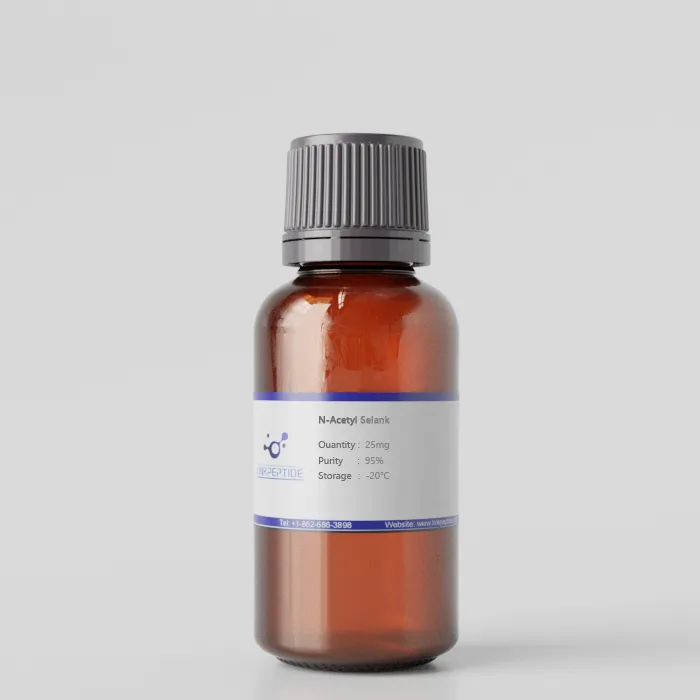
Product Name:N-Acetyl Selank
Cas No:NA
Purity:95%
Chemical Formula:C33H57N11O9
Molar Mass:751.9
Storage:-20 degree Celsius
Application:N-Acetyl Selank is a chemically modified version of the neuropeptide Selank, enhanced through N-terminal acetylation for improved metabolic stability and bioavailability. It is a synthetic analog of tuftsin, originally developed to modulate the central nervous system with anxiolytic, nootropic, and neuroprotective effects. N-Acetyl Selank influences monoamine neurotransmitter balance, supports BDNF expression, and modulates the immune-neuroendocrine interface. It is studied in models of anxiety, cognitive impairment, depression, and neuroinflammation, offering a non-sedating, non-addictive alternative to traditional psychiatric agents. This peptide is widely used in neuropharmacological and psychoneuroimmunology research.
Current Research:Introduction: From Selank to N-Acetyl Selank Selank is a synthetic heptapeptide (Thr-Lys-Pro-Arg-Pro-Gly-Pro), originally developed from the natural immunomodulatory tetrapeptide tuftsin. Designed as a neuroactive and anxiolytic peptide, Selank has been extensively studied for its effects on mood regulation, learning, memory, and stress response. The N-acetylated variant of Selank offers improved proteolytic resistance and longer-lasting activity, making it an attractive compound for advanced CNS studies. N-Acetyl Selank maintains the core functional effects of Selank while exhibiting enhanced pharmacokinetics, particularly in nasal and systemic administration. Mechanism of Action: A Multifaceted Neuromodulator N-Acetyl Selank acts through several key neurobiological pathways: Modulation of GABAergic signaling – Enhances inhibitory neurotransmission, contributing to its calming and anti-anxiety effects without sedation. Influence on monoamines – Regulates serotonin, dopamine, and norepinephrine levels, which are critical for mood and cognitive function. Upregulation of BDNF (Brain-Derived Neurotrophic Factor) – Supports synaptic plasticity and neuronal survival, potentially offering neurotrophic effects similar to antidepressants. Reduction of inflammatory cytokines – Exhibits immunomodulatory effects, lowering IL-6 and TNF-α levels in neuroinflammation models. These diverse effects place N-Acetyl Selank at the intersection of neurotransmitter modulation, neuroplasticity enhancement, and immune regulation. Applications in Anxiety and Depression Selank and its analogs are especially well-studied for anxiolytic (anti-anxiety) effects: In rodent models, N-Acetyl Selank reduces anxiety-like behavior without impairing motor function or inducing sedation. Unlike benzodiazepines, it does not develop tolerance or dependence, and does not affect REM sleep cycles. In preclinical studies of depression, N-Acetyl Selank demonstrates antidepressant-like effects comparable to SSRIs, through serotonin stabilization and enhanced neurotrophic factor expression. Its lack of systemic side effects and non-addictive profile makes it a valuable research candidate for mood disorder treatment alternatives. Cognitive Enhancement and Nootropic Research N-Acetyl Selank enhances learning and memory performance, particularly in models of: Chronic stress or fatigue Age-related cognitive decline Neurotoxic damage (e.g., scopolamine-induced amnesia) These effects are mediated by dopaminergic and cholinergic support, as well as increased BDNF expression, which supports synaptic connectivity and memory consolidation. Researchers are investigating its potential use in mild cognitive impairment (MCI), Alzheimer’s disease, and attention-deficit disorders. Immunomodulatory and Stress Response Roles N-Acetyl Selank retains Selank’s psychoneuroimmunological activity, including: Normalization of cytokine profiles in models of systemic inflammation Balancing Th1/Th2 immune responses Reducing stress-induced immunosuppression These effects are particularly valuable in neuroimmune dysfunction, such as in chronic fatigue syndrome, long-COVID, and autoimmune-associated anxiety. It may serve as a prototype for peptide-based stress resilience agents. Advantages of N-Acetyl Modification Compared to native Selank, N-Acetyl Selank shows: Increased resistance to enzymatic degradation Enhanced half-life and stability in circulation Improved nasal absorption and CNS penetration These enhancements make it more suitable for systemic studies or longer-acting formulations in translational research. Conclusion: A Stabilized Peptide for Neuroimmune and Mood Research N-Acetyl Selank represents a new class of non-sedative anxiolytics and neuroregulators with a broad application profile. Its unique combination of anxiolytic, nootropic, neuroprotective, and immunomodulatory actions sets it apart from conventional drugs. With excellent safety data in animal models and strong mechanistic rationale, it continues to gain interest in studies on mental health, aging, cognition, and stress physiology.
Reference:
Get a Quote
 LinkPeptide

![[Leu31,Pro34]-Neuropeptide Y (human, rat)](https://www.linkpeptide.com/wp-content/uploads/2024/10/Leu31Pro34-Neuropeptide-Y-human-rat-jpg-3.webp "[Leu31,Pro34]-Neuropeptide Y (human, rat)")